Global Automotive Digital Rearview Mirror Market Research Report 2026-2032


QYResearch has recently released the industry report “2026 Global Ultrasonic Corrosion Mapping System Market Research Report”, covering product definition, technology routes, market size, competitive landscape, application scenarios, regional structure and industrial chain changes of ultrasonic corrosion mapping systems. This article focuses on demand changes, technology evolution and supply chain opportunities for ultrasonic corrosion mapping systems in oil and gas, refining, chemicals, power generation, shipbuilding and offshore engineering, pressure vessels and industrial asset integrity management.
An ultrasonic corrosion mapping system is a nondestructive testing system used for corrosion inspection and wall-thickness assessment of pipelines, storage tanks, pressure vessels, ship structures, offshore equipment, power facilities and large industrial installations. It is typically composed of ultrasonic probes, phased array instruments, encoded scanners, magnetic or mechanical crawler platforms, coupling devices, data acquisition modules and corrosion imaging software. The system collects wall-thickness, corrosion pit, thinning area and defect distribution data through ultrasonic echo signals, and presents the corrosion condition of the inspected area in the form of C-scan, B-scan, thickness maps or 3D visualization results.
The core functions of ultrasonic corrosion mapping systems include wall-thickness measurement, corrosion distribution imaging, defect positioning, remaining wall-thickness evaluation, inspection data recording and report generation. They are mainly used in in-service inspection, shutdown maintenance, asset integrity management, predictive maintenance and safety compliance inspection. As industrial assets enter longer service cycles, traditional point-by-point thickness measurement is increasingly insufficient for large-area, traceable and high-efficiency inspection. Software-enabled corrosion mapping systems based on automated scanning, phased array ultrasonics and digital analysis are becoming an important upgrade direction in industrial nondestructive testing.
According to QYResearch’s preliminary research, the global ultrasonic corrosion mapping system market size was approximately US$158 million in 2025 and is expected to reach approximately US$278 million by 2032, with a compound annual growth rate of about 8.4% during 2026–2032. The above market size mainly covers ultrasonic corrosion mapping systems, phased array corrosion imaging equipment, encoded scanners, automated or semi-automated corrosion mapping platforms, and related data acquisition and analysis software used for pipelines, storage tanks, pressure vessels, ships, offshore engineering, power equipment and large industrial assets. In terms of demand structure, market growth is mainly driven by aging industrial asset integrity management, maintenance of oil and gas and chemical facilities, safety inspection of tanks and pipelines, improved shutdown inspection efficiency and digital upgrading of nondestructive testing. On the supply side, leading manufacturers are investing in phased array probes, automated scanning, remote inspection, software algorithms, 3D imaging and global service networks. Overall, the industry is entering a stage of accelerated professionalization, automation and digitalization, with future growth mainly coming from energy infrastructure maintenance, stronger industrial safety regulation, expansion of outsourced inspection services and upgrading of industrial facilities in emerging markets.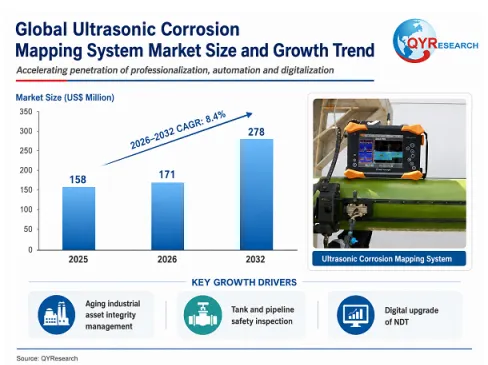
Representative global companies in the ultrasonic corrosion mapping system market include Eddyfi Technologies、Nexxis、Phoenix Inspection Systems、Baker Hughes、Evident/Olympus、OKOndt、Sonomatic、ScanTech, with the final company list subject to verification in the full report. First-tier companies usually have strong capabilities in phased array ultrasonic technology, scanner design, software platform development and global inspection service networks, and can provide integrated solutions covering probes, instruments, automated scanning platforms, data acquisition and report generation. Second-tier companies tend to focus on specific application scenarios such as small-bore pipelines, tank floors, pressure vessel shells, complex curved structures or rental service markets, competing through lightweight, modular and application-specific products. Regional suppliers and new entrants rely more on cost advantages, localized service, inspection engineering experience and customer response speed. Overall, the industry is moderately concentrated. The high-end market is mainly led by professional NDT equipment manufacturers in Europe and North America, and future competition will gradually shift from standalone hardware performance to integrated capabilities in inspection efficiency, imaging quality, software algorithms, field adaptability and service networks.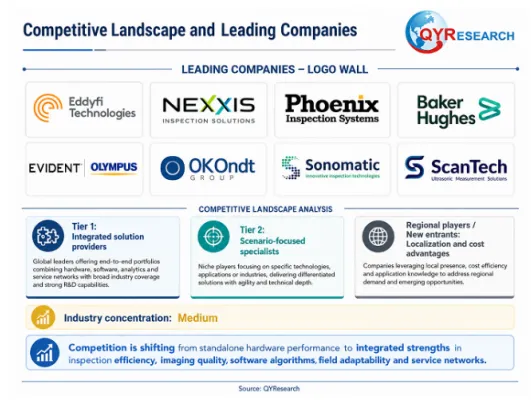
By product classification, ultrasonic corrosion mapping systems can be divided by technology route into conventional UT corrosion mapping systems, phased array UT corrosion mapping systems and automated or semi-automated scanning corrosion mapping systems. Conventional UT corrosion mapping systems are mainly based on single-probe or multi-probe wall-thickness acquisition and are suitable for local inspection, budget-sensitive projects and routine maintenance. Phased array UT corrosion mapping systems use multi-element probes and electronic scanning to achieve higher coverage efficiency and clearer corrosion imaging, making them suitable for large-area quantitative inspection of pipelines, tanks, vessels and critical equipment. Automated or semi-automated scanning systems usually integrate magnetic wheels, encoders, crawler mechanisms, mechanical rails or remote-control platforms, enabling stable inspection on vertical surfaces, large storage tanks, long-distance pipelines and hazardous areas, and are expected to grow relatively faster. By application, pipeline corrosion mapping, tank corrosion mapping, pressure vessel corrosion mapping, and ship and offshore structure corrosion mapping are mature application areas. Oil and gas pipelines, refining units and tank farms are the most concentrated demand areas due to their large equipment base, high inspection frequency and strict safety requirements, while offshore engineering, power generation and new energy-related infrastructure are expected to become faster-growing application fields.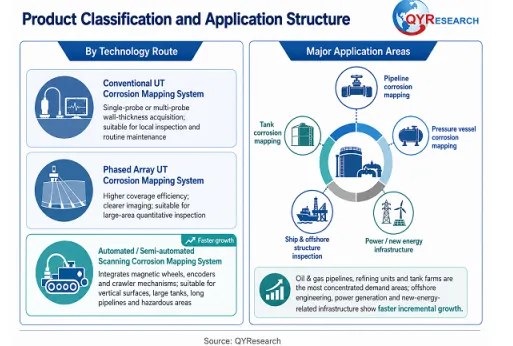
From a regional perspective, North America and Europe are important R&D and consumption markets for ultrasonic corrosion mapping systems, supported by mature nondestructive testing standards, industrial asset integrity management systems and professional inspection service ecosystems. Demand from oil and gas, chemicals, power generation, shipbuilding and infrastructure maintenance remains stable. Japan and South Korea have high requirements for precision instruments, shipbuilding, energy facility maintenance and industrial safety management, creating continuous demand for reliable inspection equipment and automated scanning solutions.
In China, demand is driven by petrochemicals, natural gas pipelines, tank farms, power facilities, shipbuilding and offshore engineering, and large-scale manufacturing maintenance. The market is upgrading from traditional thickness gauges to automated corrosion mapping and digital inspection platforms, while domestic suppliers are gradually strengthening system integration, inspection services and price competitiveness. The Middle East maintains strong demand for high-efficiency corrosion inspection systems due to its oil and gas, refining and offshore energy assets. Southeast Asia and Latin America also show growth potential as industrialization, energy infrastructure expansion and safety regulation improve.
Overall, global production and technology supply remain centered on European and North American professional suppliers, while localization, channel development and inspection service capability in China and Asia will become important variables in regional competition.
The upstream segment of the ultrasonic corrosion mapping system industrial chain mainly includes piezoelectric ceramics, composite probes, phased array elements, sensors, encoders, motors, magnetic wheels, rails, mechanical components, industrial computers, data acquisition cards, connectors, protective housings, couplants and industrial software modules. Core equipment includes ultrasonic testing instruments, phased array instruments, automated or semi-automated scanning platforms, robotic crawler systems, and data acquisition and corrosion imaging software.
Midstream companies are responsible for system design, probe and scanner integration, motion control, algorithm development, testing calibration and application adaptation. Downstream users mainly include oil and gas, refining, chemicals, power generation, shipbuilding and offshore engineering, tank operators, pressure vessel management companies, third-party inspection service providers and industrial asset integrity management companies. Key barriers in the industry include ultrasonic signal processing, phased array imaging, mechanical scanning stability, field adaptability, inspection data repeatability, software reporting systems and customer certification experience. Higher-value segments are mainly concentrated in phased array instruments, specialized probes, automated scanning platforms and data analysis software.
In the future, the supply chain will move toward modularization, lightweight design, rental models and service-oriented solutions. Companies with integrated hardware, software, algorithms and inspection application experience will be more likely to build long-term competitive advantages.
In terms of policies, barriers and challenges, major industrial countries have strict requirements for the safe operation, inspection and maintenance of oil and gas facilities, chemical plants, power equipment, pressure vessels, storage tanks and long-distance pipelines, promoting the development of nondestructive testing equipment toward higher precision, traceability and automation. Industry barriers mainly include technology development, inspection standard compatibility, field verification, customer certification, brand trust and after-sales service networks. Meanwhile, the market faces challenges such as fluctuations in procurement budgets, oil and gas capital expenditure cycles, training costs for equipment operators, inspection difficulty under complex field conditions, high requirements for data interpretation, intensifying price competition in some regions and competition from alternative inspection technologies. For new entrants, relying only on hardware assembly is unlikely to build sustainable barriers; differentiation must be built around system reliability, inspection efficiency, software analysis, industry customer experience and local service capabilities.
In the coming years, ultrasonic corrosion mapping systems will continue to upgrade toward phased array technology, automation, robotics, intelligent analysis and data platformization. As industrial companies place more emphasis on asset lifecycle management, corrosion mapping systems will gradually evolve from single-inspection tools into key data entry points for predictive maintenance and risk management systems. Technology upgrade directions include higher-resolution probe arrays, more stable scanning on curved and vertical surfaces, more portable remote inspection platforms, smarter defect recognition algorithms, more standardized inspection data management and integration with asset management software. In terms of application expansion, oil and gas and refining will remain the fundamental demand markets, while power generation, offshore engineering, shipbuilding, hydrogen energy, carbon capture, energy storage and large manufacturing facilities will bring new inspection demand. In the competitive landscape, leading companies will continue to strengthen their advantages through integrated hardware and software, mergers and acquisitions, global channels and professional services, while local suppliers are expected to gain more opportunities in price-sensitive markets, engineering service markets and regional customer scenarios.
About QYResearch
QYResearch founded in California, USA in 2007. It is a leading global market research and consulting company. With over 19 years’ experience and professional research team in various cities over the world QY Research focuses on management consulting, database and seminar services, IPO consulting, industry chain research and customized research to help our clients in providing non-linear revenue model and make them successful. We are globally recognized for our expansive portfolio of services, good corporate citizenship, and our strong commitment to sustainability. Up to now, we have cooperated with more than 60,000 clients across five continents. Let’s work closely with you and build a bold and better future.
QYResearch is a world-renowned large-scale consulting company. The industry covers various high-tech industry chain market segments, spanning the semiconductor industry chain (semiconductor equipment and parts, semiconductor materials, ICs, Foundry, packaging and testing, discrete devices, sensors, optoelectronic devices), photovoltaic industry chain (equipment, cells, modules, auxiliary material brackets, inverters, power station terminals), new energy automobile industry chain (batteries and materials, auto parts, batteries, motors, electronic control, automotive semiconductors, etc.), communication industry chain (communication system equipment, terminal equipment, electronic components, RF front-end, optical modules, 4G/5G/6G, broadband, IoT, digital economy, AI), advanced materials industry Chain (metal materials, polymer materials, ceramic materials, nano materials, etc.), machinery manufacturing industry chain (CNC machine tools, construction machinery, electrical machinery, 3C automation, industrial robots, lasers, industrial control, drones), food, beverages and pharmaceuticals, medical equipment, agriculture, etc.

Global Automotive Digital Rearview Mirror Market Outlook, In‑Depth Analysis & Forecast to 2032

Published Date: 2026-09-17

Pages: 156

Report ld: 7158701
Price:USD 4900.00
(Single User License)
Global Automotive Digital Rearview Mirror Sales Market Report, Competitive Analysis and Regional Opportunities 2026-2032
Published Date: 2026-09-15
Pages: 140
Report ld: 7063683
Price:USD 4250.00
(Single User License)
Automotive Digital Rearview Mirror- Global Market Share and Ranking, Overall Sales and Demand Forecast 2026-2032
Published Date: 2026-02-11
Pages: 120
Report ld: 5920224
Price:USD 3950.00
(Single User License)
Global Automotive Digital Rearview Mirror Market Research Report 2026
Published Date: 2026-02-11
Pages: 142
Report ld: 5913820
Price:USD 2900.00
(Single User License)
Global Automotive Digital Rearview Mirror Market Outlook, In‑Depth Analysis & Forecast to 2031
Published Date: 2025-10-03
Pages: 168
Report ld: 5156676
Price:USD 4900.00
(Single User License)
Global Automotive Digital Rearview Mirror Sales Market Report, Competitive Analysis and Regional Opportunities 2025-2031
Published Date: 2025-02-14
Pages: 91
Report ld: 3889713
Price:USD 4250.00
(Single User License)


Competition
Key players, new entrants,acquisitions, mergers and expansions,development trends and challenges.

Industry Analysis
Rawmaterial, application, product type, demand,supply,downstream, supply chain etc.

Market Size
Capacity, production, sales, revenue, price, cost etc.

Customized Information
We can offer customized survey and information to meet ourclient's need.
