Wide-format textile printer Market Report:growing at a CAGR of 8.5% from 2026 to 2032


Product Overview and Scope of Wide-Format Textile Printer
A wide-format textile printer is a specialized printing device designed for digital inkjet printing on large-format textile fabrics. It is typically capable of printing on materials such as flag fabric, lightbox fabric, exhibition display fabric, soft signage fabric, curtain fabric, apparel textiles, home textiles, and advertising display fabrics. Its core function involves using printheads to jet dye inks, pigment inks, disperse inks, or sublimation inks onto fabric or transfer paper, subsequently forming patterns through processes such as heat sublimation, color fixation, and drying. Wide-format textile printers generally feature a substantial printing width—commonly ranging from 1.6 meters, 1.8 meters, 2.5 meters, and 3.2 meters, to even wider dimensions—making them suitable for applications in soft signage advertising, home textiles, apparel fabrics, trade show displays, interior decoration, flags and banners, and personalized customization.
Wide-Format Textile Printer Market Summary
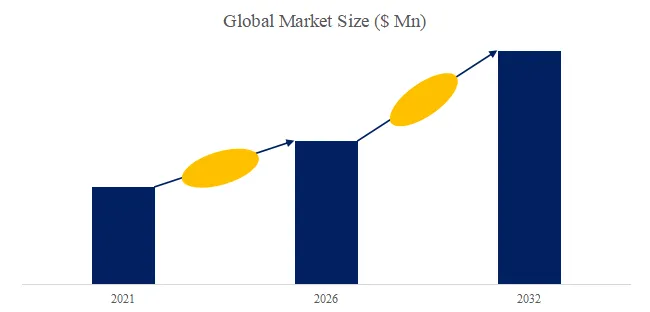
Figure00002. Wide-Format Textile PrinterIndustry Chain Diagram
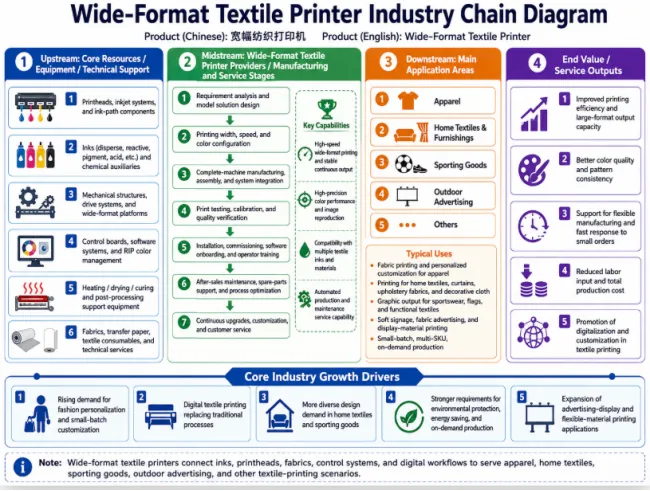
Industry Chain Overview
The upstream sector primarily encompasses printheads, inkjet systems, ink delivery components, textile inks, chemical auxiliaries, mechanical structures, transmission systems, wide-format platforms, control boards, software systems, RIP color management systems, heating, drying, and curing equipment, post-processing equipment, fabrics, transfer paper, textile consumables, and technical services. Among these elements, printheads and inks determine printing precision, color performance, and stability; the mechanical platform and transmission system influence wide-format continuous printing capabilities; while RIP software and color management systems impact pattern reproduction, color consistency, and production efficiency.
The midstream sector constitutes the core manufacturing and service segment for wide-format textile printers, executed primarily by equipment manufacturers, system integrators, and after-sales service providers. Its processes include customer requirements analysis, machine model design, configuration of printing width and speed, color system configuration, complete machine manufacturing, assembly and debugging, system integration, print testing, calibration, quality verification, installation and commissioning, software implementation, operator training, after-sales maintenance, spare parts support, process optimization, and continuous upgrades. The key capabilities of midstream enterprises are primarily manifested in their capacity for high-speed, wide-format printing and continuous, stable output; high-precision color performance and image reproduction; adaptability to a diverse range of textile inks and fabrics; as well as capabilities in automated production and maintenance services.
Downstream application fields primarily include apparel, home textiles and decorative items, sporting goods, outdoor advertising, and various other scenarios. In the apparel sector, applications focus on printing fabrics for ready-to-wear garments, personalized clothing, and flexible, small-batch production. The home textiles and decorative items sector utilizes the technology for printing fabrics for curtains, bedding, upholstery, cushions, and similar products. The sporting goods sector applies the technology to produce patterns for sportswear, jerseys, functional textiles, and team uniforms. The outdoor advertising sector employs it for printing flags, banners, display fabrics, and soft signage materials. Other applications include stage backdrops, handicrafts, luggage fabrics, and various customized textile products.
In terms of end-value, wide-format textile printers enhance printing efficiency and large-format production capacity, improve color quality and pattern consistency, and support flexible manufacturing, small-batch orders, and personalized customization. Simultaneously, they reduce labor and overall production costs, thereby driving the textile printing industry toward an upgrade characterized by digitalization, environmental sustainability, and on-demand production.
Figure00003. Global Wide-Format Textile Printer Top 20 Players Ranking and Market Share (Ranking is based on the revenue of 2025, continually updated)
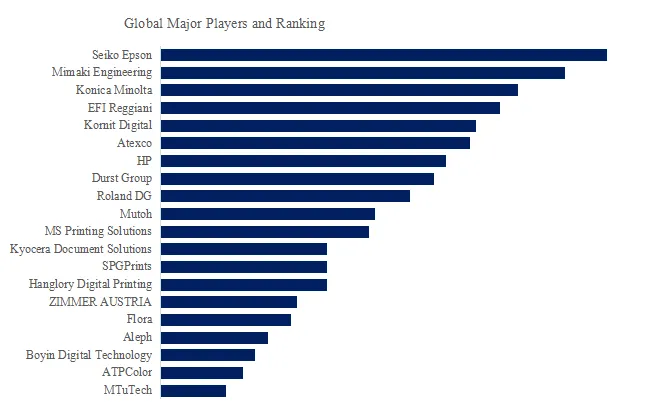
Above data is based on report from QYResearch: Global Wide-Format Textile Printer Market Report 2026-2032 (published in 2025). If you need the latest data, plaese contact QYResearch.
Figure00004.
Wide-Format Textile Printer, Global Market Size, Split by Product Segment
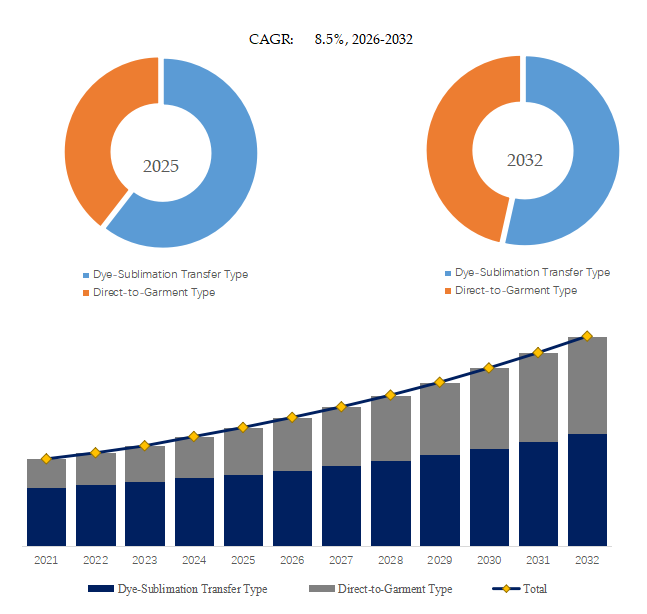
Based on or includes research from QYResearch: Global Wide-Format Textile Printer Market Report 2026-2032.
Figure00005. Wide-Format Textile Printer, Global Market Size, Split by Application Segment
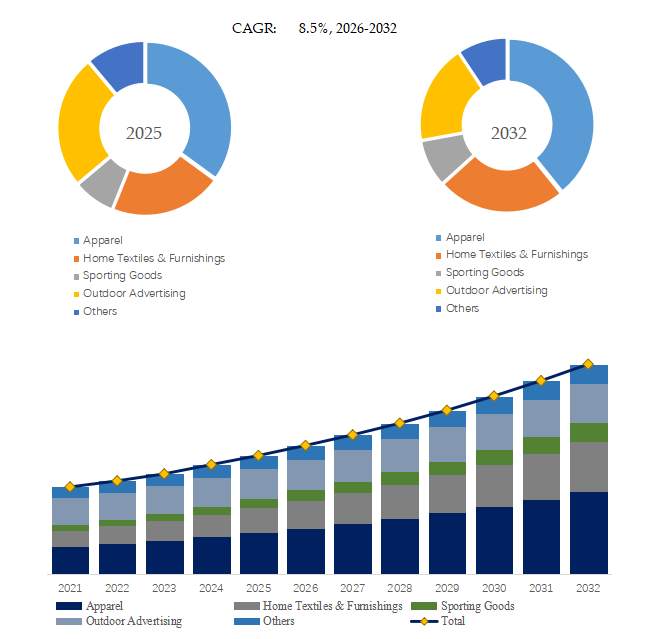
Figure00006. Wide-Format Textile Printer, Global Market Size, Split by Region
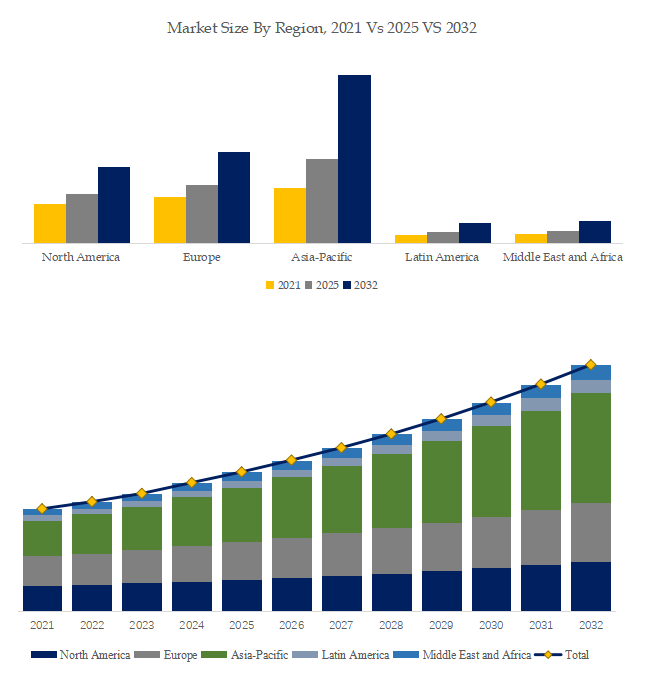
Based on or includes research from QYResearch: Global Wide-Format Textile Printer Market Report 2026-2032.
Market Drivers:
Rapid response capabilities and small-batch orders in the apparel sector are driving the adoption of digital textile printing as a substitute for traditional printing methods. Fast fashion, cross-border e-commerce, and Print-on-Demand (POD) production models require enterprises to shorten lead times for sampling, plate-making, and delivery. While traditional rotary or flatbed screen printing remains better suited for large-volume orders, wide-format textile printers are ideal for scenarios involving multiple designs, small batches, rapid job changeovers, and flexible production. Public market data also identifies the growth of fast fashion and the rising demand for customization as key drivers for the digital textile printing market.
Personalized customization and e-commerce-driven consumption are fueling increased demand for equipment. Products such as apparel, home textiles, soft furnishings, sportswear, flags, and display fabrics are placing increasing emphasis on personalized patterns, rapid product updates, and online customization options. Wide-format textile printers can directly support order-based production, thereby minimizing inventory levels and mitigating the risk of unsold stock.
Environmental regulations and the demand for streamlined production processes are boosting the market penetration of digital printing. Traditional printing typically involves plate-making, lengthy processing workflows, and significant consumption of water and chemicals, as well as extensive wastewater treatment requirements. Digital textile printing, conversely, is better suited for streamlined workflows, waste reduction, and on-demand production. Relevant market data indicates that the need to minimize waste, facilitate flexible manufacturing, and ensure sustainable production practices is driving the adoption of digital textile printing; research studies further highlight the inherent advantages of digital printing in reducing water consumption, energy usage, and material waste.
Applications in soft signage, exhibition displays, and dye-sublimation continue to expand. Wide-format textile printers have reached a mature stage of application within the soft signage sector—encompassing products such as lightbox fabrics, flags, banners, trade show backdrops, stage scenery, and retail display fabrics. Furthermore, the dye-sublimation process is particularly well-suited for use with polyester fabrics, sportswear, soft signage, and home decor items.
Restraint:
The initial investment required for this equipment is substantial, placing a significant financial burden on small and medium-sized enterprises (SMEs) looking to adopt it. Wide-format textile printers—particularly industrial-grade belt-driven direct-to-fabric systems, high-speed multi-head machines, and 3.2-meter soft signage equipment—carry procurement costs that are markedly higher than those of standard large-format inkjet printers or traditional low-end printing machinery. Furthermore, their operation necessitates a suite of ancillary components, including RIP software, drying and curing equipment, heat transfer presses, color management systems, and pre- and post-processing machinery.
The high costs associated with print heads, inks, and maintenance negatively impact the long-term economic viability of the equipment. The core operational costs of wide-format textile printers extend beyond the machine itself to encompass industrial-grade print heads, specialized inks, cleaning solutions, replacement maintenance parts, and losses incurred due to downtime. Issues such as clogged nozzles, missing jets, or print head misalignment directly compromise print quality and yield rates; in severe cases, these malfunctions can necessitate the costly replacement of the print heads themselves. Industry technical literature further corroborates that nozzle clogging leads to diminished print quality, operational downtime, and increased maintenance expenditures.
The complex requirements for matching fabrics, inks, and processing techniques limit the versatility of the equipment. Different fabric types necessitate specific ink systems: for instance, polyester typically utilizes sublimation inks, while cotton and linen commonly employ reactive or pigment-based inks; meanwhile, silk, wool, and nylon may require acid-based inks. Moreover, the process involves a series of sequential steps, including pre-treatment, drying, steaming, soaping, and heat setting. Inkjet textile printing typically mandates a pre-treatment stage to control ink bleed and enhance both color density and wash fastness; without proper pre-treatment, issues such as ink spreading, color dullness (graying), and insufficient color fastness are prone to occur.
The stringent requirements regarding color fastness, tactile feel (hand), and batch-to-batch consistency complicate production control. Apparel, home textiles, and sportswear products demand not only sharp, clear imagery but also robust resistance to washing, abrasion, and light exposure, alongside a soft tactile feel and consistent color fidelity across different production batches. Improper pre-treatment, insufficient curing, or inconsistent control of temperature and dwell times can easily result in dull colors, color bleeding, post-wash fading, and compromised product durability. Relevant technical documentation confirms that inadequate pre- or post-processing leads to poor ink absorption, color dullness, color bleeding, and fading after washing.
Conversely, traditional screen printing methods continue to retain a distinct cost advantage when applied to large-volume production orders. Wide-format textile printers are better suited for orders involving small batches, multiple designs, rapid delivery, and personalization; however, for orders characterized by ultra-large volumes, single designs, and stable long-term production, traditional rotary or flatbed screen printing still retains advantages in terms of unit cost, production efficiency, and established processes. Industry research indicates that while digital printing is well-suited for small-batch customization, it is not necessarily more economical than traditional printing in the context of large-scale production—at least not at present.
Opportunity:
The maturity of pigment inks and streamlined processing techniques is opening up new opportunities for cotton, linen, and home textile applications. Historically, wide-format textile printing has focused primarily on polyester, soft signage, and dye-sublimation applications; however, with advancements in pigment inks, pre-treatment, and curing processes, it has become significantly easier to implement streamlined production workflows for materials such as cotton, linen, blends, and decorative fabrics. Industry reports further indicate that pigment inks, single-step processing, and artificial intelligence (AI) are driving a fundamental transformation in the manufacturing methods used for textile decor and apparel production.
Nearshoring and localized supply chains are expected to drive increased demand for equipment upgrades within European and North American markets. To minimize inventory levels, shorten lead times, and mitigate the uncertainties associated with cross-border supply chains, brands in Europe and North America are increasingly shifting a portion of their apparel, home textile, and soft furnishing orders toward local or nearshore production facilities. Wide-format textile printers are ideally suited for rapid-response, small-batch production; consequently, local manufacturing facilities can leverage digital printing to replace certain outsourced printing tasks that typically entail long lead times. This shift is creating significant opportunities for equipment upgrades among small and medium-sized printing factories and design studios across Europe and North America.
AI-driven design, automated layout, and color management software are poised to significantly boost equipment utilization rates. Future growth in this sector will stem not merely from the hardware itself, but rather from the holistic efficiency gains achieved through the integration of "printer + RIP software + color management + AI pattern generation + order scheduling" workflows. By enabling automated layout composition, automated color calibration, ink volume optimization, and defect detection, wide-format textile printers can reduce reliance on manual labor and minimize waste rates, thereby increasing output per unit of time. These operational efficiencies will, in turn, strengthen customer willingness to invest in mid-to-high-end printing equipment.
Technical textiles and functional fabrics present new avenues for incremental market growth. Beyond traditional applications in apparel, home textiles, and advertising, there is a growing demand for patterning, branding, or functional coating printing across a range of technical textiles—including sun-shading fabrics, automotive interior textiles, outdoor tent materials, architectural membranes, medical textiles, and industrial filtration fabrics. As advancements continue in inkjet control technologies and functional ink formulations, wide-format textile printers have the opportunity to expand their scope beyond purely decorative printing to encompass various functional printing applications, thereby increasing the average selling price of equipment and raising the technical barriers to entry within the industry.
The report provides a detailed analysis of the market size, growth potential, and key trends for each segment. Through detailed analysis, industry players can identify profit opportunities, develop strategies for specific customer segments, and allocate resources effectively.
The Wide-Format Textile Printer market is segmented as below:
By Company
Seiko Epson
Mimaki Engineering
Roland DG
Mutoh
Konica Minolta
Kyocera Document Solutions
HP
EFI Reggiani
Kornit Digital
Durst Group
MS Printing Solutions
SPGPrints
ZIMMER AUSTRIA
Aleph
ATPColor
Atexco
Hanglory Digital Printing
Flora
Boyin Digital Technology
MTuTech
Segment by Type
Small-Format Textile Printer (Width ≤ 1.6 m)
Medium-Format Textile Printer (Width 1.6–2.5 m)
Large-Format Textile Printer (Width 2.5–3.2 m)
Extra-Wide-Format Textile Printer (Width > 3.2 m)
Segment by Application
Apparel
Home Textiles & Furnishings
Sporting Goods
Outdoor Advertising
Others
Each chapter of the report provides detailed information for readers to further understand the Wide-Format Textile Printer market:
Chapter 1: Introduces the report scope of the Wide-Format Textile Printer report, global total market size (valve, volume and price). This chapter also provides the market dynamics, latest developments of the market, the driving factors and restrictive factors of the market, the challenges and risks faced by manufacturers in the industry, and the analysis of relevant policies in the industry. (2021-2032)
Chapter 2: Detailed analysis of Wide-Format Textile Printer manufacturers competitive landscape, price, sales and revenue market share, latest development plan, merger, and acquisition information, etc. (2021-2026)
Chapter 3: Provides the analysis of various Wide-Format Textile Printer market segments by Type, covering the market size and development potential of each market segment, to help readers find the blue ocean market in different market segments. (2021-2032)
Chapter 4: Provides the analysis of various market segments by Application, covering the market size and development potential of each market segment, to help readers find the blue ocean market in different downstream markets.(2021-2032)
Chapter 5: Sales, revenue of Wide-Format Textile Printer in regional level. It provides a quantitative analysis of the market size and development potential of each region and introduces the market development, future development prospects, market space, and market size of each country in the world..(2021-2032)
Chapter 6: Sales, revenue of Wide-Format Textile Printer in country level. It provides sigmate data by Type, and by Application for each country/region.(2021-2032)
Chapter 7: Provides profiles of key players, introducing the basic situation of the main companies in the market in detail, including product sales, revenue, price, gross margin, product introduction, recent development, etc. (2021-2026)
Chapter 8: Analysis of industrial chain, including the upstream and downstream of the industry.
Chapter 9: Conclusion.
Other relevant reports of QYResearch:
Global Wide-Format Textile Printer Market Outlook, In‑Depth Analysis & Forecast to 2032
Global Wide-Format Textile Printer Market Research Report 2026
Global Wide-Format Textile Printer Sales Market Report, Competitive Analysis and Regional Opportunities 2026-2032
Benefits of purchasing QYResearch report:
Competitive Analysis: QYResearch provides in-depth Wide-Format Textile Printer competitive analysis, including information on key company profiles, new entrants, acquisitions, mergers, large market shear, opportunities, and challenges. These analyses provide clients with a comprehensive understanding of market conditions and competitive dynamics, enabling them to develop effective market strategies and maintain their competitive edge.
Industry Analysis: QYResearch provides Wide-Format Textile Printer comprehensive industry data and trend analysis, including raw material analysis, market application analysis, product type analysis, market demand analysis, market supply analysis, downstream market analysis, and supply chain analysis.
and trend analysis. These analyses help clients understand the direction of industry development and make informed business decisions.
Market Size: QYResearch provides Wide-Format Textile Printer market size analysis, including capacity, production, sales, production value, price, cost, and profit analysis. This data helps clients understand market size and development potential, and is an important reference for business development.

Wide-Format Textile Printer- Global Market Share and Ranking, Overall Sales and Demand Forecast 2026-2032

Published Date: 2026-07-09

Pages: 155

Report ld: 6723439
Price:USD 3950.00
(Single User License)
Global Wide-Format Textile Printer Market Outlook, In‑Depth Analysis & Forecast to 2032
Published Date: 2026-06-04
Pages: 179
Report ld: 6723441
Price:USD 4900.00
(Single User License)
Global Wide-Format Textile Printer Market Research Report 2026
Published Date: 2026-06-04
Pages: 154
Report ld: 6723438
Price:USD 2900.00
(Single User License)
Global Wide-Format Textile Printer Sales Market Report, Competitive Analysis and Regional Opportunities 2026-2032
Published Date: 2026-06-04
Pages: 155
Report ld: 6723437
Price:USD 4250.00
(Single User License)


Competition
Key players, new entrants,acquisitions, mergers and expansions,development trends and challenges.

Industry Analysis
Rawmaterial, application, product type, demand,supply,downstream, supply chain etc.

Market Size
Capacity, production, sales, revenue, price, cost etc.

Customized Information
We can offer customized survey and information to meet ourclient's need.
