Analysis of the Impact of Jensen Huang's Return as NVIDIA CEO on the Global AI Industry


On November 23, 2026 (local time), NVIDIA officially announced that its board of directors had unanimously agreed to reinstate company founder Jensen Huang as President, Chief Executive Officer (CEO), and board member, just 11 days after he announced his resignation on November 12. Boosted by the reinstatement news, NVIDIA's share price surged 31.5% that day, and the Nasdaq Composite rose 6.5%, driving a strong rebound in stocks related to artificial intelligence, semiconductors, and data center infrastructure. According to NVIDIA's latest financial report for the third quarter of fiscal year 2027, the company achieved revenue of US$115.8 billion, up 103% year on year, of which data center business revenue reached US$107.6 billion, up 110% year on year, showing that global demand for AI computing infrastructure remains robust. QYResearch analysts believe that the significance of Jensen Huang's return goes beyond a single company's management change and reflects the global AI industry's heavy reliance on core computing platforms, technology ecosystems, and strategic leadership. His return is expected to strengthen the confidence of global technology companies, supply chain partners, and investment institutions in the long-term development path of the AI industry, reduce short-term strategic uncertainty, and provide a positive signal for the sustainable development of the global AI industry.
As NVIDIA's Blackwell, Vera Rubin, and other computing platforms continue to advance commercial deployment, the global AI industry is expected to further accelerate the construction of high-performance GPUs, AI servers, and data center infrastructure. At the hardware level, growing computing demand will drive development in market segments such as high-bandwidth memory (HBM), advanced packaging equipment, high-speed connectors, high-speed optical modules, server liquid cooling systems, and high-power power supplies. At the software level, the CUDA development platform, AI frameworks, development toolchains, and partner ecosystem are expected to be further consolidated, promoting collaborative innovation in AI software and hardware. The global AI industry is shifting from competition based on single-chip performance to competition based on system-level capabilities across the entire industrial chain, and future market value will accelerate toward segments such as high-speed interconnect, advanced cooling, energy management, inference optimization, and specialized software. From a regional perspective, the United States has a leading advantage in AI chip design and software ecosystems; Taiwan, South Korea, and Japan play important roles in wafer fabrication, memory chips, advanced packaging, and key materials; and Europe and mainland China are expected to unleash more market opportunities in industrial AI, smart manufacturing, and regional computing infrastructure construction.
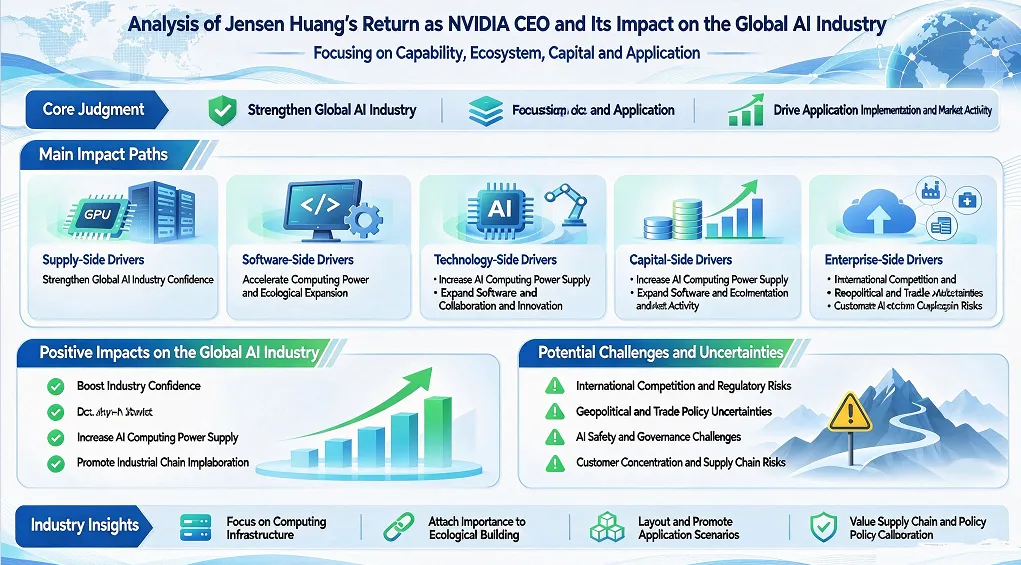
Jensen Huang's return is expected to strengthen NVIDIA's strategic continuity in areas such as large-model training, inference optimization, edge AI, embodied intelligence, and robotics, and further promote the penetration of AI technology into industries including cloud computing, industrial manufacturing, healthcare, financial services, and autonomous driving. As AI applications gradually move from technical validation to large-scale commercial deployment, related industrial investment, technology cooperation, and corporate mergers and acquisitions are expected to become more active. However, a short-term rebound in capital markets does not mean industry risks have been eliminated. Constraints on advanced process and packaging capacity, power supply pressure on data centers, intensified international market competition, export controls, and geopolitical changes will still affect the pace of development of the global AI industry. NVIDIA's board has also clearly stated that the relevant independent investigation will continue. In the future, the core contradiction in AI industry development will gradually shift from insufficient computing resources to a balance among computing costs, energy efficiency, and commercial investment returns. Whether companies can effectively translate technological advantages into actual production efficiency and commercial returns will become an important factor determining market competitiveness.
From the perspective of global industry development trends, the positive impact of Jensen Huang's return is mainly reflected in the restoration of industry confidence, improved expectations for computing investment, stability of the technology ecosystem, and acceleration of application innovation. However, the long-term growth of the AI industry still depends on technological innovation capabilities, end-market demand, supply chain stability, and business model maturity. QYResearch believes that companies should focus on four strategic directions in the future: first, seize hardware market opportunities brought by the upgrading of AI computing infrastructure; second, attach importance to competitive barriers formed by software ecosystems, technology platforms, and industrial chain collaboration; third, accelerate layout in AI inference, intelligent agents, and vertical industry application markets; and fourth, strengthen comprehensive assessment of global supply chains, regional policies, and investment return risks. As a professional institution focused on global market research and industrial competition analysis, QYResearch will continue to track AI industry development trends from multiple dimensions, including the global industrial chain, regional market landscape, supply and demand for segmented products, technological evolution, and enterprise competitiveness, and deeply explore structural growth opportunities and value migration trends in the industry, providing market research support with professional depth, global vision, and forward-looking insight for global companies' strategic planning, technology layout, investment decisions, and supply chain optimization.
Analyst: Sun Xiaoke
Ms. Sun is a senior analyst of technology and markets in QYResearch's machinery and equipment field and a core member of the machinery and equipment research department. She has long focused on the engineering machinery and industrial equipment sectors and is responsible for industry analysis, market research, competitive landscape assessment, and professional report development, and participates in customized client research projects, providing professional support for corporate strategic planning, market entry, and business decisions.


Competition
Key players, new entrants,acquisitions, mergers and expansions,development trends and challenges.

Industry Analysis
Rawmaterial, application, product type, demand,supply,downstream, supply chain etc.

Market Size
Capacity, production, sales, revenue, price, cost etc.

Customized Information
We can offer customized survey and information to meet ourclient's need.