Aluminium nitride single crystal substrate Market Report: representing a CAGR of about 11.53% from 2026 to 2032


Global AlN Single Crystal Substrate Market Moves Toward US$100 Million:
UVC LED Anchors Demand; RF / Power Devices Add Long-Term Upside
Core view: AlN single crystal substrates are not a low-cost replacement substrate. Adoption is driven by high-performance devices that require better lattice matching, thermal conductivity and low-defect density. UVC LEDs remain the most certain revenue base, while deep-UV optoelectronics, RF devices and high-voltage power devices determine the medium- to long-term platform value.
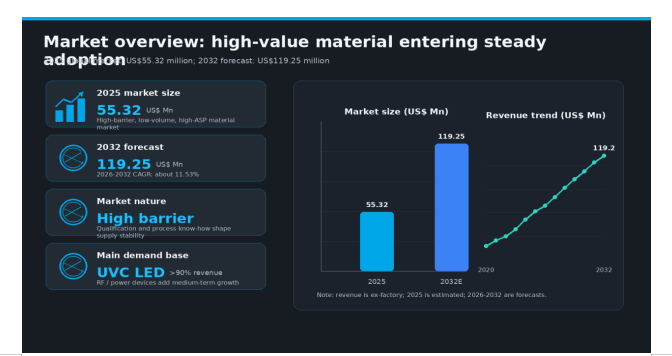
According to QYResearch's latest 2026 research, the global aluminium nitride single crystal substrate market was approximately US$55.32 million in 2025 and is expected to reach US$119.25 million by 2032, representing a CAGR of about 11.53% from 2026 to 2032. Although the market remains limited in absolute size, it is characterized by high unit value, demanding customer qualification, deep process know-how and a small qualified supplier base. Growth is therefore expected to come from steady penetration in high-performance applications—led by UVC LED and supported by validation in deep-UV optoelectronics, RF devices and high-voltage power devices—rather than rapid commoditized volume expansion.
Source: QYResearch Nanning Research Center
1.1 Market overview: limited scale, but a clearer growth path
The value of aluminium nitride single crystal substrates lies mainly in their material compatibility with high-Al-content III-nitride epitaxy, deep-UV optoelectronic devices, and high-frequency, high-voltage devices. Compared with sapphire, SiC and template-based routes, native AlN is more expensive, but it offers advantages in lattice matching, thermal conductivity, low-defect density and deep-UV device reliability. As a result, this market is better understood as a high-end device adoption market rather than a fast-ramping general substrate market.
From a growth perspective, the market expanded rapidly during 2021-2025, supported by rising UVC LED demand, more research and validation projects, and the improved maturity of leading suppliers in 2-inch product delivery, surface preparation and customer introduction. During 2026-2032, growth is expected to moderate but remain in the double digits, reflecting demand extension from a single UVC LED scenario toward a broader set of device qualification use cases, while cost, capacity and customer qualification cycles continue to constrain adoption.
1.2 Product structure: 2-inch substrates remain the main delivery format, while larger diameters enter validation and scale-up
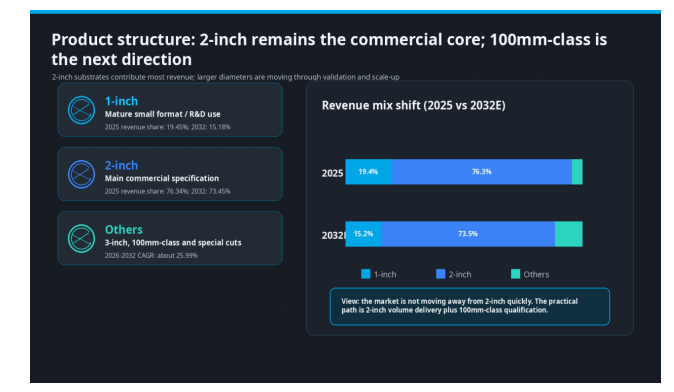
By product specification, 2-inch substrates remain the most commercialized format. In 2025, 2-inch products accounted for 76.34% of the global market revenue; by 2032, their share is expected to remain around 73.45%. This suggests that the dominant specification is unlikely to switch quickly. The 2-inch platform, supported by customer qualification, process maturity and stable supply, will continue to carry most commercial deliveries in the next few years.
At the same time, 3-inch and 100mm-class substrates are becoming important directions for the next phase of technology development. Crystal IS has disclosed development and pilot production progress for 100mm native AlN substrates, while HexaTech is also advancing a 3-inch product roadmap. The value of larger diameters lies in improving cost per unit area, enhancing downstream die economics and increasing compatibility with semiconductor manufacturing infrastructure. However, scale-up remains constrained by crystal growth yield, defect control, wafer uniformity, bow/warp, slicing and polishing quality, and customer qualification cycles.
Source: QYResearch Nanning Research Center
1.3 Applications: UVC LED remains the core, while RF and power devices add incremental demand
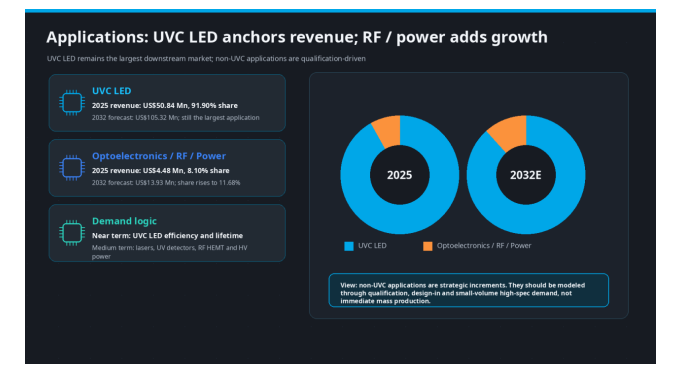
From an application perspective, UVC LED remains the most visible revenue source for aluminium nitride single crystal substrates. In 2025, UVC LED accounted for 91.90% of the global market; by 2032, its share is expected to remain around 88.32%. This indicates that, in the short and medium term, commercialization of AlN single crystal substrates will continue to revolve around efficiency, lifetime and reliability improvements in deep-UV LED chips, particularly Al-rich AlGaN structures near 260-265 nm that place higher requirements on low defect density, thermal stability and lattice compatibility.
By comparison, deep-UV laser diodes, UV detectors, AlGaN/AlN HEMTs, satellite communications and radar-related RF devices, and high-voltage power devices represent more medium- to long-term incremental directions. In 2025, the Optoelectronics, RF and Power Device segment accounted for 8.10% of the global market, and its share is expected to rise to around 11.68% by 2032. In the near term, this segment is more about qualification and introduction, and should not be extrapolated as a mass-production market too early.
Source: QYResearch Nanning Research Center
1.4 Competitive landscape: a small supplier base controls core share, with process barriers above channel barriers
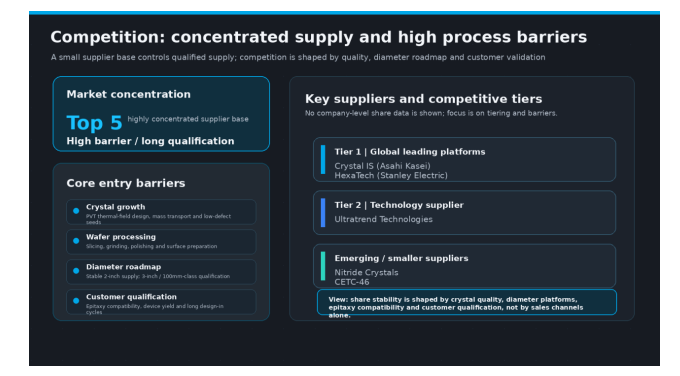
The aluminium nitride single crystal substrate market is highly concentrated. In 2025, the top five suppliers accounted for about 99.88% of global revenue. Crystal IS (Asahi Kasei) and HexaTech (Stanley Electric) form the global Tier-1 group; Ultratrend Technologies is positioned in the second tier, while Nitride Crystals and CETC-46 remain smaller-scale or newer entrants.
This concentration is not simply a result of brand influence or sales channels. It is shaped by crystal growth know-how, defect control, diameter roadmaps, surface preparation capability and long-standing customer qualification relationships. New entrants must solve thermal-field optimization, raw-material impurity control, high-quality seed acquisition, nucleation stability, defect propagation and polarity control at the same time. From this perspective, competition is less about expansion speed and more about the material process window, wafer-level quality consistency and downstream customer introduction capability.
Source: QYResearch Nanning Research Center
1.5 Regional landscape: Asia-Pacific leads consumption, while North America holds key technology platforms
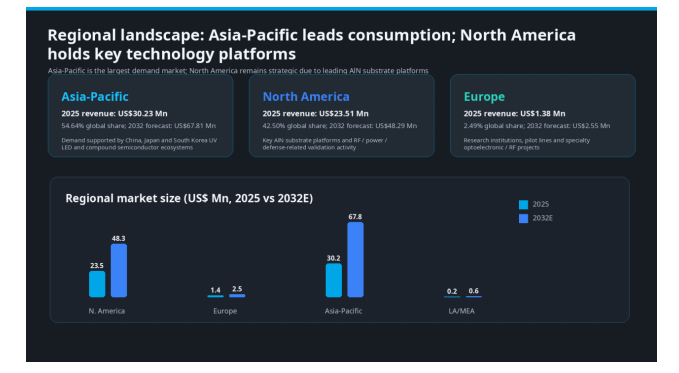
Regionally, Asia-Pacific is the largest consumption market, while North America is home to key technology platforms. In 2025, Asia-Pacific revenue was about US$30.23 million, representing 54.64% of the global market, and is expected to reach US$67.81 million by 2032. Demand in the region is supported by the UV LED, optoelectronics and compound semiconductor ecosystems in China, Japan and South Korea. Japan carries strategic influence through the Stanley Electric and Asahi Kasei / Crystal IS technology systems, while South Korea is more visible on the downstream UV LED and optoelectronic device side.
North America generated about US$23.51 million in revenue in 2025, representing 42.50% of the global market, and is expected to reach about US$48.29 million by 2032. Its importance comes not only from consumption scale, but also from AlN substrate platforms such as HexaTech and Crystal IS, as well as RF, power and defense-related ultra-wide-bandgap material validation activities. Europe remains smaller in size, but it still has technical relevance through research institutions, compound semiconductor pilot lines, and specialty deep-UV optoelectronic and RF / power device evaluation projects.
Source: QYResearch Nanning Research Center
1.6 Opportunities and constraints: high-performance applications are penetrating gradually, while cost and qualification cycles remain limiting factors
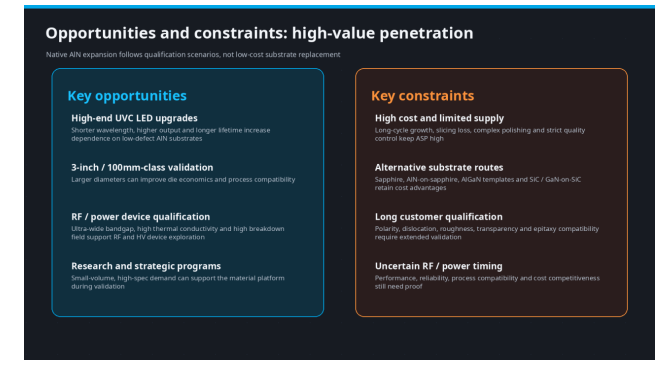
The first opportunity comes from upgrades in high-end UVC LED chips, including shorter wavelength, higher output, lower defect density and longer lifetime requirements. Second, progress in 3-inch and 100mm-class substrate qualification could improve cost per unit area and increase compatibility with semiconductor manufacturing infrastructure. Third, RF and power devices provide medium- to long-term technical upside for AlN substrates, especially in high-frequency, high-power-density, high-voltage and extreme-temperature scenarios.
The main constraints are cost, supply and alternative substrate routes. The high cost and limited availability of AlN single crystal substrates will continue to limit penetration in cost-sensitive UVC LED applications. Sapphire, AlN-on-sapphire, AlGaN-on-AlN/sapphire, SiC and GaN-on-SiC routes are likely to coexist for a long time. In addition, downstream customer qualification cycles are lengthy, and new capacity does not translate into revenue immediately. RF and power devices have medium- to long-term value, but before 2032 they should be viewed more as validation-driven incremental markets than as certain mass-production opportunities.
Source: QYResearch Nanning Research Center
1.7 Conclusion: from UVC LED substrates toward an ultra-wide-bandgap semiconductor material platform
The global aluminium nitride single crystal substrate market is gradually extending from a niche, UVC LED-led high-end substrate market toward deep-UV optoelectronics, RF devices and high-voltage power devices within the broader ultra-wide-bandgap semiconductor field. Its growth is not a linear substitution story. It is determined by material performance, diameter roadmaps, process yield, customer qualification and end-device performance upgrades.
In the near term, high-performance UVC LEDs and related deep-UV optoelectronic devices remain the most realistic demand sources. In the medium term, the market will need to track 2-inch volume stability, 3-inch / 100mm-class large-diameter qualification and customer introduction progress. Over the longer term, the adoption path will depend on whether RF and power devices can make progress in reliability, process compatibility, cost and application validation. Suppliers with stable crystal growth capability, a credible large-diameter roadmap, strong surface preparation quality and deep customer collaboration are more likely to capture the main incremental value around 2032.
The report provides a detailed analysis of the market size, growth potential, and key trends for each segment. Through detailed analysis, industry players can identify profit opportunities, develop strategies for specific customer segments, and allocate resources effectively.
The Aluminium Nitride Single Crystal Substrate market is segmented as below:
By Company
Ultratrend Technologies Inc
HexaTech (Stanley Electric)
Crystal IS (Asahi Kasei)
Nitride Crystals
CETC-46
Segment by Type
1 Inch
2 Inch
Others
Segment by Application
UVC LED
Optoelectronics, RF and Power Device
Each chapter of the report provides detailed information for readers to further understand the Aluminium Nitride Single Crystal Substrate market:
Chapter 1: Introduces the report scope of the Aluminium Nitride Single Crystal Substrate report, global total market size (valve, volume and price). This chapter also provides the market dynamics, latest developments of the market, the driving factors and restrictive factors of the market, the challenges and risks faced by manufacturers in the industry, and the analysis of relevant policies in the industry. (2021-2032)
Chapter 2: Detailed analysis of Aluminium Nitride Single Crystal Substrate manufacturers competitive landscape, price, sales and revenue market share, latest development plan, merger, and acquisition information, etc. (2021-2026)
Chapter 3: Provides the analysis of various Aluminium Nitride Single Crystal Substrate market segments by Type, covering the market size and development potential of each market segment, to help readers find the blue ocean market in different market segments. (2021-2032)
Chapter 4: Provides the analysis of various market segments by Application, covering the market size and development potential of each market segment, to help readers find the blue ocean market in different downstream markets.(2021-2032)
Chapter 5: Sales, revenue of Aluminium Nitride Single Crystal Substrate in regional level. It provides a quantitative analysis of the market size and development potential of each region and introduces the market development, future development prospects, market space, and market size of each country in the world..(2021-2032)
Chapter 6: Sales, revenue of Aluminium Nitride Single Crystal Substrate in country level. It provides sigmate data by Type, and by Application for each country/region.(2021-2032)
Chapter 7: Provides profiles of key players, introducing the basic situation of the main companies in the market in detail, including product sales, revenue, price, gross margin, product introduction, recent development, etc. (2021-2026)
Chapter 8: Analysis of industrial chain, including the upstream and downstream of the industry.
Chapter 9: Conclusion.
Other relevant reports of QYResearch:
Global Aluminium Nitride Single Crystal Substrate Market Outlook, In‑Depth Analysis & Forecast to 2032
Global Aluminium Nitride Single Crystal Substrate Sales Market Report, Competitive Analysis and Regional Opportunities 2026-2032
Global Aluminium Nitride Single Crystal Substrate Market Research Report 2026
Global Aluminium Nitride Single Crystal Substrate Sales Market Report, Competitive Analysis and Regional Opportunities 2026-2032
Benefits of purchasing QYResearch report:
Competitive Analysis: QYResearch provides in-depth Aluminium Nitride Single Crystal Substrate competitive analysis, including information on key company profiles, new entrants, acquisitions, mergers, large market shear, opportunities, and challenges. These analyses provide clients with a comprehensive understanding of market conditions and competitive dynamics, enabling them to develop effective market strategies and maintain their competitive edge.
Industry Analysis: QYResearch provides Aluminium Nitride Single Crystal Substrate comprehensive industry data and trend analysis, including raw material analysis, market application analysis, product type analysis, market demand analysis, market supply analysis, downstream market analysis, and supply chain analysis.
and trend analysis. These analyses help clients understand the direction of industry development and make informed business decisions.
Market Size: QYResearch provides Aluminium Nitride Single Crystal Substrate market size analysis, including capacity, production, sales, production value, price, cost, and profit analysis. This data helps clients understand market size and development potential, and is an important reference for business development.

Global Aluminium Nitride Single Crystal Substrate Market Outlook, In‑Depth Analysis & Forecast to 2032

Published Date: 2026-04-27

Pages: 119

Report ld: 6636837
Price:USD 4900.00
(Single User License)
Global Aluminium Nitride Single Crystal Substrate Sales Market Report, Competitive Analysis and Regional Opportunities 2026-2032
Published Date: 2026-04-27
Pages: 119
Report ld: 5567750
Price:USD 4250.00
(Single User License)
Global Aluminium Nitride Single Crystal Substrate Market Research Report 2026
Published Date: 2026-04-27
Pages: 120
Report ld: 5525421
Price:USD 2900.00
(Single User License)
Aluminium Nitride Single Crystal Substrate- Global Market Share and Ranking, Overall Sales and Demand Forecast 2026-2032
Published Date: 2026-04-27
Pages: 121
Report ld: 5507458
Price:USD 3950.00
(Single User License)
Aluminium Nitride Single Crystal Substrate - Global Market Share and Ranking, Overall Sales and Demand Forecast 2025-2031
Published Date: 2025-10-18
Pages: 85
Report ld: 5184497
Price:USD 3950.00
(Single User License)
Global Aluminium Nitride Single Crystal Substrate Market Outlook, In‑Depth Analysis & Forecast to 2031
Published Date: 2025-10-18
Pages: 119
Report ld: 5184496
Price:USD 4900.00
(Single User License)


Competition
Key players, new entrants,acquisitions, mergers and expansions,development trends and challenges.

Industry Analysis
Rawmaterial, application, product type, demand,supply,downstream, supply chain etc.

Market Size
Capacity, production, sales, revenue, price, cost etc.

Customized Information
We can offer customized survey and information to meet ourclient's need.
