AI Can Produce Answers in Seconds, but Who Is Responsible for the Answers? The Irreplaceability of Professional Research Institutions


In recent years, artificial intelligence technology has developed rapidly, and AI tools such as ChatGPT and DeepSeek have gradually integrated into the daily work of enterprises. Whether searching for industry materials, analyzing the competitive landscape, or understanding the development trends of a certain niche market, information that previously required a great deal of time to collect and organize can now, by simply entering a few questions, produce a preliminary report within one minute. AI has greatly improved the efficiency of information acquisition and processing, and has also made market research—which originally had a certain professional threshold—more convenient.
However, when we carefully examine these seemingly professional analysis results, we will find some issues that cannot be ignored.
The first is the authenticity of information. AI-generated content does not necessarily have real data sources, and sometimes it even fabricates non-existent enterprises, products, market data, or references. Especially in some niche industries where public information is limited, AI may conflate information from different enterprises, or derive market size lacking actual basis from scattered materials. Such content often is expressed fluently and logically complete; if users lack relevant industry experience, it is difficult for them to detect the problems at the first moment.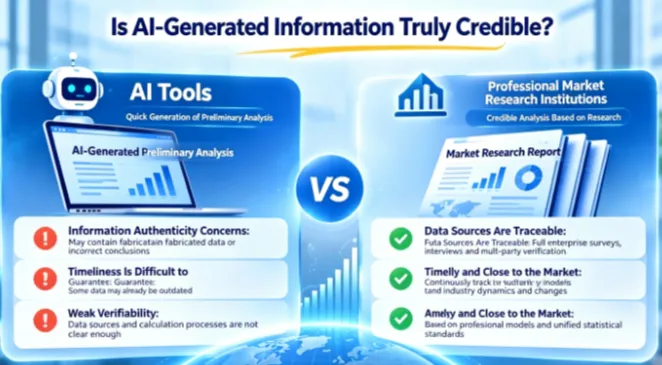
The second is the timeliness of information. The market environment is always changing, and enterprises' capacity layouts, competitive landscape, product prices, and downstream demand may all undergo obvious changes within a short period. However, the information cited by AI is not necessarily the latest; some market data, enterprise operating conditions, and even industry judgments that have long changed may still appear in newly generated analysis reports. For industries with rapid technological iteration and frequently changing competitive landscapes, using outdated data for analysis may very likely lead to conclusions inconsistent with the current actual market situation.
More noteworthy is the verifiability of information. A market analysis may contain a large number of specific figures, such as global market size, market shares of major enterprises, and growth forecasts for the next few years—but where exactly do these figures come from: public disclosure by enterprises, industry statistics, or unverified estimates? Do different data adopt a unified statistical caliber? On what assumptions are the forecast results based? When users further inquire, even if AI can provide explanations, it does not mean that these explanations have been independently verified. For enterprises that need to provide decision-making basis to management, investors, or clients, a set of data whose sources cannot be traced and whose calculation process cannot be verified is difficult to truly reassure others.
This also raises a question worth thinking about: when AI can generate a market research report within a few seconds, who guarantees that the information therein is authentic and reliable? When research conclusions deviate, who can explain the data sources, verify the research process, and take responsibility for the quality of the conclusions?
Erroneous Information May Cost Enterprises Far More Than the Research Cost
For enterprises, the value of market information is ultimately reflected in business decisions. An industry analysis report may become an important basis for an enterprise to enter a new market, formulate product strategy, plan capacity, or evaluate investment projects. If the data serving as the decision basis itself contains deviations, then even if the subsequent analysis process is rigorous, it is difficult to reach reliable conclusions.
For example, a manufacturing enterprise plans to enter a rapidly growing niche market. If the enterprise adopts an overstated market size and growth forecast, it may invest a large amount of funds in building new production lines, only to find after the project is put into production that actual demand is far below expectations; if it ignores competitors' latest expansion plans or technological progress, it may misjudge the market entry timing and face fiercer competition than expected after product launch. For enterprises expanding overseas business, inaccurate regional demand data may also affect market layout, customer development, and sales resource allocation.
The impact of these misjudgments goes far beyond the cost of a report itself. Capacity investment, R&D input, and market expansion often require months or even years of preparation. Once the direction deviates, enterprises may not only bear direct economic losses but also miss development opportunities that truly have potential.
The Value of Professional Research Institutions Comes from Research Capabilities Accumulated Over the Long Term
The value of professional market research institutions lies in providing enterprises with more accurate and timely market information through industry surveys, data verification, and professional analysis, helping enterprises reduce decision-making risks caused by information asymmetry.
QYResearch (Beijing Hengzhou Bozhi International Information Consulting Co., Ltd.) has professional analysts and researchers covering multiple industry fields, tracks industry supply and demand changes, competitive landscape, and technological development trends over the long term, and has accumulated rich industry data and market research experience.
Unlike simply collecting public information, professional market research also requires in-depth investigation of the industry chain. Especially in some niche industries, enterprises usually do not separately disclose the sales volume, revenue, or market share of specific products. Through enterprise surveys, industry expert interviews, and upstream and downstream customer surveys, combined with public materials and market estimation models, QYResearch conducts cross-verification of key data and forms research results such as market size, competitive landscape, and development trends.
For enterprises, leveraging the existing data resources, survey channels, and industry experience of professional research institutions can reduce the time spent on self-collecting materials and verifying data, and enable more efficient evaluation of market opportunities, analysis of the competitive environment, and formulation of business plans.
From Obtaining Answers to Making Judgments: The AI Era Requires Professional Research Even More
The development of AI technology is changing the way the market research industry works. With AI tools, researchers can more efficiently complete material retrieval, information organization, and data processing, and devote more energy to industry chain surveys, data verification, and market analysis. AI and professional research are not mutually substitutive; rather, they can improve research efficiency and quality through their respective advantages.
The core of market research is not only acquiring information, but also understanding market changes and their impact on enterprise operations. Especially in rapidly developing industries such as new energy vehicles, semiconductors, and artificial intelligence, technological iteration, enterprise capacity expansion, and changes in downstream demand may all affect market trends, requiring researchers to make judgments based on the latest survey results and industry experience.
As AI tools continue to become more widespread, generating information will become easier, but the authenticity of data and the reliability of research conclusions still require professional verification. For enterprises, the speed of answer generation is certainly important, but whether the answer is trustworthy is the key to whether it can truly provide value for business decisions.
Author of this article
Zhang Jianan—Main analyst of this article
Market industry analyst at QYResearch, mainly engaged in market research on the upstream and downstream industry chains of new energy vehicles, auto parts, automotive electronics, and lithium batteries, with a focus on technological development, market supply and demand, and competitive landscape in related industries. Research topics cover product fields such as aluminum alloy electronic throttle bodies, automotive-grade smart high-side switches, e-fuse chips, automotive PCIe switch chips, electric vehicle skateboard chassis platforms, fire-resistant EV battery housing materials, LiFSI electrolyte salts, bidirectional charging power modules for electric vehicles, and energy storage batteries.


Competition
Key players, new entrants,acquisitions, mergers and expansions,development trends and challenges.

Industry Analysis
Rawmaterial, application, product type, demand,supply,downstream, supply chain etc.

Market Size
Capacity, production, sales, revenue, price, cost etc.

Customized Information
We can offer customized survey and information to meet ourclient's need.