Over the Counter (OTC) & Diet Supplementary Market Expansion Report 2026: Effective Strategies and Market Expansion


Over the Counter (OTC) & Diet Supplementary Market Summary
According to the new market research report “Global Over the Counter (OTC) & Diet Supplementary Market Report 2025-2031”, published by QYResearch, the global Over the Counter (OTC) & Diet Supplementary market size is projected to reach USD 289.7 billion by 2031, at a CAGR of 7.9% during the forecast period.
Figure. Global Over the Counter (OTC) & Diet Supplementary Market Size (US$ Million), 2020-2031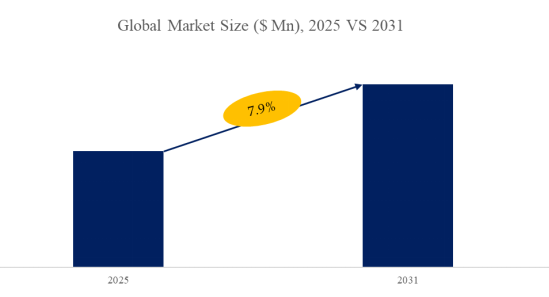
Above data is based on report from QYResearch: Global Over the Counter (OTC) & Diet Supplementary Market Report 2025-2031 (published in 2025). If you need the latest data, plaese contact QYResearch.
Figure. Global Over the Counter (OTC) & Diet Supplementary Top 10 Players Ranking and Market Share (Ranking is based on the revenue of 2024, continually updated)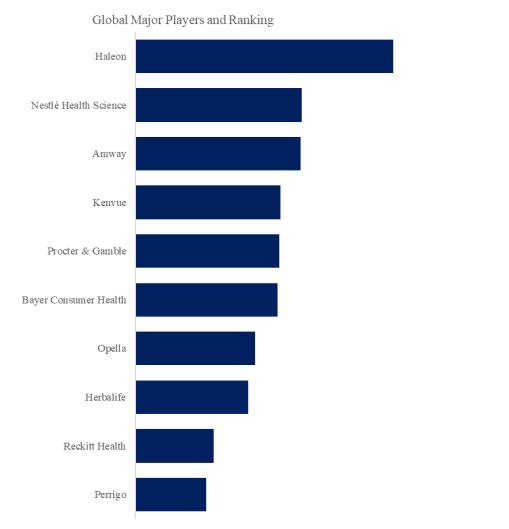
Above data is based on report from QYResearch: Global Over the Counter (OTC) & Diet Supplementary Market Report 2025-2031 (published in 2025). If you need the latest data, plaese contact QYResearch.
According to QYResearch Top Players Research Center, the global key manufacturers of Over the Counter (OTC) & Diet Supplementary include Haleon, Nestlé Health Science, Amway, Kenvue, Procter & Gamble, Bayer Consumer Health, Opella, Herbalife, Reckitt Health, Perrigo, etc. In 2024, the global top 10 players had a share approximately 34.0% in terms of revenue.
Figure. Over the Counter (OTC), Global Market Size, Split by OTC Product Segment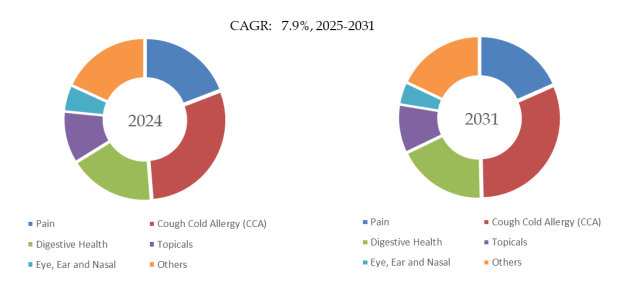
Based on or includes research from QYResearch: Global Over the Counter (OTC) & Diet Supplementary Market Report 2025-2031.
In terms of OTC product type, currently Cough Cold Allergy (CCA) is the largest segment, hold a share of 29.6%.
Figure. Diet Supplementary, Global Market Size, Split by Type Segment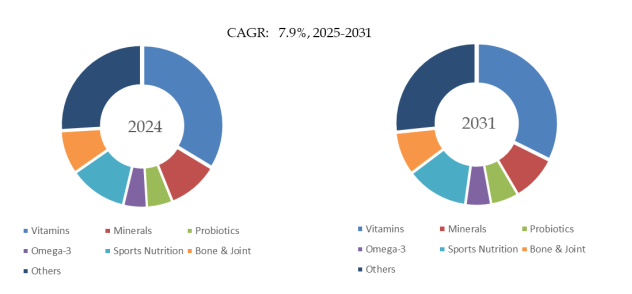
Based on or includes research from QYResearch: Global Over the Counter (OTC) & Diet Supplementary Market Report 2025-2031.
In terms of product type, currently Vitamins is the largest segment, hold a share of 33.7%.
Market Drivers:
OTC growth is propelled by U.S. monograph modernization, which streamlines updates and clarifications to ingredient conditions—lowering time-to-market for line extensions and switches—alongside a steady pipeline of Rx-to-OTC conversions (e.g., naloxone nasal spray/Narcan and the Opill switch) that expand consumer access.
Value expansion is reinforced by self-care economics and by digital distribution/e-pharmacy adoption in both the U.S. and EU, which broaden reach and price transparency.
Near-term opportunities include retail media–driven launches, store-brand/PL mix gains in inflationary periods, and category premiumization in analgesics, allergy, GI and derm—supported by continued consumer migration to nonprescription options and a U.S. OTC market estimated at ~$40B with mid-single-digit growth.
Sustained high penetration—about three in four U.S. adults using supplements in 2024—underpins a resilient demand base across multivitamins, probiotics, omega-3s and immunity products, with spend levels holding despite inflation.
Growth catalysts include the post-pandemic focus on immune resilience and healthy aging, plus expanding evidence programs and data infrastructure (NIH ODS strategic plan; nutrition research investments) that enable better product differentiation and claim discipline.
Channel opportunities remain strongest in e-commerce/D2C and professional-dispensed settings, while compliance-savvy brands can convert share as the FTC’s updated Health Products Compliance Guidance tightens substantiation standards for health claims.
Market benefit from the structural rise of self-care to lower healthcare burden (time and cost savings, improved access) and from omnichannel retail (e-pharmacies, marketplaces, retail media), which accelerates trial and repeat.
Regulatory clarity is advancing on both sides—OTC via OMOR processes; supplements via clearer advertising substantiation expectations—favoring scaled players that can invest in evidence, quality systems, and compliant messaging.
European and North American markets show continued value growth in self-care as inflation cools, with IQVIA tracking robust OTC value momentum in Europe—signaling room for premium formats, science-forward claims, and pharmacist-led recommendation models across categories.
Restraint:
Regulatory modernization has lowered barriers, but it has also created new execution risks: OMUFA fees and OMOR timelines introduce budgeting and pipeline uncertainty, while failure to meet sterile-drug and cGMP expectations can trigger warning letters, recalls, and retailer delistings (e.g., FDA’s 2023–2024 actions on non-sterile OTC eye products, including EzriCare/Delsam cases and multi-brand eye-drop warnings). Supply-chain and quality lapses—especially for ophthalmics and other high-risk dosage forms—carry outsized liability and brand damage. In parallel, heightened enforcement visibility raises reputational stakes across national chains and e-commerce.
Two tightening pressure points are claim substantiation and manufacturing controls. The FTC’s updated Health Products Compliance Guidance requires “competent and reliable scientific evidence” and treats testimonials/endorsements as advertiser claims—escalating litigation and enforcement risk for weak or exaggerated messages. At the plant level, FDA continues to cite 21 CFR Part 111 violations (label control, specifications, testing, CAPA), with recent warning letters underscoring cGMP gaps. In the EU, health-claim authorization remains highly restrictive, complicating pan-EU positioning. Growing state-level rules in the U.S. (e.g., New York’s ban on sales of weight-loss/muscle-building supplements to minors) add compliance complexity and potential sales friction.
Market is facing multi-jurisdictional regulatory divergence, faster enforcement cycles, and retail/e-commerce transparency that amplifies any lapse in quality or claims. Operationally, global sourcing (APIs, botanicals, probiotics, packaging), sterile or sensitive dosage forms, and third-party manufacturing elevate quality-system and traceability risk; one defect can cascade into nationwide recalls and class-action exposure. Strategically, OMUFA/OMOR fees (OTC) and FTC substantiation supplements standards raise fixed compliance costs, favoring scaled players while squeezing smaller brands; meanwhile, fragmented state rules and EU claim constraints complicate label harmonization and marketing calendars. Net-net: governance, evidence generation, and supplier QA are now decisive risk controls for self-care portfolios.
Opportunity:
OTC is being shaped by faster regulatory pathways, with the CARES Act section 505G and OMOR creating clearer update cycles for monograph ingredients, encouraging line extensions and innovation.
Rx to OTC switches continue to expand access and category reach, highlighted by naloxone nasal spray and Opill, which signal an ongoing shift toward consumer managed care.
Omnichannel growth is reinforcing this momentum, as European e pharmacies and pure play platforms scale rapidly and drive discovery and price transparency across cough and cold, pain, digestive and derm segments.
Private label penetration is rising in inflation sensitive baskets, prompting national brands to lean into premium formats and evidence based claims to defend share.
Consumer adoption remains high and stable, with usage sustained across core segments and growing interest in magnesium, prebiotics and other specialty items that address sleep, stress and metabolic wellness.
Evidence expectations are tightening, as marketers calibrate claims and substantiation to meet the updated FTC Health Products Compliance Guidance, which is reshaping creative, testimonials and influencer programs.
Digital channels and professional dispensing continue to gain weight, while format innovation in gummies, softgels and ready to mix products supports premium pricing and repeat purchase.
Self care is becoming a durable consumer habit, with regulators providing clearer guardrails for nonprescription use in OTC and clearer advertising standards in supplements, which together reward companies that invest in quality systems and credible data.
Omnichannel retail is accelerating choice and price transparency, as e pharmacy and marketplace models scale across Europe and beyond, lifting the role of search, ratings and retail media in product discovery.
Competitive intensity is rising through private label expansion and switch driven entries, pushing brands toward premiumization, science forward positioning and faster regulatory and supply responses.
About QYResearch
QYResearch founded in California, USA in 2007.It is a leading global market research and consulting company. With over 17 years’ experience and professional research team in various cities over the world QY Research focuses on management consulting, database and seminar services, IPO consulting, industry chain research and customized research to help our clients in providing non-linear revenue model and make them successful. We are globally recognized for our expansive portfolio of services, good corporate citizenship, and our strong commitment to sustainability. Up to now, we have cooperated with more than 60,000 clients across five continents. Let’s work closely with you and build a bold and better future.
QYResearch is a world-renowned large-scale consulting company. The industry covers various high-tech industry chain market segments, spanning the semiconductor industry chain (semiconductor equipment and parts, semiconductor materials, ICs, Foundry, packaging and testing, discrete devices, sensors, optoelectronic devices), photovoltaic industry chain (equipment, cells, modules, auxiliary material brackets, inverters, power station terminals), new energy automobile industry chain (batteries and materials, auto parts, batteries, motors, electronic control, automotive semiconductors, etc.), communication industry chain (communication system equipment, terminal equipment, electronic components, RF front-end, optical modules, 4G/5G/6G, broadband, IoT, digital economy, AI), advanced materials industry Chain (metal materials, polymer materials, ceramic materials, nano materials, etc.), machinery manufacturing industry chain (CNC machine tools, construction machinery, electrical machinery, 3C automation, industrial robots, lasers, industrial control, drones), food, beverages and pharmaceuticals, medical equipment, agriculture, etc.
Global Over the Counter (OTC) & Diet Supplementary Sales Market Report, Competitive Analysis and Regional Opportunities 2026-2032

Published Date: 2026-01-04

Pages: 114

Report ld: 5562402
Price:USD 4250.00
(Single User License)
Global Over the Counter (OTC) & Diet Supplementary Market Research Report 2026
Published Date: 2026-01-04
Pages: 153
Report ld: 5531273
Price:USD 2900.00
(Single User License)
Over the Counter (OTC) & Diet Supplementary - Global Market Share and Ranking, Overall Sales and Demand Forecast 2026-2032
Published Date: 2026-01-04
Pages: 142
Report ld: 5500380
Price:USD 3950.00
(Single User License)
Global Over the Counter (OTC) & Diet Supplementary Market Outlook, In‑Depth Analysis & Forecast to 2031
Published Date: 2025-11-04
Pages: 168
Report ld: 5184525
Price:USD 4900.00
(Single User License)
Over the Counter (OTC) & Diet Supplementary - Global Market Share and Ranking, Overall Sales and Demand Forecast 2025-2031
Published Date: 2025-11-04
Pages: 155
Report ld: 5184524
Price:USD 3950.00
(Single User License)
Global Over the Counter (OTC) & Diet Supplementary Sales Market Report, Competitive Analysis and Regional Opportunities 2025-2031
Published Date: 2025-11-04
Pages: 115
Report ld: 5005356
Price:USD 4250.00
(Single User License)


Competition
Key players, new entrants,acquisitions, mergers and expansions,development trends and challenges.

Industry Analysis
Rawmaterial, application, product type, demand,supply,downstream, supply chain etc.

Market Size
Capacity, production, sales, revenue, price, cost etc.

Customized Information
We can offer customized survey and information to meet ourclient's need.
