Powdered Hydroxypropyl Methyl Cellulose(HPMC) Market Development Strategy Report 2026: Expanding Reach and Impact


Powdered Hydroxypropyl Methyl Cellulose(HPMC) Market Summary
Powdered hydroxypropyl methyl cellulose is a type of non-ionic cellulose ether made from natural cellulose as raw material, which is alkalized and introduced with hydroxypropyl and methyl substituents. It is usually a white or almost white powder, odorless or slightly odorless, and can be dispersed and gradually swollen to form transparent or semi transparent viscous solutions when in contact with water. It has functions such as thickening, water retention, film formation, bonding, lubrication, suspension stability, and rheological adjustment. It has good compatibility with most salts and formula components, and can cover various application needs according to viscosity grades and degrees of substitution. It is typically used in the pharmaceutical field for tablet bonding and coating, slow and controlled release skeleton materials and capsule formulations, in the food field for thickening stability and taste improvement, and in daily chemical and personal care for thickening. Film formation and suspension stability, as well as water retention, anti sagging, and construction performance improvement in building materials and water-based systems.
Hydroxypropyl methyl cellulose is mainly used for:
Building materials: HPMC is widely used in the construction industry, especially in building materials such as dry mortar, tile adhesive, putty powder, etc. Its main functions include: improving the bonding strength of materials such as cement and gypsum; Enhance the fluidity of materials and improve construction performance; Extend the operable time to prevent the material from drying and solidifying too quickly; Good water retention to prevent drying and cracking.
Coatings and paints: As a thickener, HPMC can control the viscosity of coatings, making them more uniform and smooth. At the same time, it also has good anti precipitation properties, which can ensure the long-term stability of the coating. The use of high viscosity HPMC coatings can improve surface quality and prolong coating durability.
Daily chemical industry: In shampoo, bath gel, lotion and other products, HPMC can effectively increase viscosity, provide ideal consistency, while not affecting the transparency of products, and can maintain stability in different pH values.
Medicine and food: HPMC is also widely used as a sustained-release agent for drugs, coating material for capsules, etc., to ensure the long-term stability of drugs. In the food industry, HPMC is used as a stabilizer, thickener, and gelling agent in food processing to ensure the taste and structure of food.
Shandong Heda is a leading enterprise in the domestic cellulose ether industry. Since 2000, the company has been committed to the research and development, production, and sales of non-ionic cellulose ethers. After more than 20 years of precipitation, it has become one of the few domestic enterprises in the same industry with independent research and innovation capabilities, and large-scale production of high-end models of building materials, pharmaceutical, and food grade non-ionic cellulose ether products. As of the end of 2022, the company has a cellulose ether production capacity of 34000 tons per year and a construction capacity of 41000 tons per year; In October 2022, the company announced that the cellulose ether project (Phase I) with a production capacity of 30000 tons per year has entered the trial production stage; In August 2023, the company acquired equity in Zhongfuzhi, which will add 10000 tons/year of hydroxyethyl cellulose (HEC) production capacity, further enhancing the company's position in the cellulose ether field. In terms of plant capsules, as of the end of 2022, the company has an annual production capacity of 30 billion plant hollow capsules and a construction capacity of 5 billion capsules; In March 2023, the fundraising project "Hershey Annual Production of 15 Billion Plant Capsules and Intelligent Stereoscopic Library Upgrade Project" will be announced, which will further expand the company's plant capsule production capacity after completion. Shandong Heda's main products are non-ionic cellulose ether HPMC and HEMC. The acquisition of Zhongfu Zhiwei will enhance HEC's supply capacity and expand its product range. Widely used in many fields such as building materials, pharmaceuticals, food, textiles, daily chemical products, petroleum extraction, mining, papermaking, polymerization reactions, and aerospace. Among them, the largest usage of non-ionic cellulose ether is in the field of building materials, mainly used in pre mixed mortar, binders PVC、 Putty, etc.
Shandong Heda has the ability to produce high-end building material grade HPMC models. Building material grade cellulose ether belongs to a relatively low-end variety, especially for many domestic manufacturers with small production scales. They mostly focus on producing building material grade products with relatively low quality requirements, and the homogenization competition of mid to low end products is fierce. The building material grade cellulose ether produced by Shandong Heda can be divided into two categories: mid to high end models and ordinary models, which have product differentiation advantages. Among the building materials grade HPMC of middle and high-end models, the building materials grade HPMC with a gel temperature of 75 ℃ is mainly used in dry mixed mortar and other fields, which has strong high-temperature resistance and good application effect. Its application performance is irreplaceable for the building materials grade HPMC with a gel temperature of 60 ℃, and high-end customers have high requirements for the quality stability of this type of products. At the same time, the production of HPMC with a gel temperature of 75 ℃ has certain technical difficulties. The investment scale of the production plant is large, and the entry threshold is high. The product price is significantly higher than the building material grade HPMC with a gel temperature of 60 ℃. PVC specific HPMC is an important additive for the production of PVC. Although HPMC is added in small quantities and accounts for a low proportion of PVC production costs, its product application effect is good, so its quality requirements are high.
Cellulose ether is a general term for a series of cellulose derivatives generated from natural cellulose through a series of chemical and physical processes such as alkalization, etherification, and post-treatment under certain conditions. Cellulose macromolecules have hydrogen bonds within and between chains, making it difficult to dissolve in water and almost all organic solvents. However, the introduction of ether groups through etherification can improve hydrophilicity and greatly enhance solubility in water and organic solvents. Cellulose ether is known as the "industrial monosodium glutamate". Cellulose ether has excellent properties such as solution thickening, good water solubility, suspension or latex stability, protective colloid effect, film-forming ability, water retention, etc. It is widely used in many fields such as building materials, medicine, food, textile, daily chemical, petroleum extraction, mining, papermaking, polymerization reaction, honeycomb ceramics, aerospace and new energy batteries. Cellulose ether has the advantages of wide application, small unit usage, good modification effect, and environmental friendliness. In its addition field, it can significantly improve and optimize product performance, which is conducive to improving resource utilization efficiency and product added value. It is an essential environmentally friendly additive in various fields of the national economy.
According to the new market research report “Global Powdered Hydroxypropyl Methyl Cellulose(HPMC) Market Report 2026-2032”, published by QYResearch, the global Powdered Hydroxypropyl Methyl Cellulose(HPMC) market size is projected to reach USD 0.99 billion by 2032, at a CAGR of 4.3% during the forecast period.
Figure. Global Powdered Hydroxypropyl Methyl Cellulose(HPMC) Market Size (US$ Million), 2021-2032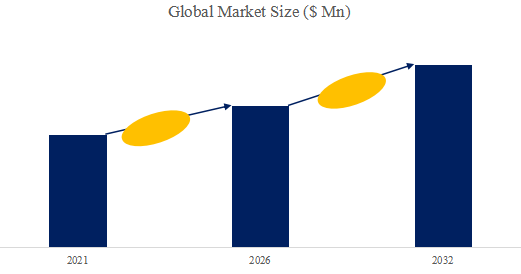
Above data is based on report from QYResearch: Global Powdered Hydroxypropyl Methyl Cellulose(HPMC) Market Report 2026-2032 (published in 2025). If you need the latest data, plaese contact QYResearch.
Figure. Global Powdered Hydroxypropyl Methyl Cellulose(HPMC) Top 16 Players Ranking and Market Share (Ranking is based on the revenue of 2025, continually updated)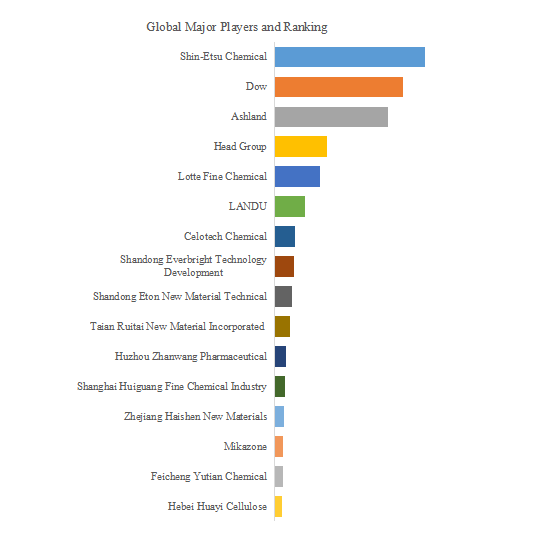
Above data is based on report from QYResearch: Global Powdered Hydroxypropyl Methyl Cellulose(HPMC) Market Report 2026-2032 (published in 2026). If you need the latest data, plaese contact QYResearch.
According to QYResearch Top Players Research Center, the global key manufacturers of Powdered Hydroxypropyl Methyl Cellulose(HPMC) include Shin-Etsu Chemical, Dow, Ashland, Head Group, Lotte Fine Chemical, LANDU, Celotech Chemical, Shandong Everbright Technology Development, Shandong Eton New Material Technical, Taian Ruitai New Material Incorporated, etc. In 2025, the global top 10 players had a share approximately 77.0% in terms of revenue.
The global market for powdered hydroxypropyl methyl cellulose can be regarded as the most stable type of cellulose ether in demand, driven by two main lines: pharmaceutical excipients and building materials, while food and daily chemical products provide incremental elasticity. Structurally, pharmaceutical grade emphasizes regulatory compliance and batch consistency, usually with stronger bargaining power. Some leading companies are also intensifying the construction of pharmaceutical high-performance cellulose and supply systems to cope with demand growth. The architectural grade is highly dependent on systems such as tile adhesive, plastering, and exterior wall insulation, which contribute significantly to water retention and opening time. The demand is strongly related to infrastructure investment and regional construction seasonality, and the demand for special grades is more prominent under high temperature and dry conditions. On the supply side, there is a coexistence pattern of top multinational and Chinese scale factories. Multinational manufacturers have more obvious advantages in pharmaceuticals and high-end specifications, while Chinese manufacturers have cost and capacity flexibility in building materials and general specifications. Some companies have publicly disclosed individual production capacity of tens of thousands of tons per year. Price and profitability are usually driven by three factors: first, cost fluctuations of upstream cellulose pulp and substitution reaction related chemicals; second, effective supply changes caused by environmental safety compliance and energy consumption constraints; third, downstream real estate and infrastructure prosperity, as well as the pace of pharmaceutical customer certification volume increase; Therefore, while the total volume of the market is steadily increasing, the differentiation of product structure will increase. In the future, more opportunities will be concentrated in the pharmaceutical grade high consistency level, food grade clean label formula adaptation level, and building special level for high-temperature construction and high water retention needs.
Main driving factors: The continuous expansion of downstream pharmaceutical and health consumption has led to an increase in demand for pharmaceutical excipients. Powdered hydroxypropyl methyl cellulose has strong versatility and low substitution cost in tablet bonding and coating, slow-release skeleton, capsule and particle forming; The upgrading of food and beverage formulas has led to an increase in demand for thickening, stabilization, emulsification, and improved taste, especially in the trend of low fat, low sugar, and plant-based systems that rely more on efficient thickening and stabilization; The increasing demand for skin sensation, suspension stability, and film-forming thickening in daily chemical and personal care, coupled with the rising proportion of water-based systems, has led to their wider application in water-based formulations; The increasing demand for water-based coatings and building materials in the industrial sector for water retention, rheological regulation, and construction improvement is driving the increase in mid to low end specifications.
Main obstacles: Different viscosity grades and substitution windows require high process control, and insufficient batch consistency and impurity control can affect customer validation and long-term supply; The price fluctuations of key raw materials such as upstream cellulose pulp and epichlorohydrin will squeeze profits, and the increase in environmental and safety compliance investment will increase unit manufacturing costs; The audit cycle for pharmaceutical and food customers is long, with high requirements for regulatory documents and quality systems, making it difficult for small and medium-sized manufacturers to import; The competition of homogeneous products has led to significant downward pressure on prices, and high-end specifications and certification capabilities have become the key to differentiation.
Industry development opportunities: The increasing demand for high-end formulations and controlled release brings opportunities for upgrading products with high viscosity, high purity, and specific substitution degrees. Supporting pharmacopoeia compliance and complete traceability systems can enter higher gross profit customers; Plant based and functional foods are accelerating their penetration, driving customized demands for low dosage, efficient thickening, stability, and better transparency and taste; The promotion of water-based coatings and green building materials policies has led to an increase in demand for building grade water retention and thickening, and enterprises with scale and cost advantages are expected to expand their market share; At the same time, localized supply and multi base delivery capabilities for global brands will become a competitive focus, and manufacturers with sustained quality stability and application technology service capabilities are more likely to achieve import substitution and export growth.
About QYResearch
QYResearch founded in California, USA in 2007.It is a leading global market research and consulting company. With over 17 years’ experience and professional research team in various cities over the world QY Research focuses on management consulting, database and seminar services, IPO consulting (data is widely cited in prospectuses, annual reports and presentations), industry chain research and customized research to help our clients in providing non-linear revenue model and make them successful. We are globally recognized for our expansive portfolio of services, good corporate citizenship, and our strong commitment to sustainability. Up to now, we have cooperated with more than 60,000 clients across five continents. Let’s work closely with you and build a bold and better future.
QYResearch is a world-renowned large-scale consulting company. The industry covers various high-tech industry chain market segments, spanning the semiconductor industry chain (semiconductor equipment and parts, semiconductor materials, ICs, Foundry, packaging and testing, discrete devices, sensors, optoelectronic devices), photovoltaic industry chain (equipment, cells, modules, auxiliary material brackets, inverters, power station terminals), new energy automobile industry chain (batteries and materials, auto parts, batteries, motors, electronic control, automotive semiconductors, etc.), communication industry chain (communication system equipment, terminal equipment, electronic components, RF front-end, optical modules, 4G/5G/6G, broadband, IoT, digital economy, AI), advanced materials industry Chain (metal materials, polymer materials, ceramic materials, nano materials, etc.), machinery manufacturing industry chain (CNC machine tools, construction machinery, electrical machinery, 3C automation, industrial robots, lasers, industrial control, drones), food, beverages and pharmaceuticals, medical equipment, agriculture, etc.

Global Powdered Hydroxypropyl Methyl Cellulose(HPMC) Market Research Report 2026

Published Date: 2026-02-13

Pages: 149

Report ld: 5992198
Price:USD 2900.00
(Single User License)
Global Powdered Hydroxypropyl Methyl Cellulose(HPMC) Market Outlook, In‑Depth Analysis & Forecast to 2032
Published Date: 2026-02-13
Pages: 179
Report ld: 5990875
Price:USD 4900.00
(Single User License)
Powdered Hydroxypropyl Methyl Cellulose(HPMC)- Global Market Share and Ranking, Overall Sales and Demand Forecast 2026-2032
Published Date: 2026-02-13
Pages: 142
Report ld: 5989973
Price:USD 3950.00
(Single User License)
Global Powdered Hydroxypropyl Methyl Cellulose(HPMC) Sales Market Report, Competitive Analysis and Regional Opportunities 2026-2032
Published Date: 2026-02-13
Pages: 103
Report ld: 5988661
Price:USD 4250.00
(Single User License)
Global Powdered Hydroxypropyl Methyl Cellulose(HPMC) Market Outlook, In‑Depth Analysis & Forecast to 2031
Published Date: 2025-11-09
Pages: 126
Report ld: 5398381
Price:USD 4900.00
(Single User License)
Global Powdered Hydroxypropyl Methyl Cellulose(HPMC) Sales Market Report, Competitive Analysis and Regional Opportunities 2025-2031
Published Date: 2025-11-09
Pages: 71
Report ld: 5394639
Price:USD 4250.00
(Single User License)


Competition
Key players, new entrants,acquisitions, mergers and expansions,development trends and challenges.

Industry Analysis
Rawmaterial, application, product type, demand,supply,downstream, supply chain etc.

Market Size
Capacity, production, sales, revenue, price, cost etc.

Customized Information
We can offer customized survey and information to meet ourclient's need.
