Greenhouse Anti-fog Film- Global Market Share and Ranking, Overall Sales and Demand Forecast 2026-2032


QYResearch recently launched the industry report “Greenhouse Anti-fog Film Market Research Report”, focusing on product definition, technology development, market size, competitive landscape, application scenarios, regional distribution and industrial chain changes of greenhouse anti-fog films. This report analyzes demand changes, technological evolution and supply chain opportunities driven by the development of modern agriculture, smart greenhouse systems and high-efficiency farming models.
With the global agricultural industry moving toward controlled, efficient and sustainable production systems, greenhouse covering materials are evolving from traditional protection materials into multifunctional agricultural solutions. Greenhouse anti-fog films have become an important component of advanced greenhouse systems due to their ability to reduce condensation, improve light utilization and maintain a more stable cultivation environment.
Greenhouse anti-fog film refers to functional agricultural plastic films used in greenhouse covering systems. These films are manufactured by combining polymer substrates such as polyethylene (PE), polyolefin (PO) and ethylene-vinyl acetate (EVA) with functional additives designed for anti-fogging, anti-drip performance, thermal insulation, ultraviolet resistance and light diffusion. By controlling water vapor condensation behavior on the film surface, greenhouse anti-fog films reduce droplet formation, improve light transmission conditions and enhance environmental control efficiency inside greenhouses.
The major functions of greenhouse anti-fog films include reducing water accumulation on crop leaves, lowering disease transmission risks, improving solar radiation utilization, enhancing thermal management efficiency and extending covering film service life. Depending on material formulation and application requirements, products are commonly manufactured using single-layer or multilayer co-extrusion technologies with functional additives such as hydrophilic agents, UV stabilizers, infrared blocking materials and light diffusion components. These products are widely applied in vegetable cultivation, flower production, fruit farming, seedling production, high-value crop cultivation and modern intelligent greenhouse systems.
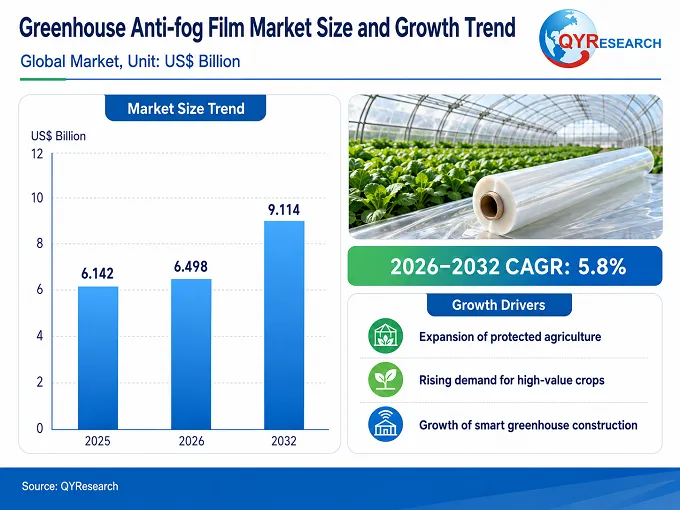
According to QYResearch preliminary research, the global greenhouse anti-fog film market was approximately US$6.142 billion in 2025 and is expected to reach approximately US$9.114 billion by 2032, with a CAGR of about 5.8% during 2026–2032. The market scope mainly covers functional agricultural plastic films used in greenhouse systems, plastic tunnels and controlled-environment agricultural cultivation scenarios. Market growth is mainly driven by the expansion of protected agriculture, increasing demand for stable crop production under extreme climate conditions, rising adoption of high-value crop cultivation and continuous improvement in agricultural productivity. On the supply side, leading manufacturers are investing in multilayer co-extrusion technologies, advanced additive systems, durability improvement and regional production networks. Overall, the greenhouse anti-fog film industry is entering a stage of functional upgrading, with future growth opportunities mainly coming from smart greenhouse construction, agricultural modernization projects, energy-efficient cultivation technologies and increasing adoption in emerging markets.
The greenhouse anti-fog film market is closely connected with the global development of controlled environment agriculture (CEA). Agricultural production is increasingly shifting from traditional open-field cultivation toward controlled systems requiring improved management of temperature, humidity, light and disease risks. According to publicly available information from the Food and Agriculture Organization of the United Nations (FAO), global agriculture continues to face challenges related to climate change, resource efficiency and food security, accelerating the adoption of technologies that improve agricultural productivity. Under this background, greenhouse covering materials with anti-condensation, light management and environmental regulation functions are gaining wider adoption.
In the coming years, greenhouse anti-fog films are expected to develop toward higher functionality, multifunctional integration and regional customization. Traditional anti-drip products will increasingly evolve into advanced films integrating anti-fogging, UV resistance, thermal insulation, light diffusion and long-life performance.
The global greenhouse anti-fog film market demonstrates a relatively specialized competitive environment, with strong capabilities concentrated among companies from Europe, Japan, China, Israel and other regions with advanced agricultural film technologies.
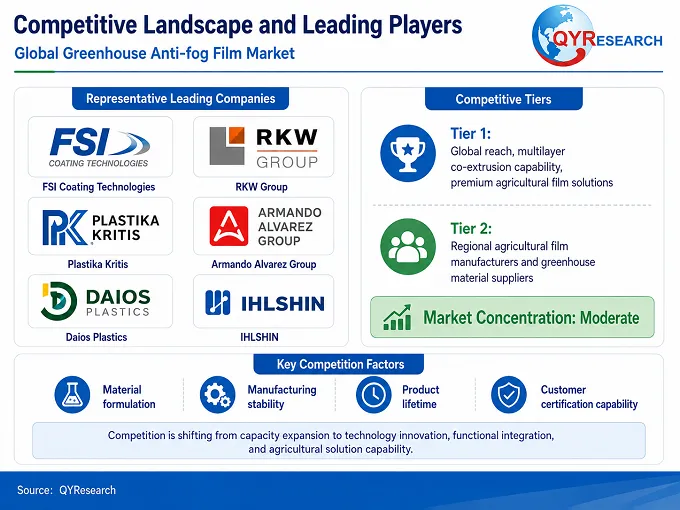
The first-tier players mainly consist of global agricultural film manufacturers with advanced polymer formulation capabilities, multilayer co-extrusion technologies and international distribution networks. Representative companies include FSI Coating Technologies、RKW Group、Plastika Kritis、Armando Alvarez Group、Daios Plastics、IHLSHIN. These companies generally provide diversified agricultural film solutions covering PE, PO and EVA-based products, while continuously upgrading toward customized and multifunctional solutions.
The second tier includes regional agricultural film manufacturers and specialized greenhouse material suppliers. Companies in China, Japan, South Korea and the Middle East have strengthened their market positions through cost advantages, localized supply chains and regional customer service capabilities.
The overall market concentration is moderate. Competition in premium greenhouse anti-fog film segments is mainly determined by material formulation capability, manufacturing stability, product lifetime, agricultural application experience and customer certification. Future competition will increasingly shift from simple production expansion toward technology innovation, functional integration and complete agricultural solution capabilities.
Greenhouse anti-fog films can be categorized based on material system and application scenario, representing two widely recognized classification approaches.
By material system, greenhouse anti-fog films mainly include PE-based anti-fog films, PO-based anti-fog films and EVA composite greenhouse films. PE anti-fog films have advantages in cost efficiency and broad applicability, making them widely used in traditional greenhouse cultivation. PO greenhouse films provide improved transparency, weather resistance and mechanical performance, and have become increasingly popular in advanced greenhouse projects and large-scale agricultural production. EVA composite films generally provide excellent flexibility, thermal insulation and anti-drip performance, making them suitable for cultivation environments requiring stronger climate control.
By application scenario, greenhouse anti-fog films are mainly used in vegetable greenhouses, flower cultivation, fruit production, seedling facilities and intelligent greenhouse systems. Vegetable cultivation remains the largest application area due to its large-scale adoption, while flowers, premium fruits and research-oriented greenhouse projects represent faster-growing segments because of their higher requirements for light control and environmental stability.
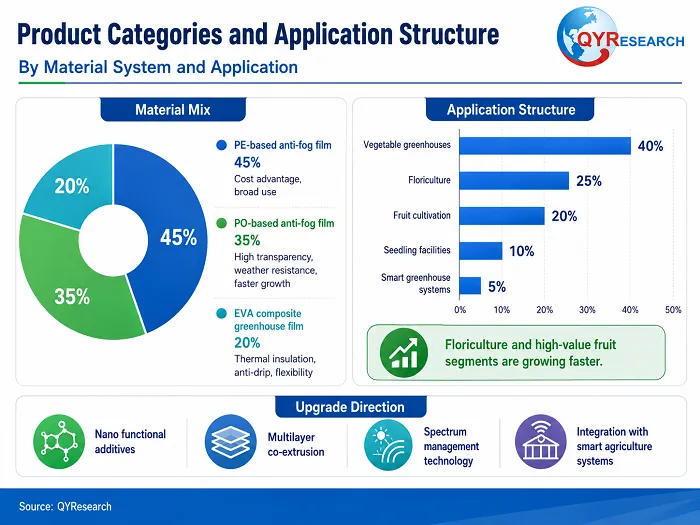
Future product innovation will focus on multifunctional additives, multilayer structures, spectrum management technologies and integration with intelligent agricultural systems. Greenhouse films are gradually evolving from simple covering materials into key environmental management components within modern agricultural systems.
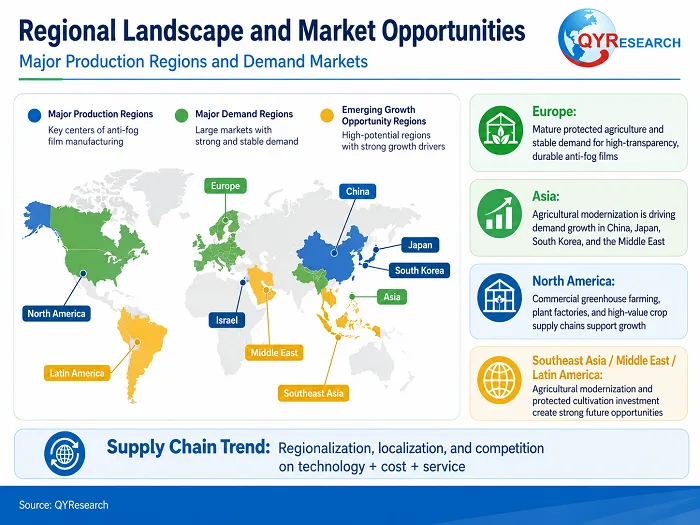
Global greenhouse anti-fog film production is mainly concentrated in China, Europe, Japan, South Korea, Israel and selected North American regions. China has become one of the world's major production bases due to its comprehensive plastics processing industry, large agricultural film manufacturing capacity and expanding protected agriculture market. European manufacturers maintain advantages in premium functional films, environmentally friendly materials and advanced greenhouse system integration.
In terms of consumption, Europe, Asia-Pacific and North America represent major demand regions. Europe has a mature protected agriculture ecosystem, with countries such as the Netherlands, Spain and Italy showing stable demand for high-transparency, durable and anti-condensation greenhouse films. In Asia, China, Japan, South Korea and Middle Eastern countries are increasing adoption of advanced greenhouse materials as agricultural modernization accelerates.
The North American market is mainly supported by commercial greenhouse farming, plant factories and high-value agricultural supply chains. Emerging regions including Southeast Asia, the Middle East and Latin America are expected to achieve faster growth due to agricultural modernization policies, water resource management needs and increasing investment in controlled cultivation systems.
The global supply chain is becoming increasingly regionalized. European and North American markets emphasize supply stability and advanced material performance, while Chinese manufacturers are accelerating overseas expansion based on manufacturing advantages and supply chain integration capabilities.
The upstream segment of the greenhouse anti-fog film industry includes polyethylene resin, polyolefin materials, EVA resin, functional additives, antioxidants, UV stabilizers, anti-drip agents, light diffusion materials and film manufacturing equipment suppliers. High-performance polymers and additive formulations are key factors determining film transparency, anti-fog performance, weather resistance and service life.
The midstream segment consists of greenhouse film manufacturers that produce functional agricultural films through blown film processing, multilayer co-extrusion, material modification and surface treatment technologies. Core competitive barriers are concentrated in formulation development, multilayer structure design, production consistency and regional climate adaptation capabilities.
The downstream segment includes greenhouse operators, agricultural enterprises, greenhouse engineering companies, agricultural parks, farming cooperatives and research institutions. Higher-value segments are concentrated in functional material development, advanced additive systems and premium film manufacturing. Future supply chains will continue moving toward sustainable materials, recyclable solutions and integration with intelligent agricultural technologies.
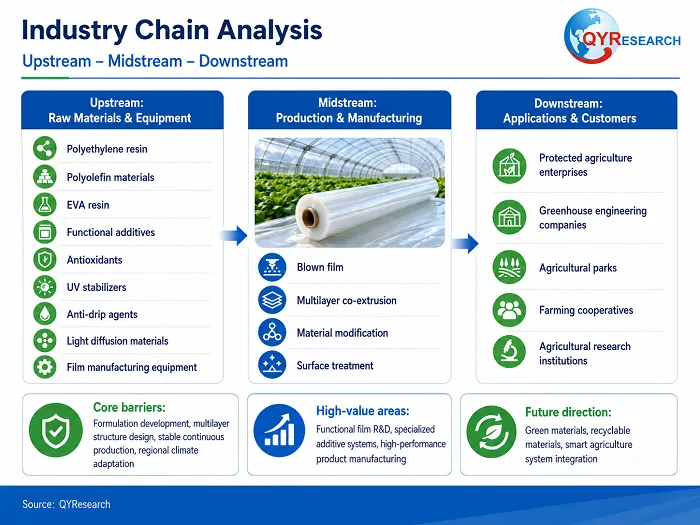
The development of the greenhouse anti-fog film industry is supported by agricultural modernization policies, food security requirements and upgrades in protected agriculture technologies. Many countries and regions are promoting water-efficient agriculture, smart greenhouse systems and high-productivity farming models, creating long-term opportunities for functional greenhouse covering materials. Meanwhile, the industry faces challenges including raw material price volatility, intense competition in low-end products, stricter environmental regulations and pressure from alternative sustainable materials. High-performance products require strong R&D capabilities, advanced manufacturing investment and long customer validation cycles, creating technical and market entry barriers.
In the coming years, greenhouse anti-fog films will continue evolving toward higher performance, multifunctionality and sustainability. Increasing complexity in agricultural environments and rising demand for premium crops will accelerate adoption of anti-fog, anti-drip, light diffusion and thermal insulation films. Future technological development will focus on advanced additives, multilayer structures, bio-based materials and integration with intelligent greenhouse management systems. Companies with strong material innovation capabilities, global supply networks and agricultural application expertise are expected to maintain competitive advantages, supporting long-term growth opportunities across the global greenhouse anti-fog film market.
[Access Free Sample Report (Including Full TOC, Tables, Figures, Charts)]
https://www.qyresearch.com/reports/6729837/greenhouse-anti-fog-film
About QYResearch
QYResearch founded in California, USA in 2007. It is a leading global market research and consulting company. With over 19 years’ experience and professional research team in various cities over the world QY Research focuses on management consulting, database and seminar services, IPO consulting, industry chain research and customized research to help our clients in providing non-linear revenue model and make them successful. We are globally recognized for our expansive portfolio of services, good corporate citizenship, and our strong commitment to sustainability. Up to now, we have cooperated with more than 60,000 clients across five continents. Let’s work closely with you and build a bold and better future.
QYResearch is a world-renowned large-scale consulting company. The industry covers various high-tech industry chain market segments, spanning the semiconductor industry chain (semiconductor equipment and parts, semiconductor materials, ICs, Foundry, packaging and testing, discrete devices, sensors, optoelectronic devices), photovoltaic industry chain (equipment, cells, modules, auxiliary material brackets, inverters, power station terminals), new energy automobile industry chain (batteries and materials, auto parts, batteries, motors, electronic control, automotive semiconductors, etc.), communication industry chain (communication system equipment, terminal equipment, electronic components, RF front-end, optical modules, 4G/5G/6G, broadband, IoT, digital economy, AI), advanced materials industry Chain (metal materials, polymer materials, ceramic materials, nano materials, etc.), machinery manufacturing industry chain (CNC machine tools, construction machinery, electrical machinery, 3C automation, industrial robots, lasers, industrial control, drones), food, beverages and pharmaceuticals, medical equipment, agriculture, etc.

Global Greenhouse Anti-fog Film Market Outlook, In‑Depth Analysis & Forecast to 2032

Published Date: 2026-09-04

Pages: 173

Report ld: 6729838
Price:USD 4900.00
(Single User License)
Greenhouse Anti-fog Film- Global Market Share and Ranking, Overall Sales and Demand Forecast 2026-2032
Published Date: 2026-09-04
Pages: 150
Report ld: 6729837
Price:USD 3950.00
(Single User License)
Global Greenhouse Anti-fog Film Market Research Report 2026
Published Date: 2026-09-04
Pages: 150
Report ld: 6729836
Price:USD 2900.00
(Single User License)
Global Greenhouse Anti-fog Film Sales Market Report, Competitive Analysis and Regional Opportunities 2026-2032
Published Date: 2026-09-04
Pages: 148
Report ld: 6729835
Price:USD 4250.00
(Single User License)
Global Greenhouse Anti-fog Film Market Report, History and Forecast 2021-2032
Published Date: 2026-08-31
Pages: 139
Report ld: 6998013
Price:USD 3350.00
(Single User License)


Competition
Key players, new entrants,acquisitions, mergers and expansions,development trends and challenges.

Industry Analysis
Rawmaterial, application, product type, demand,supply,downstream, supply chain etc.

Market Size
Capacity, production, sales, revenue, price, cost etc.

Customized Information
We can offer customized survey and information to meet ourclient's need.
