Plasma Feeder Research:compound annual growth rate (CAGR) of 5.77% from 2026 to 2032


Global Plasma Feeder Market Size
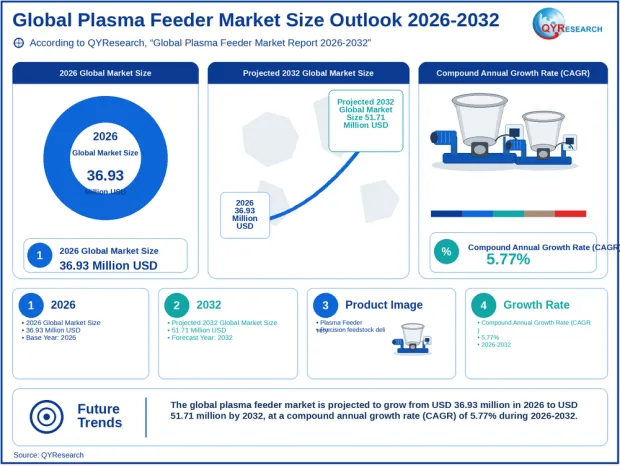
According to QYResearch’s latest report, “Global Plasma Feeder Market Report 2026-2032,” the global market is projected to reach USD 51.71 million by 2032, with a compound annual growth rate (CAGR) of 5.77% from 2026 to 2032.
Plasma feeders are precision material-delivery devices used to meter powders, wires, or other feedstock into plasma spraying, plasma transferred arc, plasma cladding, spheroidization, and related plasma processes. Typical products combine a sealed hopper, metering screw or rotary/vibratory mechanism, drive motor, carrier-gas valves and regulators, tubing, sensors, weighing or feedback elements, and a control unit. They are used to maintain a stable feed rate, improve coating or deposition repeatability, reduce material waste and manual adjustment, and support continuous automated production in aerospace, automotive, energy, electronics, medical, research, and advanced-manufacturing applications.
Figure. Plasma Feeder: Global Market Size
Source: QYResearch, “Global Plasma Feeder Market Research Report 2026-2032.”
Major Growth Drivers:
1. Industrial users are increasing investment in automated plasma processing and thermal-spray production. Stable feedstock delivery directly affects coating thickness, deposition efficiency, process repeatability, and line continuity, so customers are adopting plasma feeders to reduce manual adjustment and unplanned process variation.
2. Demand from aerospace, automotive, energy, electronics, medical, tooling, and advanced-material applications is expanding. These industries increasingly use plasma spraying, cladding, transferred-arc, and powder-treatment processes to improve wear resistance, corrosion resistance, thermal performance, and component life.
3. Tighter quality requirements are pushing users toward precise, closed, and digitally controlled feeding systems. Accurate metering, stable carrier-gas flow, recipe storage, sensors, and optional feedback control help improve traceability, material utilization, and compliance with production specifications.
4. Equipment replacement, retrofit, and customization demand remains important because existing plasma systems often need to process new materials, finer powders, or wider feed-rate ranges. Modular feeders can be integrated with installed torches, gas systems, robots, and control platforms without replacing the entire plasma-processing line.
Key Market Restraints:
1. Product performance is highly dependent on feedstock particle size, morphology, bulk density, flowability, moisture, electrostatic behavior, and process-gas conditions. Material-specific calibration and trial runs are often required, which increases lead time and limits full standardization.
2. Plasma feeders must balance metering accuracy, carrier-gas stability, sealing, wear resistance, contamination control, and compatibility with the plasma torch and control system. Poor selection or integration can cause pulsing, blockage, powder loss, unstable deposition, or accelerated component wear, raising quality-control and service requirements.
3. Demand is partly linked to capital spending in coating, welding, advanced-material, and research applications. When customers postpone new plasma cells, robot integration, or production-line upgrades, purchases of plasma feeders can be delayed, especially among small and medium-sized users.
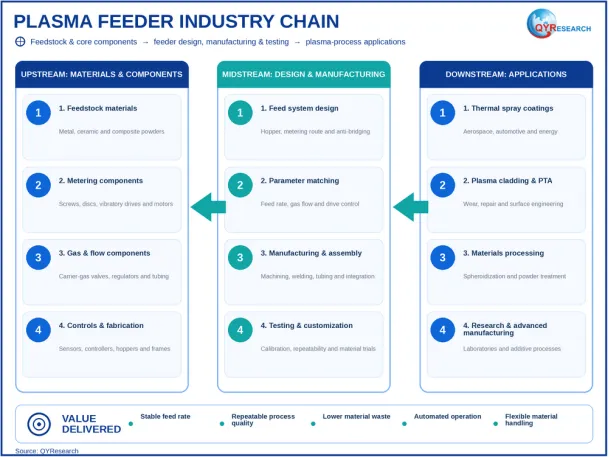
Figure. Plasma Feeder Industry Chain
Source: QYResearch, “Global Plasma Feeder Market Research Report 2026-2032.”
The industry chain for plasma feeders is structured around the progression from “feedstock materials and core components” to “feeder design, manufacturing, and testing,” and finally to “plasma-process applications,” forming a comprehensive system that spans upstream materials and components, midstream equipment manufacturing and integration, and downstream end-use applications. The upstream segment mainly encompasses metal, ceramic, and composite powders; hoppers and structural parts; metering screws, rotary discs, vibratory drives, motors, valves, regulators, tubing, sensors, and controllers. These elements determine feed consistency, sealing, carrier-gas stability, and equipment durability. The midstream segment focuses on feed-system design, metering-route selection, anti-bridging measures, gas-flow matching, manufacturing and assembly, calibration, repeatability testing, and material-specific customization. Downstream applications primarily cover thermal-spray coatings, plasma transferred arc and cladding, powder spheroidization and treatment, additive manufacturing, and laboratory research. Overall, the core value of plasma feeders lies in maintaining a stable feed rate, improving process repeatability, reducing material loss, enabling automation, and supporting flexible handling of different feedstocks in advanced surface engineering and materials-processing systems.
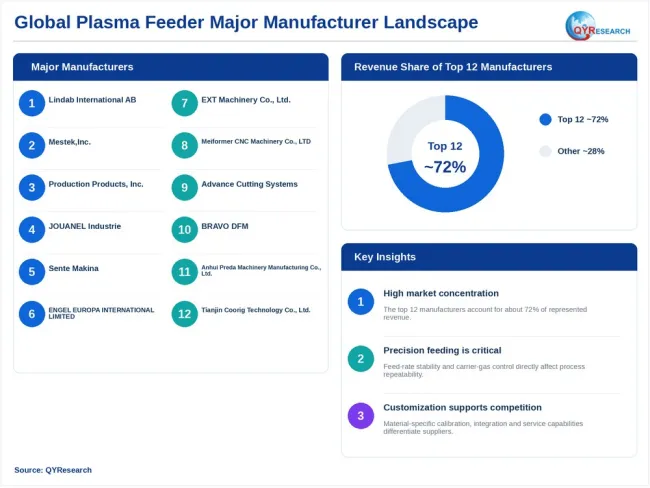
Figure. Global Top 12 Plasma Feeder Manufacturers and Market Share (based on the supplied manufacturer revenue data; report period 2026-2032)
Source: QYResearch, “Global Plasma Feeder Market Research Report 2026-2032.” Rankings are based on the supplied manufacturer revenue dataset. The latest figures are subject to QYResearch’s most recent survey.
Globally, major Plasma Feeder manufacturers include Lindab International AB, Mestek,Inc., Production Products, Inc., JOUANEL Industrie, Sente Makina, ENGEL EUROPA INTERNATIONAL LIMITED, EXT Machinery Co., Ltd., and Meiformer CNC Machinery Co., LTD, among others. The top 12 companies account for approximately 72% of the global market share.
The report provides a detailed analysis of the market size, growth potential, and key trends for each segment. Through detailed analysis, industry players can identify profit opportunities, develop strategies for specific customer segments, and allocate resources effectively.
The Plasma Feed market is segmented as below:
By Company
Actipro
Ew-nutrition
Feedworks Pty Ltd
Sonac
Darling Ingredients Inc.
Lauridsen Group Inc.
Veos Group
Kraeber&Co Gmbh
EcooFeed LLC
Rocky Mountain Biologicals
Puretein Agri LLC
SARIA Group
Segment by Type
Pig Blood
Bovine Blood
Others
Segment by Application
Animal Feed
Pet Food
Others
Each chapter of the report provides detailed information for readers to further understand the Plasma Feed market:
Chapter 1: Introduces the report scope of the Plasma Feed report, global total market size (valve, volume and price). This chapter also provides the market dynamics, latest developments of the market, the driving factors and restrictive factors of the market, the challenges and risks faced by manufacturers in the industry, and the analysis of relevant policies in the industry. (2021-2032)
Chapter 2: Detailed analysis of Plasma Feed manufacturers competitive landscape, price, sales and revenue market share, latest development plan, merger, and acquisition information, etc. (2021-2026)
Chapter 3: Provides the analysis of various Plasma Feed market segments by Type, covering the market size and development potential of each market segment, to help readers find the blue ocean market in different market segments. (2021-2032)
Chapter 4: Provides the analysis of various market segments by Application, covering the market size and development potential of each market segment, to help readers find the blue ocean market in different downstream markets.(2021-2032)
Chapter 5: Sales, revenue of Plasma Feed in regional level. It provides a quantitative analysis of the market size and development potential of each region and introduces the market development, future development prospects, market space, and market size of each country in the world..(2021-2032)
Chapter 6: Sales, revenue of Plasma Feed in country level. It provides sigmate data by Type, and by Application for each country/region.(2021-2032)
Chapter 7: Provides profiles of key players, introducing the basic situation of the main companies in the market in detail, including product sales, revenue, price, gross margin, product introduction, recent development, etc. (2021-2026)
Chapter 8: Analysis of industrial chain, including the upstream and downstream of the industry.
Chapter 9: Conclusion.
Other relevant reports of QYResearch:
Global Plasma Feed Market Research Report 2026
Global Plasma Feeder Sales Market Report, Competitive Analysis and Regional Opportunities 2026-2032
Global Plasma Feeder Market Outlook, In‑Depth Analysis & Forecast to 2032
Plasma Feeder- Global Market Share and Ranking, Overall Sales and Demand Forecast 2026-2032
Global Plasma Feeder Market Research Report 2026
Animal Plasma Feed- Global Market Share and Ranking, Overall Sales and Demand Forecast 2026-2032
Global Animal Plasma Feed Market Research Report 2026
Global Plasma Feed For Swin Market Outlook, In‑Depth Analysis & Forecast to 2032
Global Plasma Feed For Swin Sales Market Report, Competitive Analysis and Regional Opportunities 2026-2032
Plasma Feed For Swin- Global Market Share and Ranking, Overall Sales and Demand Forecast 2026-2032
Global Plasma Feed For Swin Market Research Report 2026
Benefits of purchasing QYResearch report:
Competitive Analysis: QYResearch provides in-depth Plasma Feed competitive analysis, including information on key company profiles, new entrants, acquisitions, mergers, large market shear, opportunities, and challenges. These analyses provide clients with a comprehensive understanding of market conditions and competitive dynamics, enabling them to develop effective market strategies and maintain their competitive edge.
Industry Analysis: QYResearch provides Plasma Feed comprehensive industry data and trend analysis, including raw material analysis, market application analysis, product type analysis, market demand analysis, market supply analysis, downstream market analysis, and supply chain analysis.
and trend analysis. These analyses help clients understand the direction of industry development and make informed business decisions.
Market Size: QYResearch provides Plasma Feed market size analysis, including capacity, production, sales, production value, price, cost, and profit analysis. This data helps clients understand market size and development potential, and is an important reference for business development.

Global Plasma Feeder Sales Market Report, Competitive Analysis and Regional Opportunities 2026-2032

Published Date: 2026-07-17

Pages: 143

Report ld: 6977796
Price:USD 4250.00
(Single User License)
Global Plasma Feeder Market Outlook, In‑Depth Analysis & Forecast to 2032
Published Date: 2026-07-17
Pages: 161
Report ld: 6977794
Price:USD 4900.00
(Single User License)
Plasma Feeder- Global Market Share and Ranking, Overall Sales and Demand Forecast 2026-2032
Published Date: 2026-07-17
Pages: 140
Report ld: 6756948
Price:USD 3950.00
(Single User License)
Global Plasma Feeder Market Research Report 2026
Published Date: 2026-07-17
Pages: 142
Report ld: 6476305
Price:USD 2900.00
(Single User License)
Global Plasma Feeder Sales Market Report, Competitive Analysis and Regional Opportunities 2025-2031
Published Date: 2025-11-02
Pages: 77
Report ld: 5368867
Price:USD 4250.00
(Single User License)
Global Plasma Feeder Market Outlook, In‑Depth Analysis & Forecast to 2031
Published Date: 2025-11-02
Pages: 132
Report ld: 5360639
Price:USD 4900.00
(Single User License)


Competition
Key players, new entrants,acquisitions, mergers and expansions,development trends and challenges.

Industry Analysis
Rawmaterial, application, product type, demand,supply,downstream, supply chain etc.

Market Size
Capacity, production, sales, revenue, price, cost etc.

Customized Information
We can offer customized survey and information to meet ourclient's need.
