semiconductor wafer CMP retainer rings Industry Research: the global market is projected to reach approximately US$245.73 million by 2032


Semiconductor CMP Retainer Rings: High-Performance Materials for Advanced Fab Expansion
Global Semiconductor CMP Retainer Rings Industry Research Report 2026
| Promotional Research Brief
QYResearch has released its 2026 Global Semiconductor Wafer CMP Retainer Rings Market Research Report, covering product definition, material systems, market size, competitive landscape, wafer-size applications, regional structure and industry-chain developments. The study focuses on replacement demand, material upgrades, equipment compatibility and supply-chain localization associated with global expansion in advanced logic, memory and mature-node wafer manufacturing.
Industry Highlights of Combi Oven Market
1. Advanced Process Development and Fab Expansion Drive Continuous Demand Growth
The increasing demand for advanced logic, AI chips, DRAM, NAND and three-dimensional semiconductor devices is accelerating global investment in 300mm wafer fabs. As CMP remains a critical wafer planarization process, higher equipment utilization and consumable replacement frequency are creating stable growth opportunities for CMP wafer retainer rings.
2. High-Performance Engineering Materials Enhance Product Value
CMP wafer retainer rings are evolving from conventional materials toward high-performance PEEK, modified PPS and advanced composite engineering plastics. Material durability, chemical resistance, particle control, dimensional stability and extended service life have become key competitive factors, benefiting suppliers with strong material development and precision manufacturing capabilities.
3. Semiconductor Supply Chain Localization Creates Regional Opportunities
The global semiconductor supply chain is moving toward multi-regional manufacturing networks. China, the United States, Japan, South Korea and Southeast Asia are continuously expanding semiconductor investments. Growing demand for local supply, rapid technical support and second-source qualification provides new opportunities for regional CMP retainer ring suppliers.
4. Consumable Characteristics Support Stable Replacement Demand and Long-Term Customer Relationships
CMP wafer retainer rings are periodic replacement components, and their wear performance directly affects wafer edge uniformity, particle levels and production stability. Compared with one-time equipment purchases, consumable components generate recurring demand, allowing leading suppliers to establish long-term customer relationships through qualification and reliable supply.
5. Material Innovation, Process Capability and Equipment Compatibility Define Future Competition
Future competition will shift from basic machining capability toward comprehensive advantages in material formulation, structural design, equipment platform compatibility, quality traceability and technical services. Companies capable of supporting multiple CMP platforms and providing customized solutions will gain stronger competitive advantages globally.
Market Size and Growth Trend
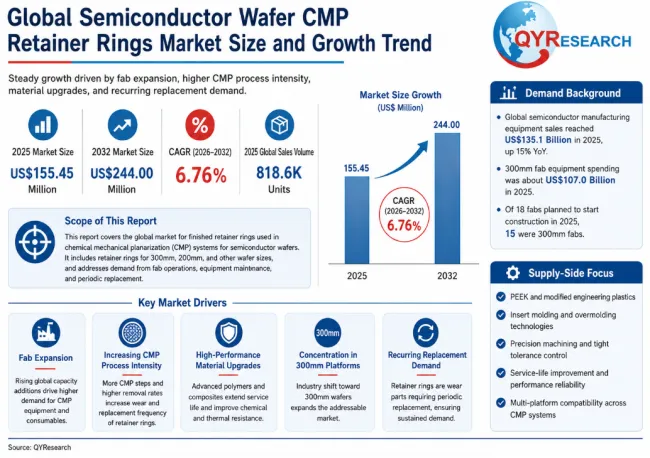
According to QYResearch, the global semiconductor wafer CMP retainer rings market reached approximately US$155.45 million in 2025, with sales volume totaling about 818,600 units. The market is projected to reach approximately US$245.73 million by 2032, representing a CAGR of approximately 6.76% from 2026 to 2032. The market value primarily covers finished retainer rings supplied for 300 mm, 200 mm, and other semiconductor wafer CMP systems, including demand arising from wafer fab operations, equipment maintenance, and the periodic replacement of components.
The industry is benefiting from wafer-fab expansion, increasing CMP process intensity and demand for higher-performance materials. SEMI reported that worldwide semiconductor manufacturing equipment sales reached US$135.1 Billion in 2025, up 15% year on year, while 300mm fab equipment spending exceeded US$100 Billion. Fifteen of the eighteen fab projects scheduled to begin construction in 2025 were 300mm facilities. These investments support higher utilization of CMP equipment and recurring replacement demand for retainer rings. Suppliers are therefore investing in modified PEEK and PPS materials, insert molding, precision machining, longer service life and broader equipment-platform coverage.
Competitive Landscape and Leading Players
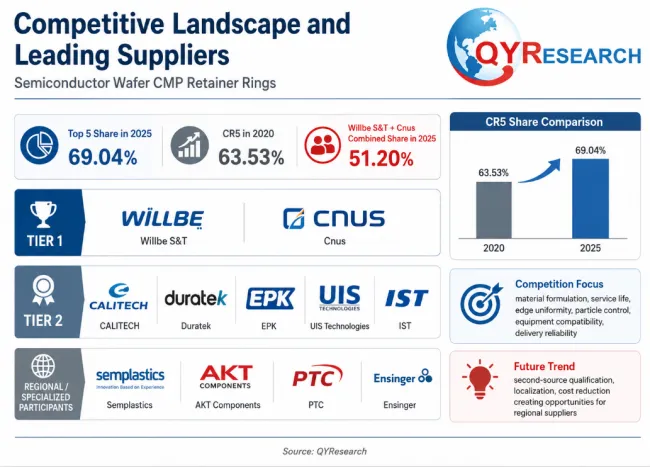
The global market is relatively concentrated.According to the QYResearch report, the five largest suppliers represented approximately 69.04% of global revenue in 2025, compared with 63.53% in 2020. Willbe S&T and Cnus form the leading tier in terms of revenue, shipment scale, customer relationships and product coverage, together accounting for approximately 51.20% of the market in 2025. CALITECH, Duratek, EPK, UIS Technologies and IST form a second group with established positions in selected materials, equipment platforms and regional markets. Semplastics, AKT Components, PTC and Ensinger participate through proprietary materials, precision-machined replacement products and specialized customer support.
Competition is shifting from conventional machining capability toward material formulation, usable life, edge-profile control, particle performance, platform compatibility and delivery reliability. Leading suppliers typically combine material selection, structural design, sample qualification and volume supply. Market concentration is expected to remain high, although second-source qualification, localized procurement and total-cost reduction strategies will create opportunities for regional manufacturers with strong materials engineering, reverse engineering, precision machining and onsite technical support.
Product Classification and Application Structure
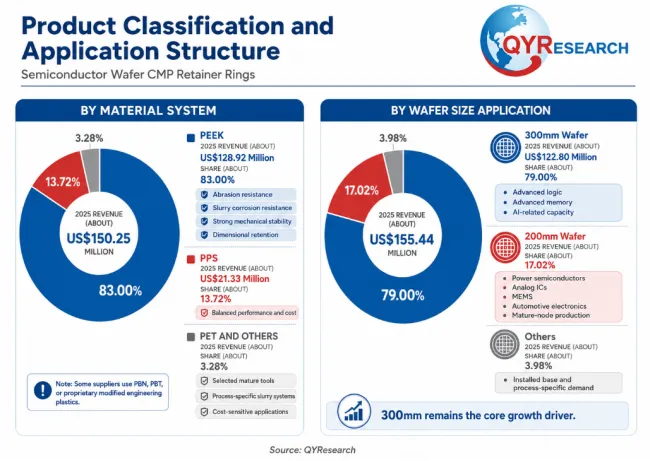
By material, the market is divided into PEEK, PPS, PET and other polymers. PEEK offers strong abrasion resistance, chemical stability, mechanical performance and dimensional consistency and remains the dominant material by value. Global PEEK retainer-ring revenue reached approximately US$128.92 Million in 2025, representing about 83% of the total market. PPS products generated approximately US$21.33 Million and are commonly selected where chemical resistance, mechanical stability and cost control must be balanced. PET and other formulations serve selected legacy platforms and process-specific requirements. Some suppliers also offer PBN, PBT and proprietary engineered polymers to improve ring life and polishing performance.
By wafer size, 300mm applications generated approximately US$122.80 Million in 2025, equal to 79.00% of the global market. The 200mm segment represented 17.02%, supported by power semiconductors, analog devices, MEMS, automotive electronics and established-node production. Other wafer sizes accounted for 3.98%. Continued investment in advanced logic, memory and AI-related manufacturing is expected to increase the share of 300mm applications, while the 200mm segment will remain supported by installed equipment and recurring maintenance demand.
Regional Landscape and Market Opportunities
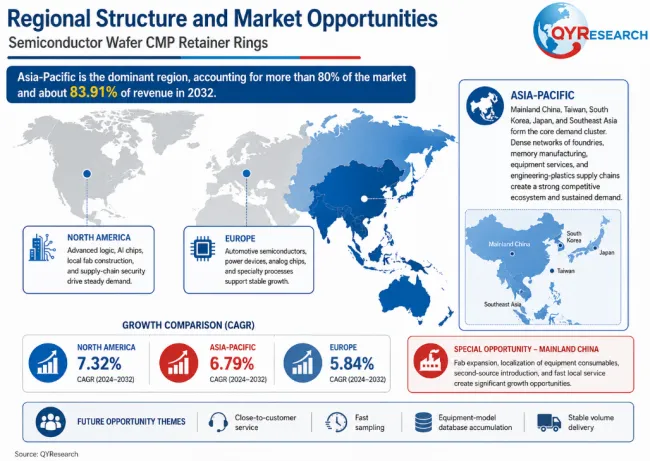
Asia-Pacific is the largest production and consumption region, accounting for more than four-fifths of global market value. Demand is concentrated in Mainland China, Taiwan, South Korea, Japan and Southeast Asia, where wafer fabs, memory manufacturers, foundries, equipment-service companies and precision polymer-processing suppliers form dense industrial clusters. The report projects that Asia-Pacific will account for approximately 83.91% of global revenue in 2032.
North America has a smaller current base but is expected to grow at approximately 7.32% during 2025–2032, supported by advanced-node investment, AI-related capacity and localized semiconductor manufacturing. Europe is primarily driven by automotive, power, analog and specialty semiconductor production. Mainland China offers significant opportunities associated with fab construction, replacement of imported consumables, second-source qualification and localized technical service. Regional competitiveness will increasingly depend on rapid prototyping, equipment-model databases, local inventory and stable volume delivery.
Industry Chain Analysis
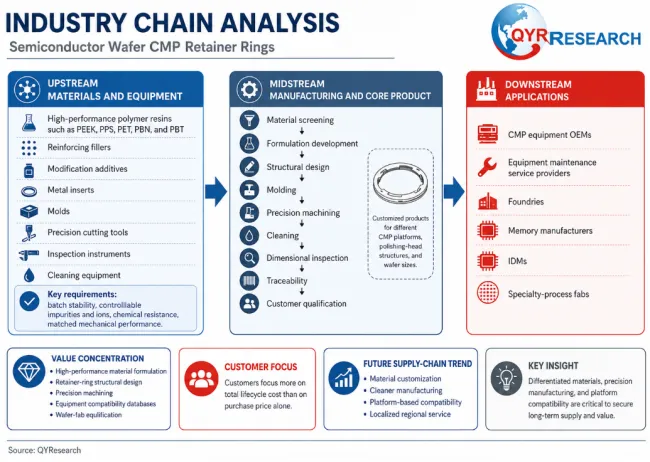
Upstream inputs include PEEK, PPS, PET, PBN and PBT resins, reinforcing fillers, modification additives, metal inserts, precision molds, cutting tools, inspection instruments and cleaning systems. Manufacturing relies on injection or compression molding, insert molding, CNC turning and milling, grinding, dimensional metrology and clean processing. Midstream suppliers perform material development, structural design, molding, precision machining, cleaning, inspection, traceability and customer qualification. Downstream customers include CMP equipment manufacturers, maintenance-service providers, foundries, memory manufacturers, integrated device manufacturers and specialty-process fabs.
The highest-value capabilities are material formulation, structural engineering, high-precision machining, equipment-platform know-how and wafer-fab qualification. Although the unit value of a retainer ring is limited compared with the CMP system itself, ring wear can affect edge removal, within-wafer uniformity, particle levels and equipment availability. Customers therefore evaluate total cost of ownership rather than unit price alone. The supply chain is expected to become more customized, cleaner, more traceable and regionally localized, benefiting suppliers with stable material quality, rapid qualification and multi-platform manufacturing capability.
Business Environment and Outlook
Semiconductor-producing regions continue to support fab investment through industrial incentives, tax measures, research funding and local supply-chain development. However, entry barriers remain substantial. Materials must provide abrasion resistance, chemical compatibility, low moisture absorption, low particle generation and dimensional stability. Products must be qualified for specific equipment and process conditions, while precision manufacturing, cleanliness, traceability and batch consistency require sustained investment. Key risks include customer concentration, high-performance resin availability, semiconductor capital-spending cycles, pricing pressure and potential changes in CMP materials or process technologies.
Over the next several years, advanced-node logic, AI computing, advanced memory, three-dimensional device structures and regional fab expansion will remain the principal demand drivers. Product development will focus on longer life, lower particle generation, improved edge control and tighter flatness and parallelism. Suppliers will increase automation, inline inspection and digital traceability, while commercial relationships will gradually evolve from standard replacement-part supply toward joint optimization of materials, ring geometry and CMP platforms. The market is relatively specialized in size but offers stable recurring demand and high qualification-based customer retention.
The report provides a detailed analysis of the market size, growth potential, and key trends for each segment. Through detailed analysis, industry players can identify profit opportunities, develop strategies for specific customer segments, and allocate resources effectively.
The Semiconductor Wafer CMP Retainer Rings market is segmented as below:
By Company
Willbe S&T
Cnus
CALITECH
Duratek
EPK
UIS Technologies
IST
Semplastics
AKT Components
PTC
Ensinger
Segment by Type
Polyphenylene Sulfide (PPS)
Polyetheretherketone (PEEK)
Polyethylene Terephthalate (PET)
Others
Segment by Application
300 mm Wafer
200 mm Wafer
Others
Each chapter of the report provides detailed information for readers to further understand the Semiconductor Wafer CMP Retainer Rings market:
Chapter 1: Introduces the report scope of the Semiconductor Wafer CMP Retainer Rings report, global total market size (valve, volume and price). This chapter also provides the market dynamics, latest developments of the market, the driving factors and restrictive factors of the market, the challenges and risks faced by manufacturers in the industry, and the analysis of relevant policies in the industry. (2021-2032)
Chapter 2: Detailed analysis of Semiconductor Wafer CMP Retainer Rings manufacturers competitive landscape, price, sales and revenue market share, latest development plan, merger, and acquisition information, etc. (2021-2026)
Chapter 3: Provides the analysis of various Semiconductor Wafer CMP Retainer Rings market segments by Type, covering the market size and development potential of each market segment, to help readers find the blue ocean market in different market segments. (2021-2032)
Chapter 4: Provides the analysis of various market segments by Application, covering the market size and development potential of each market segment, to help readers find the blue ocean market in different downstream markets.(2021-2032)
Chapter 5: Sales, revenue of Semiconductor Wafer CMP Retainer Rings in regional level. It provides a quantitative analysis of the market size and development potential of each region and introduces the market development, future development prospects, market space, and market size of each country in the world..(2021-2032)
Chapter 6: Sales, revenue of Semiconductor Wafer CMP Retainer Rings in country level. It provides sigmate data by Type, and by Application for each country/region.(2021-2032)
Chapter 7: Provides profiles of key players, introducing the basic situation of the main companies in the market in detail, including product sales, revenue, price, gross margin, product introduction, recent development, etc. (2021-2026)
Chapter 8: Analysis of industrial chain, including the upstream and downstream of the industry.
Chapter 9: Conclusion.
Other relevant reports of QYResearch:
Global Semiconductor Wafer CMP Retainer Rings Sales Market Report, Competitive Analysis and Regional Opportunities 2026-2032
Global Semiconductor Wafer CMP Retainer Rings Market Research Report 2026
Benefits of purchasing QYResearch report:
Competitive Analysis: QYResearch provides in-depth Semiconductor Wafer CMP Retainer Rings competitive analysis, including information on key company profiles, new entrants, acquisitions, mergers, large market shear, opportunities, and challenges. These analyses provide clients with a comprehensive understanding of market conditions and competitive dynamics, enabling them to develop effective market strategies and maintain their competitive edge.
Industry Analysis: QYResearch provides Semiconductor Wafer CMP Retainer Rings comprehensive industry data and trend analysis, including raw material analysis, market application analysis, product type analysis, market demand analysis, market supply analysis, downstream market analysis, and supply chain analysis.
and trend analysis. These analyses help clients understand the direction of industry development and make informed business decisions.
Market Size: QYResearch provides Semiconductor Wafer CMP Retainer Rings market size analysis, including capacity, production, sales, production value, price, cost, and profit analysis. This data helps clients understand market size and development potential, and is an important reference for business development.

Global Semiconductor Wafer CMP Retainer Rings Sales Market Report, Competitive Analysis and Regional Opportunities 2026-2032

Published Date: 2026-01-05

Pages: 100

Report ld: 5572358
Price:USD 4250.00
(Single User License)
Global Semiconductor Wafer CMP Retainer Rings Market Research Report 2026
Published Date: 2026-01-05
Pages: 138
Report ld: 5520244
Price:USD 2900.00
(Single User License)
Semiconductor Wafer CMP Retainer Rings- Global Market Share and Ranking, Overall Sales and Demand Forecast 2026-2032
Published Date: 2026-01-05
Pages: 111
Report ld: 5510498
Price:USD 3950.00
(Single User License)
Global Semiconductor Wafer CMP Retainer Rings Market Outlook, In‑Depth Analysis & Forecast to 2031
Published Date: 2025-09-26
Pages: 161
Report ld: 5053808
Price:USD 4900.00
(Single User License)
Global Semiconductor Wafer CMP Retainer Rings Sales Market Report, Competitive Analysis and Regional Opportunities 2025-2031
Published Date: 2025-09-26
Pages: 96
Report ld: 4751420
Price:USD 4250.00
(Single User License)
Global Semiconductor Wafer CMP Retainer Rings Market Research Report 2025
Published Date: 2025-09-26
Pages: 103
Report ld: 3455865
Price:USD 2900.00
(Single User License)


Competition
Key players, new entrants,acquisitions, mergers and expansions,development trends and challenges.

Industry Analysis
Rawmaterial, application, product type, demand,supply,downstream, supply chain etc.

Market Size
Capacity, production, sales, revenue, price, cost etc.

Customized Information
We can offer customized survey and information to meet ourclient's need.
