Silicon Waveguide Research:expected to reach approximately US$15.36 billion by 2032


2026 Global Silicon Waveguide Industry Research Report
QYResearch has recently released the industry report “2026 Global Silicon Waveguide Industry Research Report”, covering product definition, technology routes, market size, competitive landscape, application scenarios, regional structure, and value chain changes of silicon waveguides. This brief focuses on demand changes, technology evolution, and supply chain opportunities of silicon waveguides in optical communications, AI data center interconnects, co-packaged optics, optical computing, LiDAR, and optical sensing.
A silicon waveguide refers to a silicon-based guided optical structure and related integrated devices used for on-chip optical signal transmission, modulation, coupling, splitting, combining, multiplexing, switching, and detection. It is typically formed on SOI, silicon, silica, silicon nitride, or silicon-based composite material platforms through micro/nano fabrication, lithography, etching, thin-film deposition, doping, metallization, coupling structure design, and packaging processes. Its core function is to confine optical signals within micron- or nanometer-scale waveguides and enable coordinated operation with modulators, photodetectors, grating couplers, splitters, ring resonators, arrayed waveguide gratings, optical switches, optical engines, and optical transceiver modules.
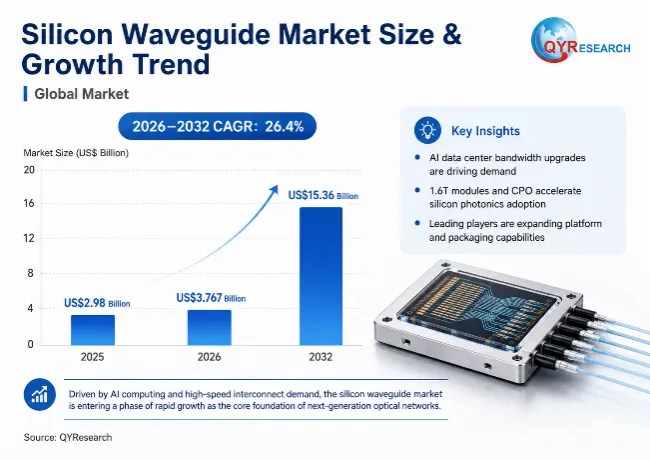
According to QYResearch preliminary research, the global silicon waveguide market size was approximately US$2.98 billion in 2025 and approximately US$3.767 billion in 2026. It is expected to reach approximately US$15.36 billion by 2032, representing a CAGR of approximately 26.4% during 2026–2032. The above market size mainly covers silicon-based waveguide structures, devices, and solutions used in silicon photonic chips, photonic integrated circuits, optical transceiver modules, optical I/O, co-packaged optics, sensing, and related system integration. From the demand side, market growth is mainly driven by AI data center bandwidth upgrades, volume deployment of 800G/1.6T and higher-speed optical modules, interconnect bottlenecks in GPU/XPU clusters, progress in CPO and near-package optics architectures, broader adoption of coherent optics, and expanding applications in LiDAR and biosensing. From the supply side, leading players are investing in low-loss waveguides, coordination between on-chip and external light sources, PIC-EIC co-design, wafer-level testing, advanced packaging, fiber coupling, thermal management, and strategic customer qualification. Overall, the industry is moving from scaled deployment in data communications toward AI compute interconnects and system-level optoelectronic integration. Future growth will mainly come from AI cluster optical interconnects, CPO optical engines, 1.6T and higher-speed modules, mature silicon photonics foundry platforms, and accelerated localization in China.
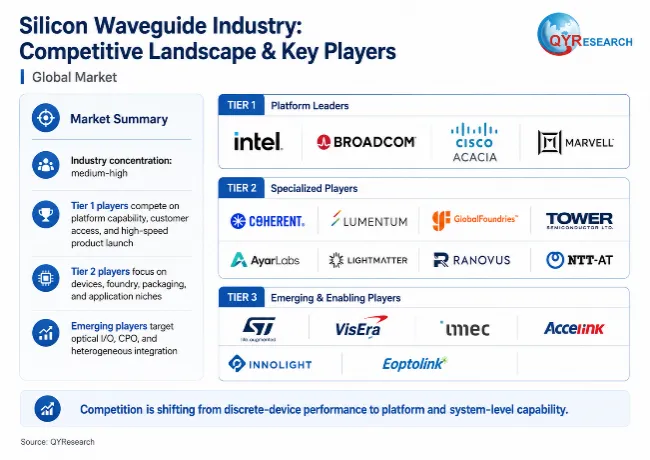
The global silicon waveguide competitive landscape is shaped by silicon photonics platform vendors, optical module and optical component suppliers, semiconductor foundries and packaging platforms, emerging AI optical interconnect companies, and research or pilot-line platforms. Representative companies include Intel, Broadcom, Cisco/Acacia, Marvell, Coherent, Lumentum, GlobalFoundries, Tower Semiconductor, Ayar Labs, Lightmatter, Ranovus, NTT-AT, VisEra, imec, STMicroelectronics, as well as China- and Asia-based players such as VisEra Technologies, Lightelligence, Accelink, Innolight, Eoptolink, TFC Communication, Broadex Technologies, and related Huawei HiSilicon ecosystem participants. The final company list is subject to the full report. First-tier companies generally have silicon photonics platforms, optical module customer resources, DSP or switching chip capabilities, or large-scale manufacturing capabilities. Their competition centers on high-speed product introduction, reliability, power consumption, packaging yield, and hyperscale customer qualification. Second-tier and regional vendors are more focused on specific devices, optical coupling, packaging, application modules, or local supply chain support. New entrants are concentrated in optical I/O, optical computing, CPO, chip-to-chip interconnects, and heterogeneous integration. Future competition will shift from single-device performance to platform capabilities. Companies that can integrate PIC design, EIC co-design, light-source strategy, coupling and packaging, wafer-level testing, and system-level customer validation will be better positioned in AI data centers and advanced optical communications.
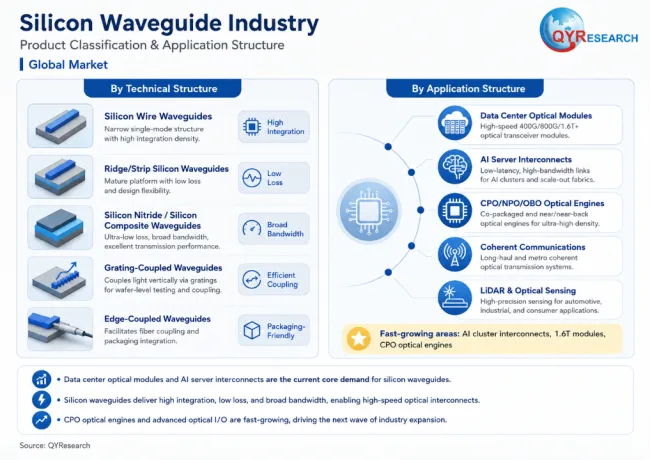
By product category, silicon waveguides can be classified into silicon wire waveguides, ridge or strip silicon waveguides, silicon nitride/silicon composite waveguides, grating-coupled waveguides, edge-coupled waveguides, ring-resonator waveguides, arrayed waveguide gratings, and on-chip optical interconnect networks. Silicon wire and ridge waveguides are suitable for high-density on-chip integration and are key building blocks for modulators, splitters, couplers, and optical switches. Silicon nitride or silicon-based composite waveguides emphasize low loss, broad bandwidth, and better process tolerance, making them suitable for long on-chip routing, sensing, laser integration, and heterogeneous packaging. Grating coupling and edge coupling structures directly affect the coupling efficiency between chips, fibers, lasers, and package substrates. By application, current demand is mainly concentrated in data center optical modules, AI server interconnects, coherent communications, CPO/NPO/OBO optical engines, LiDAR, and optical sensing. The fastest-growing directions are high-speed interconnects inside AI clusters, 1.6T and higher-speed optical modules, CPO optical engines, and on-chip/chip-to-chip optical I/O.
From a regional perspective, North America leads in silicon photonics design, AI compute platforms, cloud customers, optical I/O start-ups, and high-end system architecture definition, making it a core region for premium demand and technology innovation. Europe has strong foundations in silicon photonics research, pilot-line platforms, integrated photonics ecosystems, and automotive or industrial sensing. Japan has long-standing strengths in precision processing, optical communication devices, materials, and reliability validation. Mainland China and Taiwan have strong capabilities in optical module manufacturing, semiconductor manufacturing, packaging and testing, system customer adoption, and localization. On the demand side, North American cloud and AI infrastructure customers are the strongest drivers for high-speed optical interconnects. China has significant incremental potential supported by data center construction, communications network upgrades, domestic AI compute clusters, and a mature optical module supply chain. Other Asia-Pacific regions participate in the global division of labor through wafer manufacturing, packaging, optical components, and system integration. Future regional opportunities will focus on AI data center clusters, optical module upgrades, CPO supply chain migration, silicon photonics foundry capacity, advanced packaging support, and local customer qualification in China.
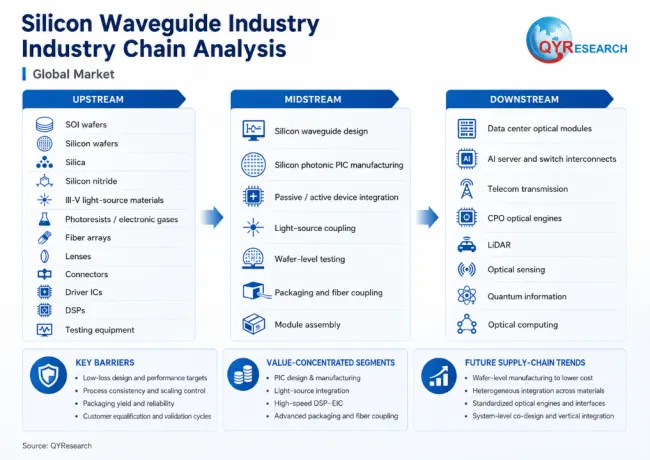
The silicon waveguide value chain includes upstream SOI wafers, silicon wafers, silica, silicon nitride, III-V light-source materials, photoresists, electronic gases, targets, metal materials, fiber arrays, lenses, isolators, connectors, package substrates, driver ICs, TIAs, DSPs, probes, and optoelectronic testing equipment. The midstream covers silicon waveguide design, silicon photonic PIC manufacturing, passive and active device integration, light-source coupling, wafer-level testing, dicing, packaging, fiber coupling, and module assembly. Downstream applications include data center optical modules, AI server and switch interconnects, telecom transmission, CPO optical engines, automotive LiDAR, medical and biosensing, industrial inspection, quantum information, and optical computing. Key barriers lie in low-loss waveguide design, process consistency, optoelectronic co-design, coupling and packaging yield, reliability validation, thermal drift control, wafer-level testing, and long customer qualification cycles. High-value segments are mainly concentrated in silicon photonic PIC design and manufacturing, light-source integration, high-speed DSP/EIC, advanced packaging, system-level optical engines, and customer validation capabilities. The supply chain is expected to evolve from traditional discrete optical component assembly toward wafer-level manufacturing, heterogeneous integration, standardized optical engines, and system-level co-design.
The report provides a detailed analysis of the market size, growth potential, and key trends for each segment. Through detailed analysis, industry players can identify profit opportunities, develop strategies for specific customer segments, and allocate resources effectively.
The Silicon Waveguide market is segmented as below:
By Company
GlobalFoundries
Tower Semiconductor
STMicroelectronics
imec
AIM Photonics
Applied Nanotools
CompoundTek
LIGENTEC
LioniX International
NTT Advanced Technology Corporation
Taiwan Semiconductor Manufacturing Company Limited
United Microelectronics Corporation
Samsung Electronics
OpenLight
Ayar Labs
Lightmatter
PsiQuantum
National Information Optoelectronics Innovation Center
Shanghai Industrial μTechnology Research Institute
Institute of Microelectronics of the Chinese Academy of Sciences
Chongqing United Microelectronics Center
Shaanxi Institute of Optoelectronic Technology Co., Ltd.
Sai MicroElectronics Inc.
Segment by Type
Strip Silicon Waveguide
Rib Silicon Waveguide
Slot Silicon Waveguide
Photonic Crystal Silicon Waveguide
Bragg Grating Silicon Waveguide
Spiral Delay Silicon Waveguide
Other
Segment by Application
Data Center Pluggable Optical Module Interconnect
AI Cluster In-Package Optical Interconnect
Switch Chip Co-Packaged Optics Interconnect
Metro and Backbone Coherent Communications
LiDAR On-Chip Beam Control
Quantum Information Photonic Circuit
Other
Each chapter of the report provides detailed information for readers to further understand the Silicon Waveguide market:
Chapter 1: Introduces the report scope of the Silicon Waveguide report, global total market size (valve, volume and price). This chapter also provides the market dynamics, latest developments of the market, the driving factors and restrictive factors of the market, the challenges and risks faced by manufacturers in the industry, and the analysis of relevant policies in the industry. (2021-2032)
Chapter 2: Detailed analysis of Silicon Waveguide manufacturers competitive landscape, price, sales and revenue market share, latest development plan, merger, and acquisition information, etc. (2021-2026)
Chapter 3: Provides the analysis of various Silicon Waveguide market segments by Type, covering the market size and development potential of each market segment, to help readers find the blue ocean market in different market segments. (2021-2032)
Chapter 4: Provides the analysis of various market segments by Application, covering the market size and development potential of each market segment, to help readers find the blue ocean market in different downstream markets.(2021-2032)
Chapter 5: Sales, revenue of Silicon Waveguide in regional level. It provides a quantitative analysis of the market size and development potential of each region and introduces the market development, future development prospects, market space, and market size of each country in the world..(2021-2032)
Chapter 6: Sales, revenue of Silicon Waveguide in country level. It provides sigmate data by Type, and by Application for each country/region.(2021-2032)
Chapter 7: Provides profiles of key players, introducing the basic situation of the main companies in the market in detail, including product sales, revenue, price, gross margin, product introduction, recent development, etc. (2021-2026)
Chapter 8: Analysis of industrial chain, including the upstream and downstream of the industry.
Chapter 9: Conclusion.
Other relevant reports of QYResearch:
Global Silicon Waveguide Market Research Report 2026
Global Silicon Waveguide Market Outlook, In‑Depth Analysis & Forecast to 2032
Global Silicon Waveguide Sales Market Report, Competitive Analysis and Regional Opportunities 2026-2032
Benefits of purchasing QYResearch report:
Competitive Analysis: QYResearch provides in-depth Silicon Waveguide competitive analysis, including information on key company profiles, new entrants, acquisitions, mergers, large market shear, opportunities, and challenges. These analyses provide clients with a comprehensive understanding of market conditions and competitive dynamics, enabling them to develop effective market strategies and maintain their competitive edge.
Industry Analysis: QYResearch provides Silicon Waveguide comprehensive industry data and trend analysis, including raw material analysis, market application analysis, product type analysis, market demand analysis, market supply analysis, downstream market analysis, and supply chain analysis.
and trend analysis. These analyses help clients understand the direction of industry development and make informed business decisions.
Market Size: QYResearch provides Silicon Waveguide market size analysis, including capacity, production, sales, production value, price, cost, and profit analysis. This data helps clients understand market size and development potential, and is an important reference for business development.

Silicon Waveguide- Global Market Share and Ranking, Overall Sales and Demand Forecast 2026-2032

Published Date: 2026-07-09

Pages: 163

Report ld: 6810060
Price:USD 3950.00
(Single User License)
Global Silicon Waveguide Market Research Report 2026
Published Date: 2026-06-19
Pages: 159
Report ld: 6810059
Price:USD 2900.00
(Single User License)
Global Silicon Waveguide Market Outlook, In‑Depth Analysis & Forecast to 2032
Published Date: 2026-06-19
Pages: 185
Report ld: 6810043
Price:USD 4900.00
(Single User License)
Global Silicon Waveguide Sales Market Report, Competitive Analysis and Regional Opportunities 2026-2032
Published Date: 2026-06-19
Pages: 158
Report ld: 6810042
Price:USD 4250.00
(Single User License)


Competition
Key players, new entrants,acquisitions, mergers and expansions,development trends and challenges.

Industry Analysis
Rawmaterial, application, product type, demand,supply,downstream, supply chain etc.

Market Size
Capacity, production, sales, revenue, price, cost etc.

Customized Information
We can offer customized survey and information to meet ourclient's need.
