Precision Planetary Reducers Research:representing a CAGR of about 7.70% during 2026–2032


Precision Planetary Reducers a High-Precision Transmission Market Driven by Humanoid Robot Industrialization and Industrial Automation Upgrades
Global Precision Planetary Reducers Industry Research Report 2026 | Promotional Research Brief
QYResearch has recently released the industry report “2026 Global Precision Planetary Reducers Market Research Report,” covering product definition, technology routes, market size, competitive landscape, application scenarios, regional structure, and value-chain changes. This brief focuses on how precision planetary reducers are evolving across industrial automation, robotics, semiconductor equipment, packaging machinery, machine tools, and humanoid robot joint actuators.
Key Research Highlights
● Humanoid Robots Create a High-Elasticity Long-Term Growth Engine
As humanoid robots move from prototype validation toward engineering development and early commercialization, demand for compact, lightweight and high-efficiency reducers in joint actuators, dexterous hands, leg drives and integrated modules is rising rapidly, creating a meaningful long-term incremental opportunity.
● Industrial Automation and Robotics Upgrades Sustain the Core Market
Industrial robots, collaborative robots, CNC machine tools, and automation production lines continue to upgrade, supporting steady volume growth for precision planetary reducers in servo-driven motion-control systems.
● Semiconductor and High-End Equipment Expansion Supports Premium Demand
Semiconductor equipment, new-energy equipment, precision packaging systems and other high-end manufacturing tools are raising requirements for low-backlash, high-rigidity, low-noise and long-life transmission components, pushing the industry toward higher-end product iteration.
● A Tiered Competitive Landscape with Strong Leading Players
European, Japanese and leading global suppliers still dominate the premium segment through precision design, quality systems and customer qualification, while Chinese and Taiwanese suppliers continue improving in cost-performance, lead time and standardized product coverage.
● Localization and Regionalized Supply Chains Are Accelerating
Driven by localization in robotics, advanced automation and semiconductor equipment, local suppliers are moving further into the mid- to high-end market, and regional capacity deployment is becoming an increasingly important source of competitiveness.
● Products Are Evolving Toward Low Backlash, Lightweight Design and Integrated Modules
Precision planetary reducers are shifting from standardized components toward integrated platform products tailored for robot joints, servo modules and dedicated automation systems, with more focus on low-backlash stability, lightweight construction, high torque density and actuator compatibility.
Market Size and Growth Trend
A precision planetary reducer is a gear reduction component used in servo-drive systems and high-precision motion-control applications. It is typically composed of a sun gear, planetary gears, ring gear, carrier, bearings, housing, and lubrication and sealing structures. Through multi-tooth meshing, it performs speed reduction, torque amplification and motion transmission. These products feature high transmission efficiency, compact structure, high torque density, low backlash, strong rigidity, fast response and strong installation adaptability, and are widely used in industrial robots, collaborative robots, humanoid robots, CNC machine tools, semiconductor equipment, packaging machinery, food processing machinery, medical devices, logistics automation and other advanced equipment. According to QYResearch, global output of precision planetary reducers reached about 6.69 million units in 2025, with an implied average selling price of around US$221 per unit.
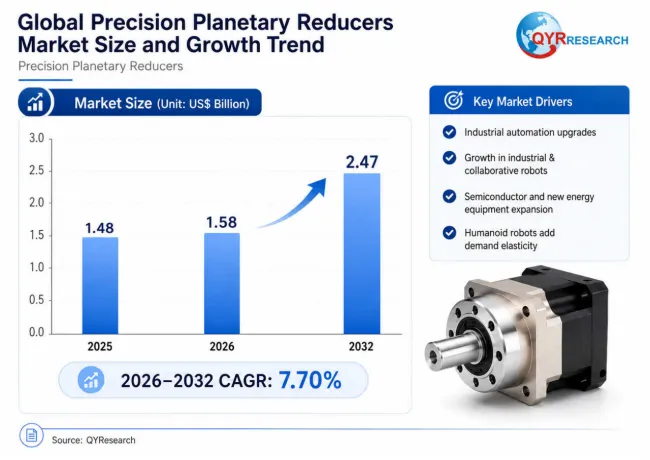
According to QYResearch, the global precision planetary reducers market size was approximately US$1.48 billion in 2025 and is expected to reach US$2.47 billion by 2032, representing a CAGR of about 7.70% during 2026–2032. The market size mainly covers precision planetary reducers used in robotics, industrial automation, semiconductor equipment, machine tools, packaging machinery, food processing machinery, medical devices, logistics automation and advanced equipment. Demand growth is mainly driven by manufacturing automation upgrades, deeper servo-system penetration, rising installations of industrial and collaborative robots, expansion of semiconductor and new-energy equipment, logistics automation investment, and expectations surrounding humanoid robot industrialization. On the supply side, leading manufacturers continue investing in lower backlash, higher torque density, lower noise, longer lifetime, lightweight design and integrated actuator compatibility.
Policy and industrial environments remain supportive as major manufacturing economies continue promoting smart manufacturing, industrial automation, robotics, semiconductor equipment and high-end equipment upgrading. At the same time, the industry still faces multiple barriers and challenges: premium products require long-term process accumulation and investment in precision equipment; customer qualification cycles in robotics and semiconductor equipment are long; price competition in the mid-range segment may pressure margins on standardized products; and key bearings, precision equipment and advanced testing resources remain subject to supply-chain volatility.
In the coming years, precision planetary reducers are expected to develop toward higher precision, lighter weight, lower noise, greater integration and more robot-specific solutions. Traditional industrial automation will continue to provide stable demand, while robotics, semiconductor equipment and intelligent logistics will support medium- to high-speed growth. Humanoid robots are likely to become an important variable in the industry’s medium- to long-term growth curve. As actuator modules evolve toward integrated “motor + reducer + encoder + drive control” solutions, suppliers with advanced process capabilities, mass-production consistency, fast delivery and proven qualification experience with robotics customers are likely to gain additional market share.
Competitive Landscape and Leading Players
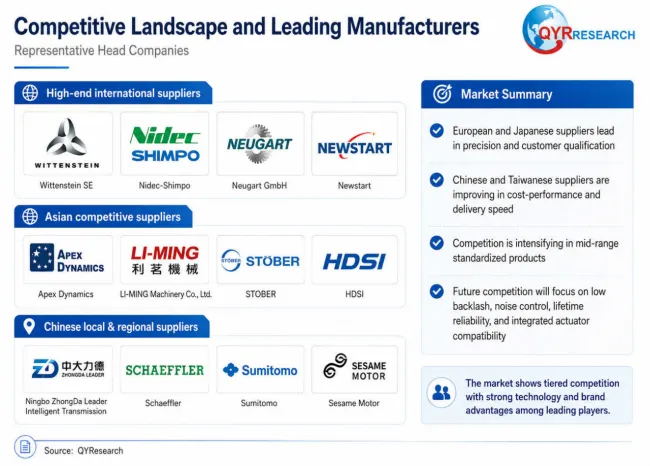
The global precision planetary reducers market features a competitive landscape in which premium segments are led by European and Japanese suppliers, while Chinese and Taiwanese suppliers are rapidly catching up and regional players continue to expand in the mid-range and value-for-money segments. Representative manufacturers include Wittenstein SE, Nidec-Shimpo, Neugart GmbH, Newstart, Apex Dynamics, LI-MING Machinery Co., Ltd., Rouist, KOFON, STOBER, HDSI, Ningbo ZhongDa Leader Intelligent Transmission, Schaeffler, LS Electric, Sesame Motor, Sumitomo, PIN HONG TECHNOLOGY, Wanshsin Seikou, Shanghai Lian Heng Precision Machinery, GAM Enterprise, and Shenzhen Zhikong Technology. Competition is increasingly shifting away from pure pricing toward low-backlash stability, noise control, lifetime validation, mass-production consistency, robot customer qualification, integrated module compatibility and global delivery capability.
Product Classification and Application Structure
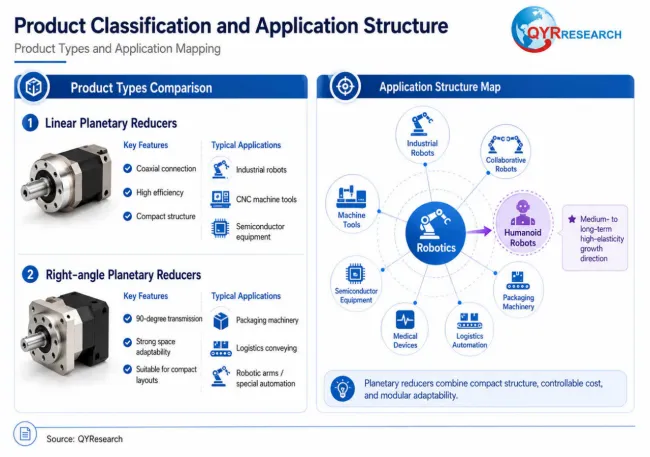
By product type, precision planetary reducers are commonly classified into inline planetary reducers and right-angle planetary reducers. Inline products offer compact structure, direct transmission paths and relatively high efficiency, making them suitable for coaxial connection with servo motors and widely used in industrial robots, collaborative robots, CNC machine tools, semiconductor equipment and automation production lines. Right-angle planetary reducers realize 90-degree transmission through bevel gears or other redirection mechanisms and are suitable for space-constrained layouts or applications requiring directional changes in power transmission, such as packaging machinery, logistics conveying, robotic arms, machine tool accessories and dedicated automation equipment. In application terms, robotics is the most strategically important direction, with industrial and collaborative robots forming the current demand base, while humanoid robots may become the most elastic incremental market over the medium to long term.
Regional Landscape and Market Opportunities
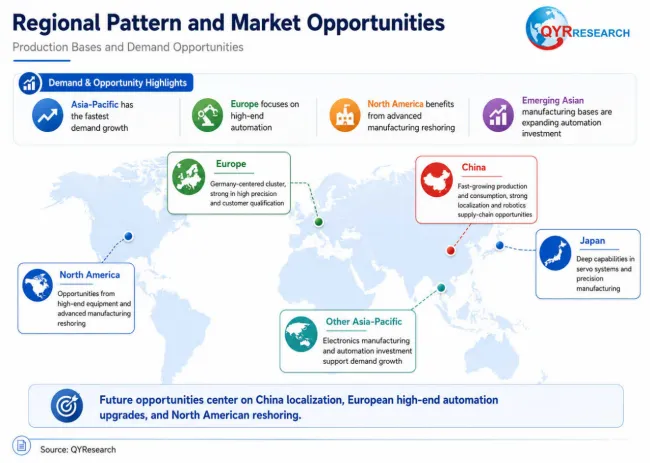
Europe, China, Japan and the broader Asia-Pacific region are the major production bases for precision planetary reducers worldwide. Europe, especially Germany, hosts high-end suppliers such as Wittenstein SE, Neugart GmbH, STOBER and Schaeffler, with strengths in precision gear design, low-backlash control, quality systems and global branding. Japan has deep capabilities in servo systems, precision machining and mechatronic integration, supported by companies such as Nidec-Shimpo, Sumitomo and HDSI. China is one of the fastest-growing production and consumption markets, driven by industrial robots, collaborative robots, semiconductor equipment, new-energy equipment, logistics automation and humanoid robot supply-chain development. Future regional opportunities are expected to center on China’s robotics localization, European high-end automation upgrades, North American advanced manufacturing reshoring, and rising automation investment in emerging Asian manufacturing bases.
Industry Chain Analysis
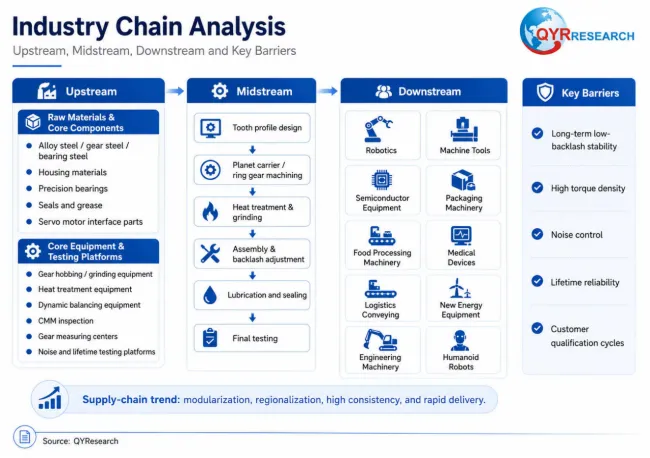
The upstream segment of the precision planetary reducers value chain includes alloy steel, gear steel, bearing steel, aluminum alloy or cast-iron housing materials, precision bearings, seals, grease, heat-treatment materials and servo motor interface parts, while also relying on core equipment such as gear hobbing machines, grinding equipment, heat-treatment systems, dynamic balancing equipment, CMM inspection tools, gear measuring centers, and noise and lifetime testing platforms. Midstream manufacturing covers tooth profile design, planet carrier processing, ring gear machining, heat treatment, grinding, assembly, backlash adjustment, lubrication and sealing, and final testing. Downstream applications include robotics, machine tools, semiconductor equipment, packaging machinery, food processing machinery, medical devices, logistics conveying, new-energy equipment, engineering machinery and humanoid robots. Key barriers are concentrated in long-term low-backlash stability, high torque density, noise control, lifetime reliability, mass-production consistency, servo-system compatibility and customer qualification cycles.
The report provides a detailed analysis of the market size, growth potential, and key trends for each segment. Through detailed analysis, industry players can identify profit opportunities, develop strategies for specific customer segments, and allocate resources effectively.
The Precision Planetary Reducer market is segmented as below:
By Company
Wittenstein SE
Nidec
Neugart GmbH
Newstart
Apex Dynamics
LI-MING Machinery Co., Ltd.
Rouist
KOFON
STOBER
HDSI
Ningbo ZhongDa Leader Intelligent Transmission
Schaeffler
LS Electric
Sesame Motor
Sumitomo
PIN HONG TECHNOLOGY
Wanshsin Seikou
Shanghai Lian Heng Precision Machinery
GAM Enterprise
Shenzhen Zhikong Technology
Segment by Type
Linear Planetary Gear Reducers
Right Angle Planetary Gear Reducers
Segment by Application
Cartesian Robots
Food Processing Machinery
Packaging Machinery
Textile, Printing Machinery
Semiconductor Equipment
Machine Tools
Aerospace
Medical Devices
Logistics Transportation
Injection Molding Machinery
Lithium Battery Equipment
Photovoltaic Equipment
Woodworking Machinery
Humanoid Robot
Others
Each chapter of the report provides detailed information for readers to further understand the Precision Planetary Reducer market:
Chapter 1: Introduces the report scope of the Precision Planetary Reducer report, global total market size (valve, volume and price). This chapter also provides the market dynamics, latest developments of the market, the driving factors and restrictive factors of the market, the challenges and risks faced by manufacturers in the industry, and the analysis of relevant policies in the industry. (2021-2032)
Chapter 2: Detailed analysis of Precision Planetary Reducer manufacturers competitive landscape, price, sales and revenue market share, latest development plan, merger, and acquisition information, etc. (2021-2026)
Chapter 3: Provides the analysis of various Precision Planetary Reducer market segments by Type, covering the market size and development potential of each market segment, to help readers find the blue ocean market in different market segments. (2021-2032)
Chapter 4: Provides the analysis of various market segments by Application, covering the market size and development potential of each market segment, to help readers find the blue ocean market in different downstream markets.(2021-2032)
Chapter 5: Sales, revenue of Precision Planetary Reducer in regional level. It provides a quantitative analysis of the market size and development potential of each region and introduces the market development, future development prospects, market space, and market size of each country in the world..(2021-2032)
Chapter 6: Sales, revenue of Precision Planetary Reducer in country level. It provides sigmate data by Type, and by Application for each country/region.(2021-2032)
Chapter 7: Provides profiles of key players, introducing the basic situation of the main companies in the market in detail, including product sales, revenue, price, gross margin, product introduction, recent development, etc. (2021-2026)
Chapter 8: Analysis of industrial chain, including the upstream and downstream of the industry.
Chapter 9: Conclusion.
Other relevant reports of QYResearch:
Global Precision Planetary Reducer Sales Market Report, Competitive Analysis and Regional Opportunities 2026-2032
Global Precision Planetary Reducer Market Research Report 2026
Global Precision Planetary Reducers Sales Market Report, Competitive Analysis and Regional Opportunities 2026-2032
Global Precision Planetary Reducers Market Research Report 2026
Precision Planetary Reducers- Global Market Share and Ranking, Overall Sales and Demand Forecast 2026-2032
Global Robot Precision Planetary Reducers Market Outlook, In‑Depth Analysis & Forecast to 2032
Global Robot Precision Planetary Reducers Sales Market Report, Competitive Analysis and Regional Opportunities 2026-2032
Global Servo Precision Planetary Reducers Market Research Report 2026
Servo Precision Planetary Reducers- Global Market Share and Ranking, Overall Sales and Demand Forecast 2026-2032
Robot Precision Planetary Reducers- Global Market Share and Ranking, Overall Sales and Demand Forecast 2026-2032
Global Robot Precision Planetary Reducers Market Research Report 2026
Global Industrial Robot Precision Planetary Reducer Market Outlook, In‑Depth Analysis & Forecast to 2032
Global Industrial Robot Precision Planetary Reducer Sales Market Report, Competitive Analysis and Regional Opportunities 2026-2032
Industrial Robot Precision Planetary Reducer- Global Market Share and Ranking, Overall Sales and Demand Forecast 2026-2032
Global Industrial Robot Precision Planetary Reducer Market Research Report 2026
Global Small Size Precision Planetary Reducer (90mm and below) Market Outlook, In‑Depth Analysis & Forecast to 2032
Global Small Size Precision Planetary Reducer (90mm and below) Sales Market Report, Competitive Analysis and Regional Opportunities 2026-2032
Small Size Precision Planetary Reducer (90mm and below)- Global Market Share and Ranking, Overall Sales and Demand Forecast 2026-2032
Global Small Size Precision Planetary Reducer (90mm and below) Market Research Report 2026
Benefits of purchasing QYResearch report:
Competitive Analysis: QYResearch provides in-depth Precision Planetary Reducer competitive analysis, including information on key company profiles, new entrants, acquisitions, mergers, large market shear, opportunities, and challenges. These analyses provide clients with a comprehensive understanding of market conditions and competitive dynamics, enabling them to develop effective market strategies and maintain their competitive edge.
Industry Analysis: QYResearch provides Precision Planetary Reducer comprehensive industry data and trend analysis, including raw material analysis, market application analysis, product type analysis, market demand analysis, market supply analysis, downstream market analysis, and supply chain analysis.
and trend analysis. These analyses help clients understand the direction of industry development and make informed business decisions.
Market Size: QYResearch provides Precision Planetary Reducer market size analysis, including capacity, production, sales, production value, price, cost, and profit analysis. This data helps clients understand market size and development potential, and is an important reference for business development.

Global Precision Planetary Reducers Sales Market Report, Competitive Analysis and Regional Opportunities 2026-2032

Published Date: 2026-01-04

Pages: 103

Report ld: 5567669
Price:USD 4250.00
(Single User License)
Global Precision Planetary Reducers Market Research Report 2026
Published Date: 2026-01-04
Pages: 153
Report ld: 5531186
Price:USD 2900.00
(Single User License)
Precision Planetary Reducers- Global Market Share and Ranking, Overall Sales and Demand Forecast 2026-2032
Published Date: 2026-01-04
Pages: 135
Report ld: 5502606
Price:USD 3950.00
(Single User License)
Precision Planetary Reducers - Global Market Share and Ranking, Overall Sales and Demand Forecast 2025-2031
Published Date: 2025-11-03
Pages: 132
Report ld: 4689911
Price:USD 3950.00
(Single User License)
Global Precision Planetary Reducers Market Outlook, In‑Depth Analysis & Forecast to 2031
Published Date: 2025-09-10
Pages: 175
Report ld: 5037737
Price:USD 4900.00
(Single User License)
Global Precision Planetary Reducers Sales Market Report, Competitive Analysis and Regional Opportunities 2025-2031
Published Date: 2025-09-10
Pages: 104
Report ld: 4689912
Price:USD 4250.00
(Single User License)


Competition
Key players, new entrants,acquisitions, mergers and expansions,development trends and challenges.

Industry Analysis
Rawmaterial, application, product type, demand,supply,downstream, supply chain etc.

Market Size
Capacity, production, sales, revenue, price, cost etc.

Customized Information
We can offer customized survey and information to meet ourclient's need.
