RV Reducer Research:expected to reach approximately US$1,389.9 million by 2032


RV Reducers: A High-Rigidity Precision Transmission Market Driven by Industrial Robots and High-End Equipment Upgrades
Global RV Reducer Industry Research Report 2026 | Promotional Research Brief
QYResearch has recently released the industry report “2026 Global RV Reducer Market Research Report”. The report studies RV reducers from the perspectives of product definition, technology route, market size, competitive landscape, application scenarios, regional structure and supply chain evolution. This brief focuses on demand changes, technology upgrades and supply chain opportunities in industrial robots, precision automation equipment, machine tool rotary axes, welding and handling systems, semiconductor equipment and new energy manufacturing equipment.
Key Research Highlights
● Industrial robot joints form a stable demand base
Industrial robots remain the largest application for RV reducers. Medium- and heavy-load robots, welding robots, handling robots and palletizing robots require high rigidity, low backlash and long service life.
● Steady market expansion driven by high-end equipment upgrades
According to QYResearch, the global RV reducer market reached approximately US$882.8 million in 2025 and is expected to reach approximately US$1,389.9 million by 2032, with a CAGR of about 5.98% during 2026–2032.
● High concentration and strong leading-player advantages
The top three players accounted for about 87% of the global market in 2025. Technology, customer certification, batch consistency, long-term reliability validation and serial delivery capability remain key barriers.
● Localization continues and Chinese suppliers accelerate penetration
Chinese manufacturers are gaining share in mid-range load segments and selected high-end applications through domestic robot demand, machining supply chains, delivery responsiveness and cost advantages.
● Products evolve toward high rigidity, long life and modular integration
RV reducers are evolving from single transmission components into key integrated units for robot joint modules and high-end equipment rotary platforms.
● Policy support and supply-chain localization strengthen long-term opportunities
Smart manufacturing, robotics, high-end CNC machine tools, new energy equipment and semiconductor equipment provide a solid demand foundation and localization opportunity for RV reducers.
● Humanoid robots are expected to become a potential medium- to long-term incremental growth market.
As humanoid robots gradually transition from experimental validation to engineering implementation and early-stage commercialization, their high-load joints are expected to place increasing demand on high-rigidity and high-precision transmission systems. RV reducers therefore have potential application opportunities in key load-bearing joints, providing new growth potential and upside for the industry.
Market Size and Growth Trend
An RV reducer is a precision reduction transmission component used in high-precision, high-torque and heavy-load rotary motion applications. It typically combines a pre-stage gear reduction mechanism with a cycloidal pinwheel transmission structure and features high rigidity, high load capacity, low backlash, strong shock resistance, smooth transmission and long service life.
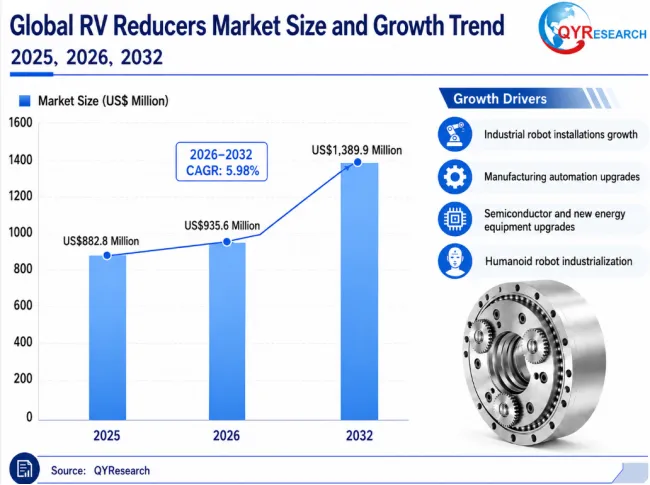
According to QYResearch, the global RV reducer market reached approximately US$882.8 million in 2025, is expected to reach about US$935.6 million in 2026 and approximately US$1,389.9 million by 2032, representing a CAGR of about 5.98% during 2026–2032. Growth is mainly driven by industrial robot installations, manufacturing automation upgrades, semiconductor and new energy equipment upgrades, and supply-chain localization among Chinese robot OEMs.
In the field of humanoid robot applications, RV reducers and harmonic drives exhibit a clear division of labor in terms of application scenarios and performance advantages. Based on different technical architectures, they jointly form the core components of robotic joint transmission systems. Harmonic drives are characterized by small size, light weight, high single-stage reduction ratio, and high motion accuracy. They are well suited for lightweight, highly flexible joints such as robot forearms, wrists, and hands, where space constraints and high-precision motion control are critical. However, their allowable torque capacity is typically limited to around 1,500 Nm, which restricts further expansion into medium- and high-load joint applications.
In contrast, RV reducers offer significantly higher torque capacity and structural rigidity, with allowable torque reaching approximately 8,000 Nm. They are therefore well suited for high-load core joints such as hips, knees, and shoulders, where strong load-bearing capability and resistance to high impact are required. However, due to their more complex structure, larger number of components, and higher manufacturing and assembly precision requirements, RV reducers are relatively heavier and bulkier. In the current development stage of humanoid robots, where lightweight design and cost control remain key priorities, large-scale adoption is still somewhat constrained, although they already show clear potential for deployment in critical load-bearing joints.
From an industry environment perspective, RV reducers continue to benefit from global trends such as manufacturing automation upgrades, robotics industry expansion, and the localization of high-end equipment and core components. In the Chinese market in particular, sustained growth in industrial robots, CNC machine tools, new energy vehicles, semiconductor equipment, and smart manufacturing provides a solid and structurally expanding demand base. At the same time, the industry is characterized by high technological and certification barriers, with long-term performance depending on gear profile accuracy, heat treatment control, assembly consistency, bearing lifespan, and overall reliability. In addition, suppliers must undergo long validation cycles with downstream robot manufacturers, creating a high entry threshold for new participants.
Looking ahead, the RV reducer industry is expected to continue evolving toward higher rigidity, higher precision, longer service life, and lighter-weight designs. Industrial robots remain the primary demand driver, with medium- and heavy-load robots, welding and handling robots, palletizing robots, and new energy manufacturing equipment contributing steady incremental demand. Meanwhile, applications such as machine tool rotary tables, positioners, and semiconductor automation equipment are expected to generate higher value-added demand. As Chinese manufacturers continue to improve process consistency, product portfolio coverage, and customer certification capabilities, the penetration of domestic RV reducers in the mid-end market is expected to increase steadily, with gradual expansion into selected high-end applications.
In the process of humanoid robot development transitioning from experimental validation to engineering implementation and early-stage commercialization, multi-degree-of-freedom joint structures place increasingly stringent requirements on high-precision, high-torque-density, and high-reliability transmission systems. As a key component in high-load joints, RV reducers are expected to be gradually adopted in load-bearing positions such as hips, knees, and shoulders, while forming a complementary relationship with harmonic drives. As humanoid robot industrialization accelerates, increasing joint counts and structural complexity are expected to further expand the long-term growth potential of RV reducers.
Overall, the global RV reducer market is expected to maintain steady growth rather than experiencing explosive expansion. Industry competition will gradually shift from capacity-driven scaling toward comprehensive capabilities, including product quality consistency, service life reliability, customer lock-in strength, technological iteration speed, and global delivery and service capabilities. Companies with strong core manufacturing expertise and long-term validated customer relationships are expected to gain a stronger competitive advantage.
Competitive Landscape and Leading Companies
The global RV reducer market remains highly concentrated. Japanese suppliers continue to hold significant advantages in high-end industrial robot main-axis joints, heavy-load applications and international robot customer systems. Nabtesco and Sumitomo Drive Technologies are representative leaders in high-end precision reduction gears.
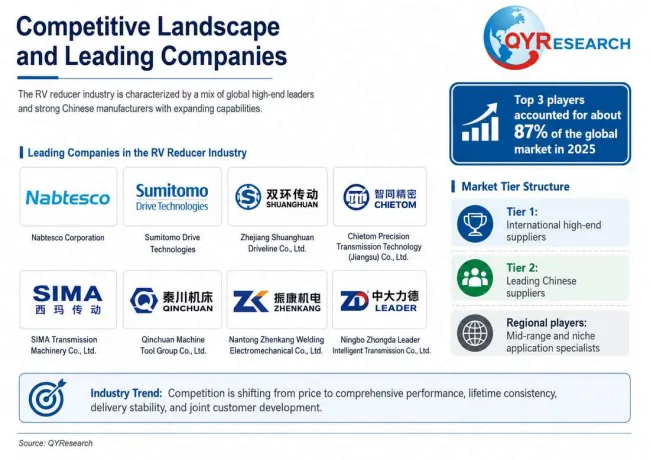
Chinese manufacturers have accelerated penetration in small- and medium-load robots, welding robots, handling robots, collaborative automation units and selected machine tool rotary platforms. Representative suppliers include Zhejiang Shuanghuan Driveline, Chietom Precision Transmission Technology, SIMA Transmission Machinery, Qinchuan Machine Tool, Nantong Zhenkang Welding Electromechanical and Ningbo Zhongda Leader Intelligent Transmission. Future competition will shift from price to comprehensive performance, lifetime consistency, delivery stability and joint customer development.
Product Classification and Application Structure
The most stable classification methods for RV reducers include structural form and rated output torque/load capacity. By structure, RV reducers can be divided into solid-shaft type, hollow-shaft type and integrated-bearing type. By load capacity, they can be grouped into small, medium, large and heavy-duty models.
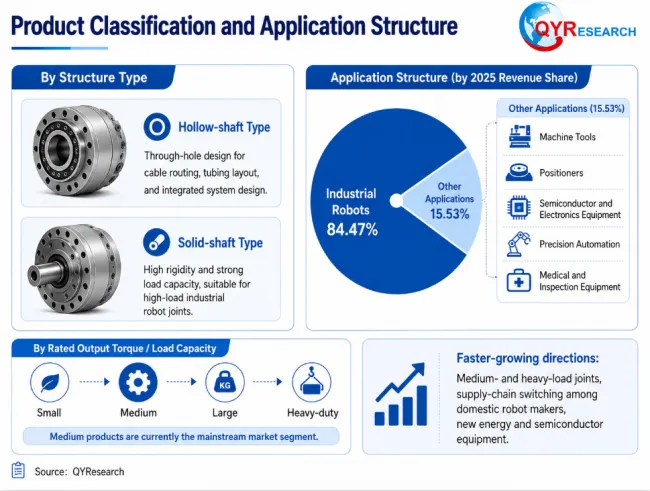
Industrial robots remain the largest application segment, accounting for approximately 84.47% of revenue in 2025. Other applications include machine tools, positioners, semiconductor and electronics equipment, precision automation, medical and inspection equipment. Faster-growing areas include medium- and heavy-load joints, robot OEM supply-chain switching, and new energy and semiconductor equipment.
Regional Landscape and Market Opportunities
Global RV reducer production is mainly concentrated in Japan and China. According to QYResearch, Japan’s RV reducer production value reached approximately US$545.0 million in 2025, accounting for about 61.74% of the global total, while China reached approximately US$330.2 million, accounting for about 37.40%.
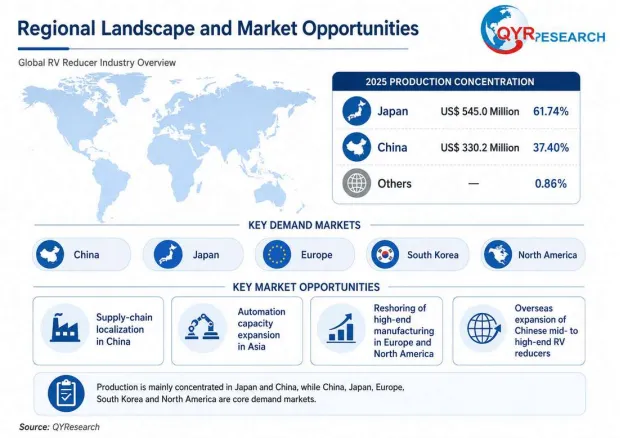
On the demand side, China, Japan, Europe, South Korea and North America are the core markets. Future regional opportunities will mainly come from Chinese supply-chain localization, automation capacity expansion in Asia, high-end manufacturing reshoring in Europe and North America, multi-sourcing strategies among robot customers, and overseas expansion of Chinese mid- to high-end RV reducers.
Industry Chain Analysis
The upstream of the RV reducer supply chain includes alloy steel, bearing steel, precision bearings, pins, crankshafts, seals, grease, heat-treatment materials, and high-precision machining and testing equipment. Midstream activities cover RV reducer design, component machining, heat treatment, precision assembly, performance testing and serial delivery. Downstream customers include industrial robot OEMs, system integrators, machine tool makers, automation equipment makers, new energy equipment makers, and semiconductor and electronics equipment makers.
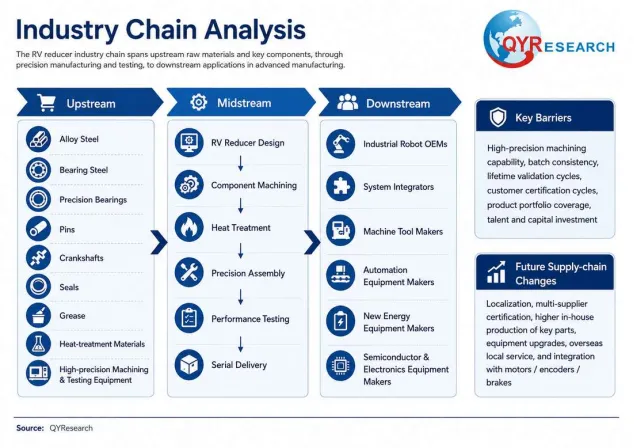
Key industry barriers include high-precision machining capability, batch consistency, lifetime validation cycles, customer certification cycles, product portfolio coverage, talent and capital investment. Future supply-chain changes will focus on localization, multi-supplier certification, higher in-house production of key parts, equipment upgrades, overseas local service, and integration with motors, encoders and brakes.
The report provides a detailed analysis of the market size, growth potential, and key trends for each segment. Through detailed analysis, industry players can identify profit opportunities, develop strategies for specific customer segments, and allocate resources effectively.
The RV Reducer market is segmented as below:
By Company
Nabtesco
Sumitomo Drive Technologies
Zhejiang Shuanghuan Driveline
Chietom Precision Transmission Technology
SIMA Transmission Machinery
Qinchuan Machine Tool
Nantong Zhenkang Welding Electromechanical
Hengfengtai Precision Machinery
Ningbo Zhongda Leader Intelligent Transmission
Segment by Type
Hollow-shaft
Solid-shaft
Segment by Application
Industrial Robot Industry
Machine Tool Industry
Semiconductor Manufacturing Equipment Industry
Humanoid robot
Other
Each chapter of the report provides detailed information for readers to further understand the RV Reducer market:
Chapter 1: Introduces the report scope of the RV Reducer report, global total market size (valve, volume and price). This chapter also provides the market dynamics, latest developments of the market, the driving factors and restrictive factors of the market, the challenges and risks faced by manufacturers in the industry, and the analysis of relevant policies in the industry. (2021-2032)
Chapter 2: Detailed analysis of RV Reducer manufacturers competitive landscape, price, sales and revenue market share, latest development plan, merger, and acquisition information, etc. (2021-2026)
Chapter 3: Provides the analysis of various RV Reducer market segments by Type, covering the market size and development potential of each market segment, to help readers find the blue ocean market in different market segments. (2021-2032)
Chapter 4: Provides the analysis of various market segments by Application, covering the market size and development potential of each market segment, to help readers find the blue ocean market in different downstream markets.(2021-2032)
Chapter 5: Sales, revenue of RV Reducer in regional level. It provides a quantitative analysis of the market size and development potential of each region and introduces the market development, future development prospects, market space, and market size of each country in the world..(2021-2032)
Chapter 6: Sales, revenue of RV Reducer in country level. It provides sigmate data by Type, and by Application for each country/region.(2021-2032)
Chapter 7: Provides profiles of key players, introducing the basic situation of the main companies in the market in detail, including product sales, revenue, price, gross margin, product introduction, recent development, etc. (2021-2026)
Chapter 8: Analysis of industrial chain, including the upstream and downstream of the industry.
Chapter 9: Conclusion.
Other relevant reports of QYResearch:
Global RV Reducer Market Outlook, In‑Depth Analysis & Forecast to 2032
Global RV Reducer Sales Market Report, Competitive Analysis and Regional Opportunities 2026-2032
Global RV Reducer Market Research Report 2026
Global Mini RV Reducer Market Outlook, In‑Depth Analysis & Forecast to 2032
Global Mini RV Reducer Sales Market Report, Competitive Analysis and Regional Opportunities 2026-2032
Global Mini RV Reducer Market Research Report 2026
Mini RV Reducer- Global Market Share and Ranking, Overall Sales and Demand Forecast 2026-2032
Robot RV Reducers- Global Market Share and Ranking, Overall Sales and Demand Forecast 2026-2032
Global Robot RV Reducers Sales Market Report, Competitive Analysis and Regional Opportunities 2026-2032
Global Robot RV Reducers Market Outlook, In‑Depth Analysis & Forecast to 2032
Global Robot RV Reducers Market Research Report 2026
Global RV Reducer Bearings Market Outlook, In‑Depth Analysis & Forecast to 2032
Global RV Reducer Bearings Sales Market Report, Competitive Analysis and Regional Opportunities 2026-2032
RV Reducer Bearings- Global Market Share and Ranking, Overall Sales and Demand Forecast 2026-2032
Global RV Reducer Bearings Market Research Report 2026
Global RV Reducer for Robot Market Research Report 2026
Hollow Type RV Reducers- Global Market Share and Ranking, Overall Sales and Demand Forecast 2026-2032
Global Hollow Type RV Reducers Market Research Report 2026
Rotate Vector (RV) Reducer- Global Market Share and Ranking, Overall Sales and Demand Forecast 2026-2032
High-Precision RV Reducers- Global Market Share and Ranking, Overall Sales and Demand Forecast 2026-2032
Benefits of purchasing QYResearch report:
Competitive Analysis: QYResearch provides in-depth RV Reducer competitive analysis, including information on key company profiles, new entrants, acquisitions, mergers, large market shear, opportunities, and challenges. These analyses provide clients with a comprehensive understanding of market conditions and competitive dynamics, enabling them to develop effective market strategies and maintain their competitive edge.
Industry Analysis: QYResearch provides RV Reducer comprehensive industry data and trend analysis, including raw material analysis, market application analysis, product type analysis, market demand analysis, market supply analysis, downstream market analysis, and supply chain analysis.
and trend analysis. These analyses help clients understand the direction of industry development and make informed business decisions.
Market Size: QYResearch provides RV Reducer market size analysis, including capacity, production, sales, production value, price, cost, and profit analysis. This data helps clients understand market size and development potential, and is an important reference for business development.

Global RV Reducer Market Outlook, In‑Depth Analysis & Forecast to 2032

Published Date: 2026-05-14

Pages: 131

Report ld: 6707665
Price:USD 4900.00
(Single User License)
Global RV Reducer Sales Market Report, Competitive Analysis and Regional Opportunities 2026-2032
Published Date: 2026-05-14
Pages: 133
Report ld: 5571417
Price:USD 4250.00
(Single User License)
RV Reducer- Global Market Share and Ranking, Overall Sales and Demand Forecast 2026-2032
Published Date: 2026-05-14
Pages: 130
Report ld: 5503672
Price:USD 3950.00
(Single User License)
Global RV Reducer Market Research Report 2026
Published Date: 2026-04-17
Pages: 104
Report ld: 5521637
Price:USD 2900.00
(Single User License)
RV Reducer - Global Market Share and Ranking, Overall Sales and Demand Forecast 2025-2031
Published Date: 2025-11-04
Pages: 114
Report ld: 4258490
Price:USD 3950.00
(Single User License)
Global RV Reducer Sales Market Report, Competitive Analysis and Regional Opportunities 2025-2031
Published Date: 2025-09-10
Pages: 95
Report ld: 4258487
Price:USD 4250.00
(Single User License)


Competition
Key players, new entrants,acquisitions, mergers and expansions,development trends and challenges.

Industry Analysis
Rawmaterial, application, product type, demand,supply,downstream, supply chain etc.

Market Size
Capacity, production, sales, revenue, price, cost etc.

Customized Information
We can offer customized survey and information to meet ourclient's need.
