QYResearch's Customized Study Helps a Client Establish an Actionable New Product Platform Plan


From "judging which technology route is more advanced" to "deciding the company's product platform for the next five years," process route selection is often one of the most complex and costliest strategic decisions for manufacturing enterprises. Technical feasibility does not equal commercial viability, and laboratory-leading performance does not guarantee stable mass production. In one customized research case, the process roadmap provided by QYResearch for a functional materials and precision manufacturing company was formally incorporated into the client's new product platform project review, and used for technology route screening, production line investment prioritization, supply chain layout, and customer validation plan design.
The client, which has long served the new energy, electronics, and industrial equipment sectors, planned to build a next-generation high-performance functional film product platform. At project initiation, the company had already formed three candidate process routes internally: solution coating, melt co-extrusion, and dry lamination.
However, different departments had significant disagreements on route selection. The R&D department focused more on product performance ceilings, the production department emphasized mass-production yield rates and compatibility with existing equipment, the procurement team was concerned about reliance on key raw materials, and the sales team hoped to quickly produce samples that could be validated by top-tier customers. Each department had its own justifications, yet they lacked a unified decision-making framework that could simultaneously answer whether the technology could be realized, whether costs were acceptable, whether customers would pay, and whether scaling risks were controllable.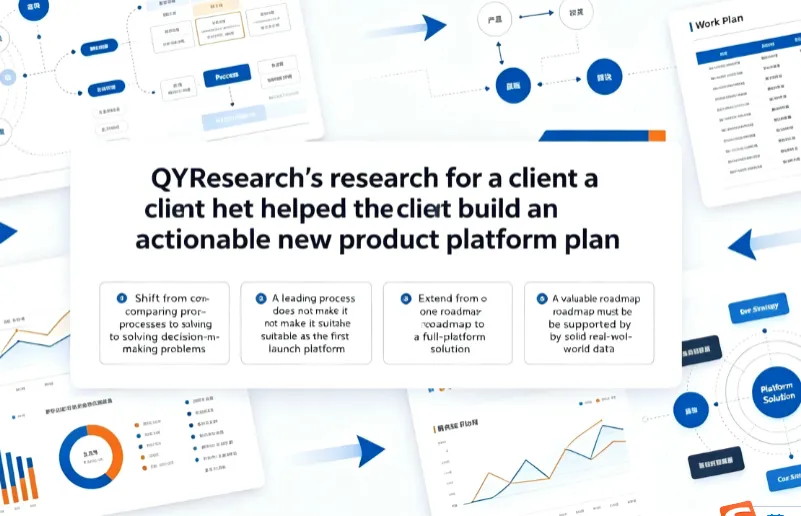
Shifting from "comparing processes" to "solving business decision-making problems"
After project initiation, QYResearch did not simply rank the three routes. Instead, it started from the client's new product strategy and business objectives, breaking the problem down into five decision-making levels.
First, what core performance characteristics must the target product meet, which indicators are customer entry barriers, and which can create differentiated premiums; second, what are the respective maturity levels of each process route at the laboratory, pilot, and mass-production stages; third, whether key equipment, raw materials, and process parameters possess stability and replicability; fourth, how unit costs, capital investment, and cash payback periods vary under different capacity utilization and yield rate conditions; and fifth, the synergy between each route and the client's existing production lines, technical teams, supply systems, and customer resources.
Throughout the research, QYResearch comprehensively leveraged industry research, industrial chain interviews, competitive product analysis, equipment and material supplier research, downstream customer demand validation, and cost modeling. A complete process roadmap was established around the candidate routes, covering "technology nodes—key parameters—equipment configuration—raw material systems—yield loss—quality control—customer certification."
For each key node, the project team further established evaluation metrics including technology readiness level, cost sensitivity, supply security, scaling risk, and customer acceptance, enabling information previously scattered across R&D, production, procurement, and sales departments to be integrated into a single analytical framework.
Leading process performance does not necessarily make it suitable as the initial launch platform
Research findings showed that while the client's most favored candidate route had advantages in certain laboratory performance indicators, its core raw material supply was highly concentrated, some key equipment required non-standard modifications, and it would likely face a lengthy yield ramp-up period in early mass production.
Another route, considered relatively traditional, did not excel in ultimate performance, but offered higher compatibility with the client's existing plant, equipment systems, and production teams, and had a more mature supply chain, enabling faster formation of stable samples and batch supply capabilities.
A third route demonstrated good long-term upgrade potential, with room for development in reducing specific material usage and improving product consistency. However, its related equipment, process controls, and downstream certification systems required further maturation, making it unsuitable as the sole new product platform in the short term.
Based on these conclusions, QYResearch did not simply provide a "first place" ranking, but rather proposed a three-tier process portfolio: "main platform, enhanced platform, and forward-looking reserve."
The main platform adopted the route with higher technology maturity and shorter customer validation cycles, prioritizing coverage of mass-scale products; the enhanced platform retained the route with higher performance ceilings for joint development with high-value-added applications and key customers; and the forward-looking reserve route was triggered by four condition categories—material substitution, equipment localization, pilot yield rates, and customer demand—with expanded investment to proceed only after these conditions were met.
Extending from a roadmap to a product platform execution plan
To ensure the research findings could be integrated into the client's actual operational processes, QYResearch delivered, alongside the process roadmap, phased capacity planning, target cost curves, a key supplier map, customer certification priorities, competitive product benchmarking matrices, and risk monitoring indicators.
During client management reviews, these research outputs were used to answer four critical questions: which production line should receive priority funding in the initial phase; which product performance characteristics are worth the company bearing higher costs for; which raw materials and equipment require early supplier lock-in or joint development; and under what conditions should the second technology platform be activated in the next two to three years.
Ultimately, the client did not adopt the original "select a single route and invest all at once" approach. Instead, it adopted a phased, scalable, and switchable product platform architecture, and adjusted equipment procurement schedules, sample development priorities, supplier collaboration scope, and key customer validation lists accordingly. The process roadmap thus ceased to be a static technical analysis document and became a management tool connecting R&D planning, capital expenditure, supply chain development, and market entry strategies.
A valuable roadmap must be able to support real decisions
This case demonstrates that a truly valuable process roadmap is not a compilation of technical data or a static ranking of different processes, but rather a framework that places technology, markets, costs, supply chains, customer needs, and the company's own capabilities within the same decision-making coordinate system.
For companies in the stages of new product development, production line upgrades, import substitution, or cross-industry entry, the core of route selection is not to find a theoretical absolute optimum, but to identify the combination plan with the highest probability of commercial success under specific timing, resources, organizational capabilities, and customer conditions.
QYResearch will continue to leverage its capabilities in specialized industry research, industrial chain investigation, competitive landscape analysis, and customized consulting, providing integrated research support around enterprise decision-making scenarios—from market opportunity identification, technology route assessment, cost and capacity estimation, to customer demand validation and commercialization pathway design.
By embedding research findings into product approval, investment review, and business decision-making processes, QYResearch is committed to helping clients reduce trial-and-error costs in technology selection and industrialization, and to improving the explainability, executability, and success rate of new product platform decisions.


Competition
Key players, new entrants,acquisitions, mergers and expansions,development trends and challenges.

Industry Analysis
Rawmaterial, application, product type, demand,supply,downstream, supply chain etc.

Market Size
Capacity, production, sales, revenue, price, cost etc.

Customized Information
We can offer customized survey and information to meet ourclient's need.