Nuclear Fuel Industry Research: growing at a CAGR of 6.8% from 2026 to 2032


QYResearch recently released an industry report titled Global Nuclear Fuel Industry Analysis. The report conducts a systematic study covering material systems, manufacturing processes, supply chain structures, market size dynamics, the competitive landscape, and regional development trends, with a specific focus on the growth of fuel demand and technological upgrade pathways amidst the expansion of nuclear power.
Nuclear fuel is a critical functional material system used to release energy in nuclear fission reactors. Typically based on uranium materials, it undergoes conversion, enrichment, forming, and assembly processes to become fuel assemblies. Its core forms include UO₂ ceramic fuel pellets, fuel rods, and fuel assembly structures, characterized by high energy density, stable fission performance, and excellent radiation resistance.
Nuclear fuel is primarily used in nuclear power generation, nuclear propulsion, and scientific research or specialized energy systems. Its function is to release nuclear fission energy in a continuous and controllable manner while ensuring long-term stable operation and safe cladding containment; it stands as one of the most critical strategic consumable materials in nuclear power plant operations.
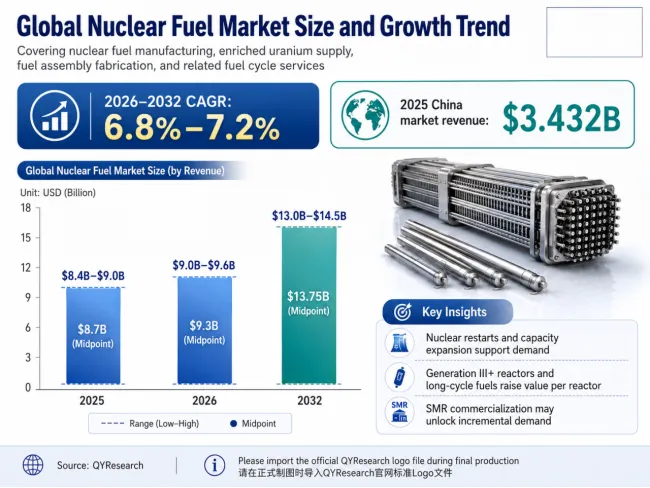
According to preliminary research by QYResearch, the global nuclear fuel market size in 2025 is estimated to be between $8.4 billion and $9.0 billion, with the Chinese market accounting for approximately $3.432 billion in sales revenue. The global market is projected to reach approximately $13.0–$14.5 billion by 2032, with a compound annual growth rate (CAGR) of about 6.8%–7.2% during the 2026–2032 period. These figures encompass nuclear fuel manufacturing, enriched uranium supply, fuel assembly fabrication, and related fuel cycle services.
Regarding demand structure, a global cycle of nuclear power restarts and capacity expansion is taking shape. As many nations advance the low-carbon transformation of their energy structures and nuclear installed capacity continues to rise, the demand for fuel assemblies is experiencing steady growth. Simultaneously, high-burnup reactor types (such as Generation III+ pressurized water reactors) and long-cycle fuel technologies are increasing the value of fuel per reactor.
On the supply side, the nuclear fuel industry is characterized by high concentration and national strategic importance. Leading enterprises are continuously strengthening their positioning regarding uranium resource control, enrichment capabilities, fuel design, and reactor compatibility, making supply chain security a core strategic issue. Future growth will be driven primarily by the construction of new nuclear units, shortened refueling cycles for aging units, and the commercialization of Small Modular Reactors (SMRs).
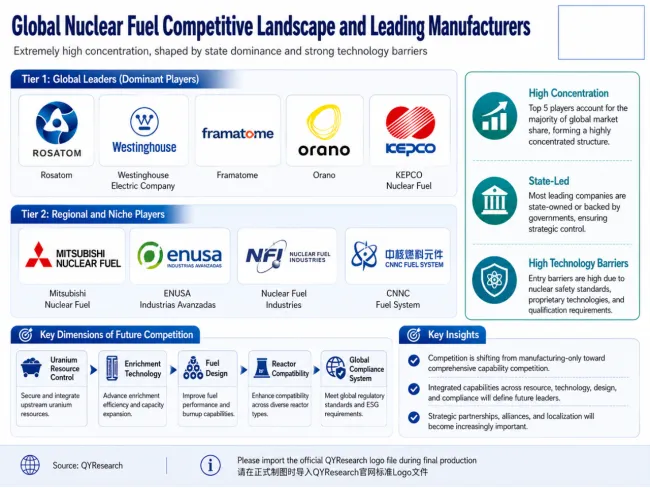
The global nuclear fuel industry is highly concentrated, characterized by state dominance and significant technological barriers. The first tier comprises Rosatom, Westinghouse Electric Company, Framatome, Orano, and KEPCO Nuclear Fuel; these companies hold dominant positions in fuel design, enrichment capabilities, and global supply networks.
The second tier includes regional suppliers such as Mitsubishi Nuclear Fuel, ENUSA Industrias Avanzadas, Nuclear Fuel Industries, and CNNC Fuel System.
Future competition will shift from a focus on manufacturing capabilities alone to a contest of comprehensive capabilities, encompassing uranium resource control, enrichment technology, fuel design, reactor compatibility, and global compliance systems.
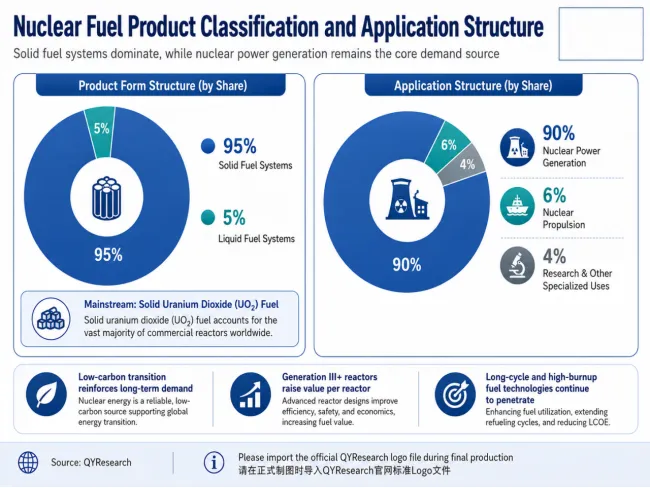
In terms of product form, nuclear fuel is primarily categorized into solid and liquid fuel systems; solid uranium dioxide (UO₂) fuel represents the mainstream application, accounting for the vast majority of the commercial reactor market.
Regarding application structure, the primary uses include nuclear power generation, nuclear propulsion, and scientific research alongside other specialized applications. Nuclear power generation serves as the core source of demand and holds a dominant position; with the global transition toward low-carbon energy accelerating, the long-term demand for this application remains highly certain.
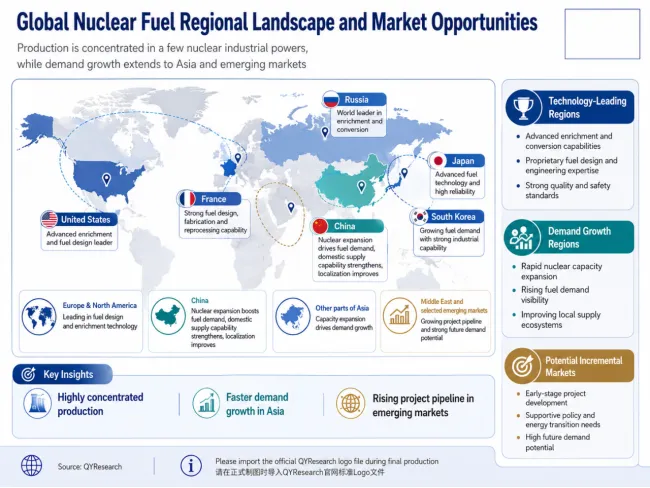
Global nuclear fuel production is highly concentrated in a few nations with advanced industrial systems, including Russia, the United States, France, Japan, South Korea, and China. While Europe and North America hold a leading edge in fuel design and enrichment technologies, Asia is experiencing more rapid growth in installed nuclear power capacity.
Amid the rapid expansion of its nuclear power sector, China has seen a steady rise in fuel demand, alongside strengthening domestic supply capabilities and an increasing localization rate across the industry chain. Driven by energy mix restructuring, the Middle East and certain emerging markets are building up a pipeline of nuclear power projects, signaling significant potential for future growth in fuel demand.
The upstream segment of the nuclear fuel industry chain primarily encompasses natural uranium mining, uranium enrichment services, and nuclear material conversion; the midstream involves fuel assembly design and manufacturing; and the downstream covers nuclear power plant operations and the application of nuclear propulsion systems. Core value within the chain is concentrated in uranium enrichment technology, fuel assembly design capabilities, and certification systems for long-term supply qualifications.
The industry is characterized by extremely high barriers to entry, shaped by nuclear safety regulations, international non-proliferation treaties, technology restrictions, and supply chain security requirements. Future development of the industry chain will trend toward diversified supply sources, safety redundancy systems, and regionalized manufacturing.
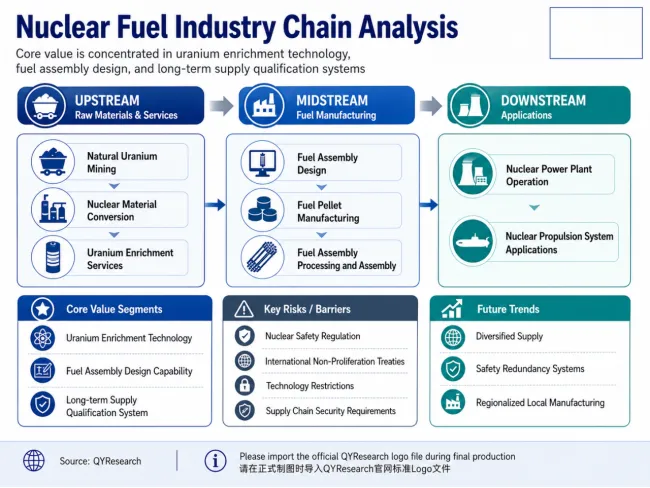
The nuclear fuel industry is heavily constrained by global nuclear safety regulations, the nuclear non-proliferation regime, and national energy policies; it faces extremely high barriers to entry and relies significantly on accumulated technical expertise, long-term certifications, and state-level support. Key risks stem from supply chain stability, the security of uranium resources, and international political factors.
Driven by the dual imperatives of global low-carbon energy transitions and energy security, the industry is poised for a clear cycle of nuclear power restarts in the coming years. Core trends will include the advancement of Small Modular Reactor (SMR) technology and the commercialization of advanced fuels—such as high-burnup and accident-tolerant fuels. Competition will increasingly concentrate among technologically leading nations and industry leaders, while regionalized supply chain systems rapidly take shape.
The report provides a detailed analysis of the market size, growth potential, and key trends for each segment. Through detailed analysis, industry players can identify profit opportunities, develop strategies for specific customer segments, and allocate resources effectively.
The Nuclear Fuel market is segmented as below:
By Company
Rosatom
KEPCO Nuclear Fuel (KNF)
Framatome
Westinghousenu Clear
Orano
Nuclear Fuel Industries,Ltd
ENUSA Industrias Avanzadas
Mitsubishi Nuclear Fuel (MNF)
CNNC Fuel System
Nuclear Fuel Complex
Segment by Type
Solid Fuel
Liquid Fuel
Segment by Application
Nuclear Power Generation
Nuclear Propulsion
Others
Each chapter of the report provides detailed information for readers to further understand the Nuclear Fuel market:
Chapter 1: Introduces the report scope of the Nuclear Fuel report, global total market size (valve, volume and price). This chapter also provides the market dynamics, latest developments of the market, the driving factors and restrictive factors of the market, the challenges and risks faced by manufacturers in the industry, and the analysis of relevant policies in the industry. (2021-2032)
Chapter 2: Detailed analysis of Nuclear Fuel manufacturers competitive landscape, price, sales and revenue market share, latest development plan, merger, and acquisition information, etc. (2021-2026)
Chapter 3: Provides the analysis of various Nuclear Fuel market segments by Type, covering the market size and development potential of each market segment, to help readers find the blue ocean market in different market segments. (2021-2032)
Chapter 4: Provides the analysis of various market segments by Application, covering the market size and development potential of each market segment, to help readers find the blue ocean market in different downstream markets.(2021-2032)
Chapter 5: Sales, revenue of Nuclear Fuel in regional level. It provides a quantitative analysis of the market size and development potential of each region and introduces the market development, future development prospects, market space, and market size of each country in the world..(2021-2032)
Chapter 6: Sales, revenue of Nuclear Fuel in country level. It provides sigmate data by Type, and by Application for each country/region.(2021-2032)
Chapter 7: Provides profiles of key players, introducing the basic situation of the main companies in the market in detail, including product sales, revenue, price, gross margin, product introduction, recent development, etc. (2021-2026)
Chapter 8: Analysis of industrial chain, including the upstream and downstream of the industry.
Chapter 9: Conclusion.
Other relevant reports of QYResearch:
Global Nuclear Fuel Market Outlook, In‑Depth Analysis & Forecast to 2032
Global Nuclear Fuel Sales Market Report, Competitive Analysis and Regional Opportunities 2026-2032
Global Nuclear Fuel Market Research Report 2026
Nuclear Fuels- Global Market Share and Ranking, Overall Sales and Demand Forecast 2026-2032
Global Nuclear Fuels Market Research Report 2026
Global Nuclear Fuel Core Market Outlook, In‑Depth Analysis & Forecast to 2032
Global Nuclear Fuel Core Sales Market Report, Competitive Analysis and Regional Opportunities 2026-2032
Global Nuclear Fuel Core Market Research Report 2026
Nuclear Fuel Core - Global Market Share and Ranking, Overall Sales and Demand Forecast 2026-2032
Nuclear Fuel Tubes- Global Market Share and Ranking, Overall Sales and Demand Forecast 2026-2032
Global Nuclear Fuel Tubes Market Research Report 2026
Global Nuclear Fuel Bundle Market Outlook, In‑Depth Analysis & Forecast to 2032
Global Nuclear Fuel Bundle Market Research Report 2026
Global Nuclear Fuel Bundle Sales Market Report, Competitive Analysis and Regional Opportunities 2026-2032
Nuclear Fuel Bundle- Global Market Share and Ranking, Overall Sales and Demand Forecast 2026-2032
Nuclear Fuel Element- Global Market Share and Ranking, Overall Sales and Demand Forecast 2026-2032
Global Nuclear Fuel Element Market Research Report 2026
Nuclear Fuel Storage- Global Market Share and Ranking, Overall Sales and Demand Forecast 2026-2032
Global Nuclear Fuel Storage Market Research Report 2026
Nuclear Fuel Handling- Global Market Share and Ranking, Overall Sales and Demand Forecast 2026-2032
Benefits of purchasing QYResearch report:
Competitive Analysis: QYResearch provides in-depth Nuclear Fuel competitive analysis, including information on key company profiles, new entrants, acquisitions, mergers, large market shear, opportunities, and challenges. These analyses provide clients with a comprehensive understanding of market conditions and competitive dynamics, enabling them to develop effective market strategies and maintain their competitive edge.
Industry Analysis: QYResearch provides Nuclear Fuel comprehensive industry data and trend analysis, including raw material analysis, market application analysis, product type analysis, market demand analysis, market supply analysis, downstream market analysis, and supply chain analysis.
and trend analysis. These analyses help clients understand the direction of industry development and make informed business decisions.
Market Size: QYResearch provides Nuclear Fuel market size analysis, including capacity, production, sales, production value, price, cost, and profit analysis. This data helps clients understand market size and development potential, and is an important reference for business development.

Global Nuclear Fuel Market Outlook, In‑Depth Analysis & Forecast to 2032

Published Date: 2026-07-05

Pages: 149

Report ld: 6138521
Price:USD 4900.00
(Single User License)
Global Nuclear Fuel Sales Market Report, Competitive Analysis and Regional Opportunities 2026-2032
Published Date: 2026-07-05
Pages: 134
Report ld: 6135923
Price:USD 4250.00
(Single User License)
Global Nuclear Fuel Market Research Report 2026
Published Date: 2026-07-05
Pages: 133
Report ld: 6133332
Price:USD 2900.00
(Single User License)
Nuclear Fuel- Global Market Share and Ranking, Overall Sales and Demand Forecast 2026-2032
Published Date: 2026-07-05
Pages: 135
Report ld: 6130752
Price:USD 3950.00
(Single User License)
Global Nuclear Fuel Sales Market Report, Competitive Analysis and Regional Opportunities 2025-2031
Published Date: 2025-12-08
Pages: 109
Report ld: 5539548
Price:USD 4250.00
(Single User License)
Global Nuclear Fuel Market Research Report 2025
Published Date: 2025-12-08
Pages: 155
Report ld: 5539544
Price:USD 2900.00
(Single User License)


Competition
Key players, new entrants,acquisitions, mergers and expansions,development trends and challenges.

Industry Analysis
Rawmaterial, application, product type, demand,supply,downstream, supply chain etc.

Market Size
Capacity, production, sales, revenue, price, cost etc.

Customized Information
We can offer customized survey and information to meet ourclient's need.
