Silicon Interposer for HBM Research:compound annual growth rate of approximately 12.26% during 2026–2032


2026 Global Silicon Interposer for HBM Market Research Report
QYResearch has recently released the industry report “2026 Global Silicon Interposer for HBM Market Research Report”, covering product definition, technology roadmap, market size, competitive landscape, application scenarios, regional structure and supply chain evolution. This article focuses on demand changes, technology evolution and supply chain opportunities in AI accelerators, high-performance computing, advanced GPUs, customized AI ASICs and high-end heterogeneous integration packages.
Industry Definition
Silicon Interposer for HBM refers to a silicon-based interconnect carrier used for 2.5D heterogeneous integration of high-bandwidth memory and logic chips. It is typically manufactured through silicon wafer processing, TSV formation, fine redistribution layers, micro-bump interconnection, deep trench capacitor integration or related passive integration technologies to form a high-density interconnect structure. The product is characterized by high I/O density, short interconnect length, low signal loss, strong power integrity and high package integration capability. Its key functions are to provide high-speed parallel interconnection, power distribution, mechanical support and thermal-mechanical coordination between logic chips such as GPUs, AI accelerators, CPUs, FPGAs and ASICs and stacked HBM devices.
This promotional research material focuses on silicon interposers and related design, manufacturing, processing and advanced packaging integration activities used for integrating HBM with high-performance logic chips. Major applications include AI training and inference accelerator cards, data center GPUs, high-performance computing processors, networking and communication ASICs, chiplet-based heterogeneous integration platforms and selected high-end FPGA and dedicated computing chips.
Market Size and Growth Trend
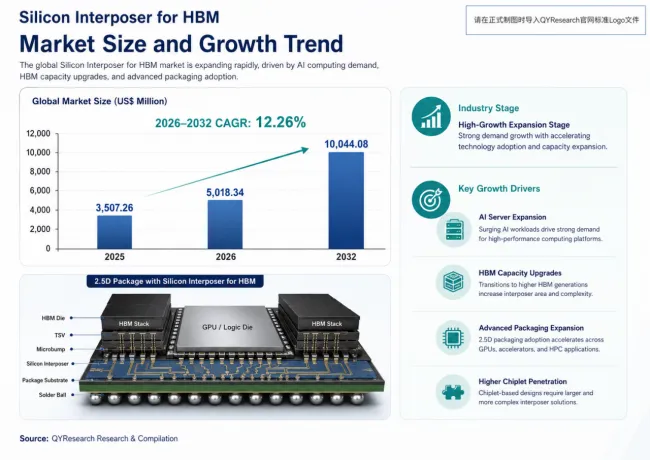
According to QYResearch’s preliminary research, the global Silicon Interposer for HBM market size was approximately US$3,507.26 million in 2025 and is expected to reach approximately US$5,018.34 million in 2026. By 2032, the market is projected to reach approximately US$10,044.08 million, representing a compound annual growth rate of approximately 12.26% during 2026–2032. The above market size mainly covers silicon interposer wafers, interposer processing, design coordination and the market value attributable to the interposer segment within advanced packaging integration for 2.5D integration of HBM and AI/HPC logic chips. From the demand side, market growth is mainly driven by AI server expansion, higher HBM stack capacity, larger GPU and ASIC package sizes, growing chiplet architecture adoption, cloud service providers’ customized AI chips and advanced packaging capacity expansion.
Competitive Landscape and Leading Vendors
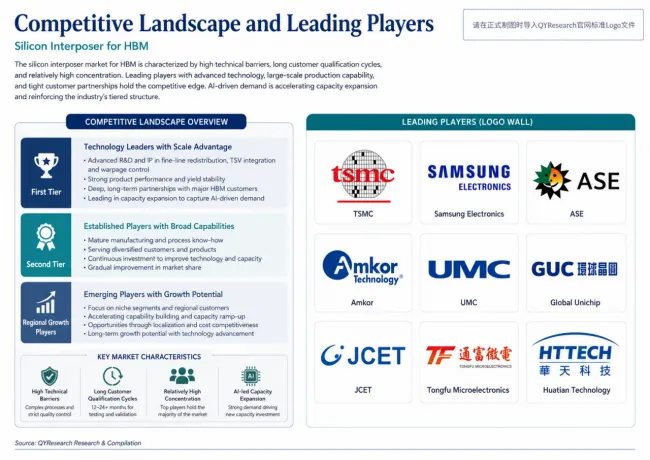
The global Silicon Interposer for HBM market is highly concentrated, technically demanding and characterized by long customer qualification cycles. Representative companies include TSMC, Samsung Electronics, ASE Technology, Amkor Technology, UMC, Global Unichip, JCET, Tongfu Microelectronics and Huatian Technology. The final company list and revenue scope will be subject to the complete report. The first tier is mainly composed of foundries and advanced packaging companies with wafer manufacturing capabilities, advanced packaging platforms, large-size silicon interposer processes and leading AI/HPC customer resources. Their advantages are concentrated in CoWoS-like platforms, 2.5D integration experience, yield control, capacity scale and co-development capabilities with GPU and ASIC customers.
Product Classification and Application Structure
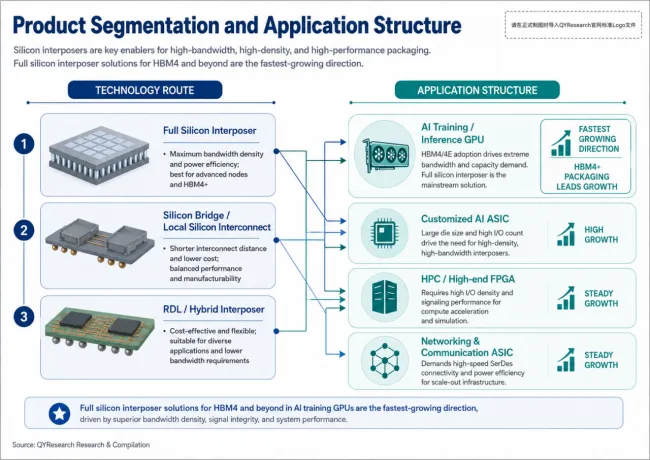
By technology route, Silicon Interposer for HBM can be categorized into full silicon interposer solutions, local silicon interconnect or silicon bridge solutions, and RDL or hybrid interposer solutions. Full silicon interposer solutions typically offer higher interconnect density and a mature foundation in high-end AI/HPC applications, making them suitable for high-bandwidth integration of GPUs, AI ASICs and multiple HBM stacks. Local silicon interconnect or silicon bridge solutions focus on high-density connection in key interconnect regions and are suitable for chiplet systems balancing cost, package area and performance. Major application scenarios include AI training and inference GPUs, cloud customized AI ASICs, HPC processors, high-end networking switch chips, data center accelerator cards and selected high-end FPGAs.
Regional Structure and Market Opportunities
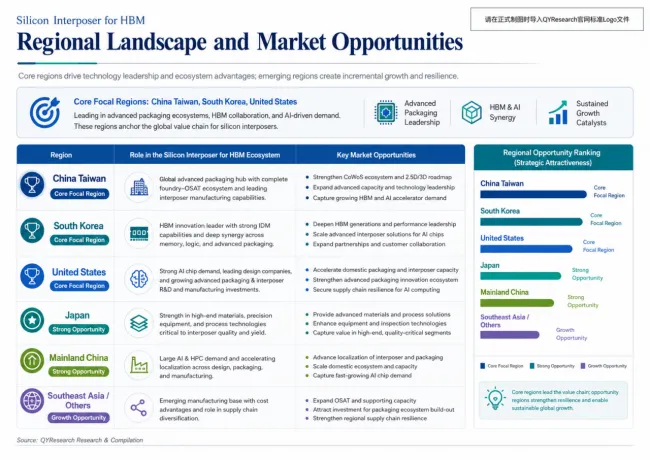
Major production capabilities for Silicon Interposer for HBM are concentrated in Taiwan, South Korea, the United States, Japan and Mainland China. Taiwan holds a central position in the high-end HBM silicon interposer market, supported by foundry manufacturing, CoWoS-like advanced packaging, AI GPU supply chains and package substrate ecosystems. South Korea is strengthening coordination from HBM to 2.5D packaging based on its memory, HBM and advanced packaging investments. The United States is increasing advanced packaging and test investment, driven by AI chip design, policy support and domestic supply chain rebuilding. Japan has strong supporting capabilities in key materials, equipment, package substrates and precision manufacturing. Mainland China is accelerating its layout in silicon interposer manufacturing, assembly and test, materials and equipment.
Industry Chain Analysis
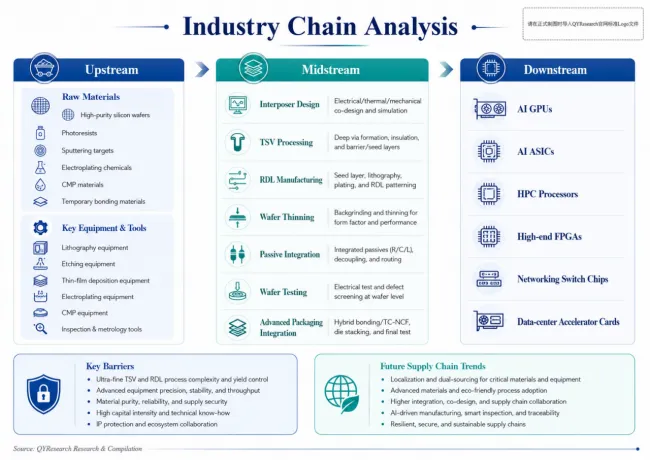
The upstream supply chain of Silicon Interposer for HBM includes high-purity silicon wafers, photoresists, sputtering targets, electroplating chemicals, CMP materials, insulating dielectrics, micro-bump materials, temporary bonding materials, cleaning chemicals, inspection consumables, and equipment for lithography, etching, thin-film deposition, electroplating, CMP, bonding, dicing, inspection and metrology. Core enabling technologies include TSV formation, deep via filling, fine RDL routing, wafer thinning, warpage control, micro-bump interconnection, power integrity design, thermal-mechanical simulation and advanced packaging co-design. The midstream includes silicon interposer design, wafer processing, TSV/RDL manufacturing, passive device integration, wafer-level testing and package integration with logic chips and HBM. Downstream applications include AI GPUs, AI ASICs, HPC processors, high-end FPGAs, networking switch chips, data center accelerator cards and supercomputing systems.
Policies, Barriers, Challenges and Outlook
Policy environments in major semiconductor economies increasingly support advanced packaging, AI chips, HBM, chiplets and high-performance computing, with policy focus extending from front-end wafer manufacturing to packaging, testing, materials, equipment and design collaboration. Technical barriers include TSV aspect ratio control, fine-line capability, yield stability, large-size interposer warpage control, power integrity design, thermal-mechanical reliability, HBM stack coordination and customer system validation. Industry challenges include tight advanced packaging capacity, long equipment lead times, material supply stability, package substrate coordination, competition from alternative technologies, cost reduction pressure and geopolitical supply chain risks.
In the coming years, demand for Silicon Interposer for HBM is expected to continue growing around AI computing expansion, higher HBM capacity, larger advanced package sizes and broader chiplet architecture adoption. Technology upgrades will focus on larger interposers, higher-density RDL, compatibility with higher HBM stack counts, stronger power integrity, lower-loss interconnects, higher-yield TSV processes, deep trench capacitor integration and coordination with silicon photonics, chiplets and advanced substrates.
The report provides a detailed analysis of the market size, growth potential, and key trends for each segment. Through detailed analysis, industry players can identify profit opportunities, develop strategies for specific customer segments, and allocate resources effectively.
The Silicon Interposer for HBM market is segmented as below:
By Company
TSMC
Samsung Electronics
Segment by Type
Single Logic Die
Dual Logic Die
Three-Or-More Logic Dies
Segment by Application
AI Accelerator
Graphics Processing Unit
Programmable Logic Device
Network Switch and Router Chip
General High-Performance Computing Processor
Each chapter of the report provides detailed information for readers to further understand the Silicon Interposer for HBM market:
Chapter 1: Introduces the report scope of the Silicon Interposer for HBM report, global total market size (valve, volume and price). This chapter also provides the market dynamics, latest developments of the market, the driving factors and restrictive factors of the market, the challenges and risks faced by manufacturers in the industry, and the analysis of relevant policies in the industry. (2021-2032)
Chapter 2: Detailed analysis of Silicon Interposer for HBM manufacturers competitive landscape, price, sales and revenue market share, latest development plan, merger, and acquisition information, etc. (2021-2026)
Chapter 3: Provides the analysis of various Silicon Interposer for HBM market segments by Type, covering the market size and development potential of each market segment, to help readers find the blue ocean market in different market segments. (2021-2032)
Chapter 4: Provides the analysis of various market segments by Application, covering the market size and development potential of each market segment, to help readers find the blue ocean market in different downstream markets.(2021-2032)
Chapter 5: Sales, revenue of Silicon Interposer for HBM in regional level. It provides a quantitative analysis of the market size and development potential of each region and introduces the market development, future development prospects, market space, and market size of each country in the world..(2021-2032)
Chapter 6: Sales, revenue of Silicon Interposer for HBM in country level. It provides sigmate data by Type, and by Application for each country/region.(2021-2032)
Chapter 7: Provides profiles of key players, introducing the basic situation of the main companies in the market in detail, including product sales, revenue, price, gross margin, product introduction, recent development, etc. (2021-2026)
Chapter 8: Analysis of industrial chain, including the upstream and downstream of the industry.
Chapter 9: Conclusion.
Other relevant reports of QYResearch:
Global Silicon Interposer for HBM Market Outlook, In‑Depth Analysis & Forecast to 2032
Global Silicon Interposer for HBM Sales Market Report, Competitive Analysis and Regional Opportunities 2026-2032
Global Silicon Interposer for HBM Market Research Report 2026
Benefits of purchasing QYResearch report:
Competitive Analysis: QYResearch provides in-depth Silicon Interposer for HBM competitive analysis, including information on key company profiles, new entrants, acquisitions, mergers, large market shear, opportunities, and challenges. These analyses provide clients with a comprehensive understanding of market conditions and competitive dynamics, enabling them to develop effective market strategies and maintain their competitive edge.
Industry Analysis: QYResearch provides Silicon Interposer for HBM comprehensive industry data and trend analysis, including raw material analysis, market application analysis, product type analysis, market demand analysis, market supply analysis, downstream market analysis, and supply chain analysis.
and trend analysis. These analyses help clients understand the direction of industry development and make informed business decisions.
Market Size: QYResearch provides Silicon Interposer for HBM market size analysis, including capacity, production, sales, production value, price, cost, and profit analysis. This data helps clients understand market size and development potential, and is an important reference for business development.

Silicon Interposer for HBM- Global Market Share and Ranking, Overall Sales and Demand Forecast 2026-2032

Published Date: 2026-07-09

Pages: 123

Report ld: 6605111
Price:USD 3950.00
(Single User License)
Global Silicon Interposer for HBM Market Outlook, In‑Depth Analysis & Forecast to 2032
Published Date: 2026-05-20
Pages: 127
Report ld: 6605110
Price:USD 4900.00
(Single User License)
Global Silicon Interposer for HBM Sales Market Report, Competitive Analysis and Regional Opportunities 2026-2032
Published Date: 2026-05-20
Pages: 121
Report ld: 6605109
Price:USD 4250.00
(Single User License)
Global Silicon Interposer for HBM Market Research Report 2026
Published Date: 2026-05-20
Pages: 121
Report ld: 6605108
Price:USD 2900.00
(Single User License)


Competition
Key players, new entrants,acquisitions, mergers and expansions,development trends and challenges.

Industry Analysis
Rawmaterial, application, product type, demand,supply,downstream, supply chain etc.

Market Size
Capacity, production, sales, revenue, price, cost etc.

Customized Information
We can offer customized survey and information to meet ourclient's need.
