Server Memory Module Research:compound annual growth rate of approximately 23.51% during 2026–2032


2026 Global Server Memory Module Industry Research Report
QYResearch has recently released the industry report 2026 Global Server Memory Module Industry Research Report, focusing on product definition, technology routes, market size, competitive landscape, application scenarios, regional structure, and supply chain changes of server memory modules. This summary highlights demand evolution, technology upgrades, and supply chain opportunities for server memory modules used in cloud data centers, AI servers, high-performance computing, database servers, and enterprise computing platforms.
Industry Definition
Server Memory Modules in this report focus on registered and buffered memory modules used in enterprise servers, data center servers, high-performance computing platforms, and mission-critical business systems. These modules are typically based on DDR4, DDR5, and next-generation high-capacity DRAM devices, integrating registers, clock drivers, power management ICs, SPD, temperature sensors, ECC functions, and high-reliability PCB designs to support signal buffering, capacity expansion, stable operation, and data integrity. RDIMM modules use a register between the memory controller and DRAM chips to improve signal stability and support higher server memory capacities, making them widely used in enterprise servers and data-center platforms.
Their core functions include increasing memory capacity per server, improving stability under high workloads, reducing signal integrity pressure on the memory controller, and supporting reliable operation through ECC, thermal management, platform certification, and long-life supply. As CPU core counts, AI model sizes, and memory bandwidth requirements continue to rise, server memory modules are evolving from standard capacity-expansion components into key hardware elements that directly influence server performance, power consumption, total cost of ownership, and deployment efficiency.
Market Expansion and Demand Evolution
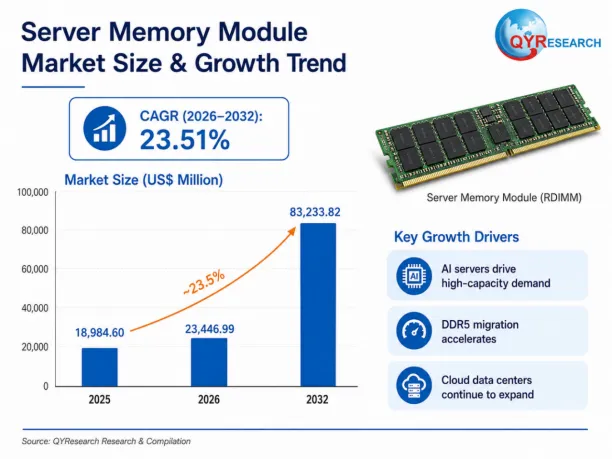
According to QYResearch’s preliminary research, the global Server Memory Module market size is estimated at approximately US$18,984.60 million in 2025 and approximately US$23,446.99 million in 2026. It is expected to reach approximately US$83,233.82 million by 2032, with a compound annual growth rate of approximately 23.51% during 2026–2032. The market scope mainly covers RDIMM, LRDIMM, MRDIMM and other registered or buffered server main memory modules for enterprise servers, cloud data centers, AI/HPC servers, database servers, and high-end workstation platforms. From the demand side, market growth is mainly driven by AI server cluster expansion, higher memory capacity per general-purpose server, DDR5 replacement of DDR4 platforms, increased capital expenditure by cloud service providers, database and virtualization workload upgrades, and rising penetration of high-capacity memory modules. From the supply side, leading suppliers are investing in advanced DRAM nodes, high-capacity 3DS/TSV packaging, 256GB and above RDIMM products, MRDIMM high-bandwidth solutions, joint platform validation, and long-term supply arrangements with global customers. According to WSTS, the global semiconductor market is projected to reach US$772 billion in 2025, with growth mainly driven by logic and memory, and is forecast to approach US$975 billion in 2026, with memory and logic continuing to lead growth. Overall, the industry is in a high-growth cycle driven by AI infrastructure, and future incremental demand will mainly come from AI inference servers, cloud data center refresh cycles, enterprise private AI deployments, memory-intensive databases, and high-performance computing platforms.
Competitive Landscape
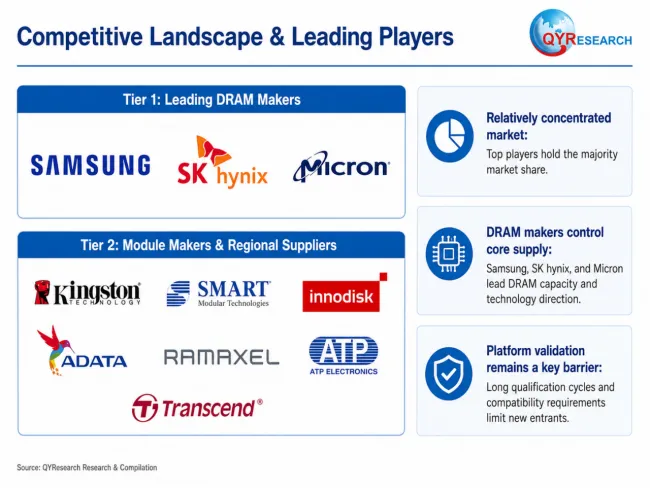
The global Server Memory Module market is characterized by a structure in which DRAM manufacturers dominate core supply, specialized module makers serve diversified customer needs, and server platform vendors jointly shape certification barriers. The first tier includes Samsung Electronics, SK hynix, and Micron, which have integrated strengths in DRAM devices, server-grade memory product definition, advanced process technology, high-capacity stacked packaging, platform validation, and global hyperscale customer resources. Samsung describes RDIMM as a server memory module using a register to buffer command and address signals, improving stability and supporting higher memory capacity platforms. Micron has announced that it had sampled 256GB DDR5 RDIMM modules to key server ecosystem partners, using 1-gamma DRAM and 3DS/TSV packaging to improve capacity, speed, and power efficiency for next-generation AI systems. SK hynix completed data center certification for a 256GB DDR5 RDIMM on the Intel Xeon 6 platform, showing the importance of high-capacity server memory validation and ecosystem collaboration. The second tier includes Kingston, SMART Modular Technologies, Innodisk, ATP Electronics, Transcend, ADATA, Ramaxel, and other server memory module suppliers, whose competitive strengths lie in stable BOM control, compatibility testing, industrial or embedded customer service, regional channels, and customized delivery. Future competition will shift from capacity and price toward advanced process technology, module density, power efficiency, platform certification, supply assurance, AI server customer engagement, and system-level memory solutions.
Product Classification and Application Structure
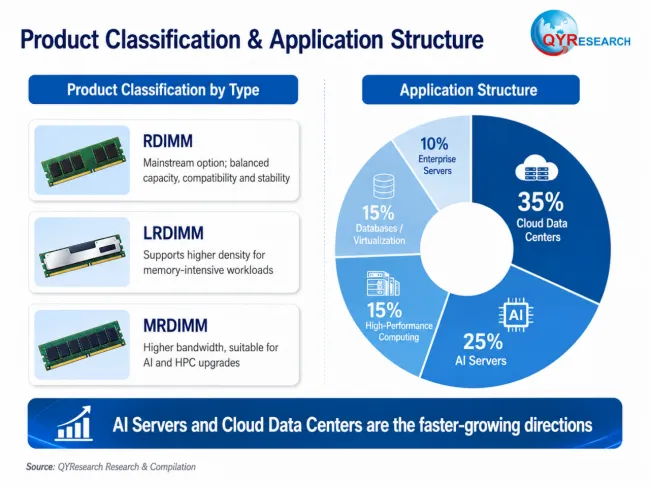
Based on the most common and stable industry classification, server memory modules can be categorized by product form into RDIMM, LRDIMM, and MRDIMM. RDIMM remains the most widely adopted registered server memory module for mainstream enterprise servers, cloud servers, database servers, and high-end workstations, offering a balanced combination of capacity, compatibility, reliability, and cost. LRDIMM further reduces electrical load on the memory controller and is suitable for very large memory capacity scenarios such as large databases, in-memory computing, virtualization clusters, and selected high-end enterprise platforms. MRDIMM targets higher bandwidth and higher capacity requirements, making it more suitable for AI inference, high-performance computing, and bandwidth-sensitive server platforms, and is expected to become an important upgrade path for premium server memory. By application, key demand areas include cloud data center servers, AI training and inference servers, HPC systems, enterprise database and ERP systems, financial and telecom core systems, virtualization and private cloud platforms, high-end workstations, and network storage devices. Faster-growing segments are concentrated in AI servers, hyperscale cloud data centers, and memory-intensive database platforms, where higher memory capacity per server, DDR5 platform transition, and rising adoption of high-capacity modules are the most direct growth drivers.
Regional Structure and Market Opportunities
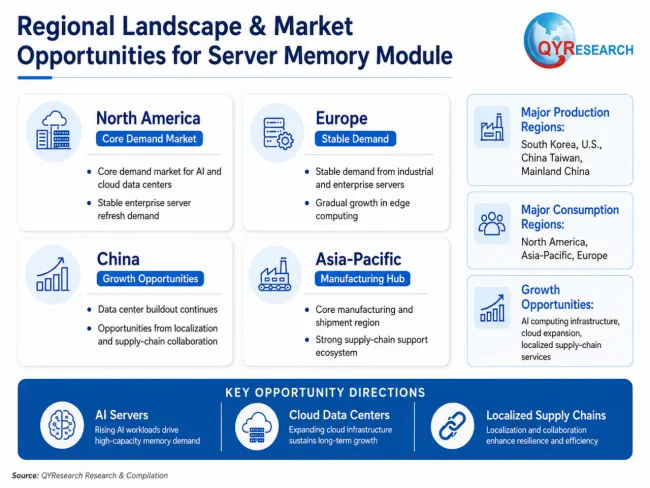
From a production and supply chain perspective, the upstream DRAM supply base for server memory modules is highly concentrated in South Korea, the United States, Japan, China Taiwan, and selected supporting segments in Mainland China. Module design, assembly, validation, server OEM/ODM collaboration, and channel services are distributed across Mainland China, China Taiwan, South Korea, the United States, Southeast Asia, and Europe. South Korean and U.S. suppliers have strong influence in advanced DRAM process technology, high-capacity server memory, and supply to major cloud customers. China Taiwan plays an important role in server motherboard, ODM manufacturing, and cloud server supply chain coordination. Mainland China has large demand from cloud computing, telecom operators, internet platforms, government and enterprise servers, and AI computing infrastructure, while also creating opportunities in domestic server ecosystems, data center construction, and supply chain security. North America remains one of the most important high-end consumption markets, driven by hyperscale cloud providers, AI infrastructure operators, and HPC customers. Asia-Pacific has both manufacturing and consumption attributes and is a key region for server memory module shipment, system assembly, and customer validation. Europe and Japan place stronger emphasis on reliability, data compliance, industrial servers, and long-term supply. Future regional opportunities will center on AI data center expansion in North America, cloud infrastructure upgrades in China and Asia-Pacific, global server OEM/ODM supply chain realignment, and localized certification and service capabilities for high-capacity DDR5 and next-generation server platforms.
Supply Chain Analysis
The upstream of the Server Memory Module industry mainly includes DRAM wafers, advanced DRAM devices, PCB substrates, register and clock driver ICs, PMICs, SPD EEPROMs, temperature sensors, passive components, connector materials, and testing consumables. DRAM devices represent the highest-value and most supply-constrained part of the chain. Core equipment and technologies include advanced memory wafer fabrication, lithography, thin-film deposition, etching, packaging, TSV/3DS stacking, module SMT, automated optical inspection, burn-in testing, signal integrity testing, and platform compatibility validation. The midstream covers server memory module design, module manufacturing, firmware and SPD configuration, BOM locking, quality testing, platform certification, and customer qualification. Downstream users include cloud service providers, AI computing centers, server OEM/ODM vendors, enterprise data centers, telecom operators, financial institutions, research organizations, and high-end workstation users. Key industry barriers include access to advanced DRAM supply, high-capacity module design capability, platform validation cycles, customer certification, reliability testing, long-life supply capability, and supply chain bargaining power. Future supply chain changes will revolve around AI customer priority allocation, accelerated DDR5 high-capacity module replacement, regionalized manufacturing and validation, memory-platform co-design, and higher value allocation to high-bandwidth and low-power module solutions.
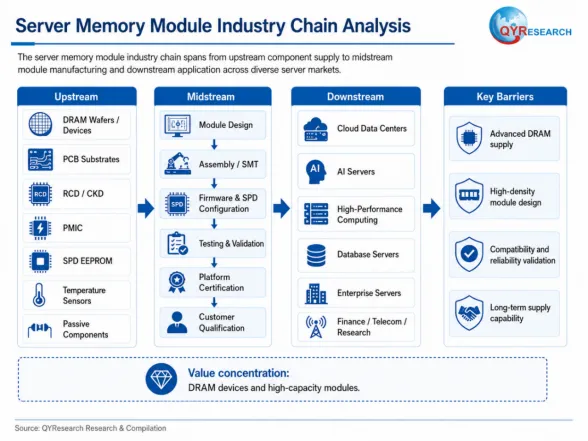
Policies, Barriers, Challenges, Drivers, and Outlook
Major economies continue to support semiconductors, data centers, AI infrastructure, and high-performance computing, increasing strategic attention on the memory and server hardware supply chain. Major barriers include high capital requirements for advanced DRAM nodes, long development cycles for high-capacity modules, strict server platform certification, long customer qualification timelines, demanding reliability and consistency testing, and hyperscale customers’ requirements for stable supply and long-term pricing mechanisms. Key challenges include DRAM supply-demand cyclicality, capacity allocation pressure between HBM and server DDR5, supply risks for materials and key ICs, concentrated customer bargaining power, rapid price fluctuation, inventory risks caused by technology transitions, and potential substitution from CXL memory expansion, server-oriented LPDDR, and new memory architectures.
In the coming years, the Server Memory Module market is expected to maintain a high-growth trajectory, driven by AI training and inference deployment, cloud infrastructure upgrades, rising CPU core counts, database and virtualization workload expansion, enterprise private AI server adoption, and high-capacity DDR5 platform penetration. Technology upgrades will focus on higher module capacity, faster transfer rates, lower power consumption, stronger signal integrity, higher reliability, MRDIMM and other high-bandwidth memory module formats, and deeper optimization with server CPUs, motherboards, BIOS, and thermal systems. DRAM manufacturers will continue to dominate high-end products and hyperscale customer resources, while specialized module makers will retain opportunities in regional markets, long-life customers, industrial servers, and customized services. Overall, Server Memory Modules are evolving from standard server components into strategic hardware for AI data centers, cloud infrastructure, and enterprise core computing platforms.
The report provides a detailed analysis of the market size, growth potential, and key trends for each segment. Through detailed analysis, industry players can identify profit opportunities, develop strategies for specific customer segments, and allocate resources effectively.
The Server Memory Module market is segmented as below:
By Company
Micron Technology, Inc.
Kingston Technology Company, Inc.
Netlist, Inc.
Wilk Elektronik S.A. / GOODRAM
ATP Electronics, Inc.
Viking Technology
SMART Modular Technologies
ADTEC Corporation
Century Micro Inc.
Samsung Electronics Co., Ltd.
SK hynix Inc.
Innodisk Corporation
Apacer Technology Inc.
ADATA Technology Co., Ltd.
Advantech Co., Ltd.
Longsys Electronics Co., Ltd. / FORESEE
Shenzhen Tigo Semiconductor Co., Ltd. / Kimtigo
BIWIN STORAGE TECHNOLOGY CO., LTD.
Segment by Type
8GB–32GB
48GB–64GB
96GB–128GB
192GB–256GB
Segment by Application
Enterprise General-Purpose Server
Cloud Data Center Server
AI and High-Performance Computing Server
Edge and Telecom Infrastructure Server
Industrial and Mission-Critical Server
Each chapter of the report provides detailed information for readers to further understand the Server Memory Module market:
Chapter 1: Introduces the report scope of the Server Memory Module report, global total market size (valve, volume and price). This chapter also provides the market dynamics, latest developments of the market, the driving factors and restrictive factors of the market, the challenges and risks faced by manufacturers in the industry, and the analysis of relevant policies in the industry. (2021-2032)
Chapter 2: Detailed analysis of Server Memory Module manufacturers competitive landscape, price, sales and revenue market share, latest development plan, merger, and acquisition information, etc. (2021-2026)
Chapter 3: Provides the analysis of various Server Memory Module market segments by Type, covering the market size and development potential of each market segment, to help readers find the blue ocean market in different market segments. (2021-2032)
Chapter 4: Provides the analysis of various market segments by Application, covering the market size and development potential of each market segment, to help readers find the blue ocean market in different downstream markets.(2021-2032)
Chapter 5: Sales, revenue of Server Memory Module in regional level. It provides a quantitative analysis of the market size and development potential of each region and introduces the market development, future development prospects, market space, and market size of each country in the world..(2021-2032)
Chapter 6: Sales, revenue of Server Memory Module in country level. It provides sigmate data by Type, and by Application for each country/region.(2021-2032)
Chapter 7: Provides profiles of key players, introducing the basic situation of the main companies in the market in detail, including product sales, revenue, price, gross margin, product introduction, recent development, etc. (2021-2026)
Chapter 8: Analysis of industrial chain, including the upstream and downstream of the industry.
Chapter 9: Conclusion.
Other relevant reports of QYResearch:
Global Server Memory Module Market Outlook, In‑Depth Analysis & Forecast to 2032
Global Server Memory Module Sales Market Report, Competitive Analysis and Regional Opportunities 2026-2032
Global Server Memory Module Market Research Report 2026
ECC Registered Server Memory Module- Global Market Share and Ranking, Overall Sales and Demand Forecast 2026-2032
Global ECC Registered Server Memory Module Market Outlook, In‑Depth Analysis & Forecast to 2032
Global ECC Registered Server Memory Module Market Research Report 2026
Global ECC Registered Server Memory Module Sales Market Report, Competitive Analysis and Regional Opportunities 2026-2032
Benefits of purchasing QYResearch report:
Competitive Analysis: QYResearch provides in-depth Server Memory Module competitive analysis, including information on key company profiles, new entrants, acquisitions, mergers, large market shear, opportunities, and challenges. These analyses provide clients with a comprehensive understanding of market conditions and competitive dynamics, enabling them to develop effective market strategies and maintain their competitive edge.
Industry Analysis: QYResearch provides Server Memory Module comprehensive industry data and trend analysis, including raw material analysis, market application analysis, product type analysis, market demand analysis, market supply analysis, downstream market analysis, and supply chain analysis.
and trend analysis. These analyses help clients understand the direction of industry development and make informed business decisions.
Market Size: QYResearch provides Server Memory Module market size analysis, including capacity, production, sales, production value, price, cost, and profit analysis. This data helps clients understand market size and development potential, and is an important reference for business development.

Server Memory Module- Global Market Share and Ranking, Overall Sales and Demand Forecast 2026-2032

Published Date: 2026-07-09

Pages: 151

Report ld: 6694593
Price:USD 3950.00
(Single User License)
Global Server Memory Module Market Outlook, In‑Depth Analysis & Forecast to 2032
Published Date: 2026-04-28
Pages: 174
Report ld: 6694597
Price:USD 4900.00
(Single User License)
Global Server Memory Module Sales Market Report, Competitive Analysis and Regional Opportunities 2026-2032
Published Date: 2026-04-28
Pages: 148
Report ld: 6694595
Price:USD 4250.00
(Single User License)
Global Server Memory Module Market Research Report 2026
Published Date: 2026-04-28
Pages: 148
Report ld: 6694594
Price:USD 2900.00
(Single User License)


Competition
Key players, new entrants,acquisitions, mergers and expansions,development trends and challenges.

Industry Analysis
Rawmaterial, application, product type, demand,supply,downstream, supply chain etc.

Market Size
Capacity, production, sales, revenue, price, cost etc.

Customized Information
We can offer customized survey and information to meet ourclient's need.
