g/i-Line Photoresists for Advanced Packaging Research:CAGR of 5.9% during 2026-2032


Product Definition
g/i-Line Photoresists for Advanced Packaging are thick-film photoresists used in key advanced packaging processes such as semiconductor bumping, redistribution layers (RDL) and through-silicon vias (TSV). They are patterned under ultraviolet exposure at g-line or i-line wavelengths. With the ability to process relatively thick films, from several micrometers to tens of micrometers, while maintaining high resolution, these photoresists meet the requirements of high-density interconnects in advanced packaging.
Industry Characteristics
1. Demand is closely linked to the expansion of advanced packaging
g/i-Line Photoresists for Advanced Packaging mainly serve wafer-level packaging, flip-chip packaging, fan-out packaging, redistribution layers, copper pillars, micro-bumps and MEMS processes. As AI chips, high-performance computing, 5G communications, automotive chips and high-end consumer electronics require higher packaging performance, demand for g/i-Line Photoresists for Advanced Packaging is also increasing.
2. Product performance focuses on thick-film patterning capability and packaging process compatibility
Many patterns in advanced packaging need to withstand electroplating, development, cleaning and subsequent heating. Therefore, photoresists require good thick-film uniformity, adhesion, sidewall profile and chemical resistance. Compared with high-end front-end photoresists, g/i-Line Photoresists for Advanced Packaging place greater emphasis on packaging process compatibility and mass-production stability.
3. High barriers to customer adoption
g/i-Line Photoresists for Advanced Packaging need to match customers’ exposure tools, coating and development equipment, electroplating processes, substrate materials and packaging structures. Before adoption, they usually go through formulation adaptation, small-batch trials, reliability validation and mass-production stability evaluation. Once downstream customers enter mass production, they usually do not frequently change suppliers, making industry supply relationships relatively stable.
Market Scale
Reasons for Historical Changes in Market Size:
In the past, g/i-Line Photoresists for Advanced Packaging were mainly driven by the development of wafer-level packaging, flip-chip packaging, redistribution layers and bumping processes. As packaging upgrades continued in smartphones, communications, automotive electronics and high-performance chips, the packaging process required more patterning steps, gradually increasing demand for thick-film photoresists and electroplating photoresists. Market fluctuations mainly came from semiconductor cycles, packaging capacity expansion schedules and changes in consumer electronics shipments.
Reasons for Future Changes in Market Size:
Future market growth will mainly come from high-end packaging demand for AI chips, HBM, Chiplet, 2.5D and 3D packaging. g/i-Line Photoresists for Advanced Packaging still have advantages in mature equipment platforms, controllable costs and suitability for thick-film patterning. Future products will place greater emphasis on thick-film uniformity, electroplating resistance, low residue and mass-production stability, and the value share of high-end packaging products is expected to continue increasing.
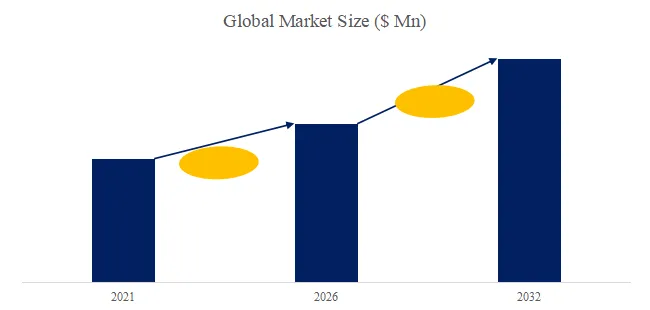
According to QYResearch Electronics and Semiconductors Research Center, the global g/i-Line Photoresists for Advanced Packaging market will reach US$ 228 million by the end of 2032, growing at a CAGR of 5.9% during 2026-2032.
Figure00001. Global g/i-Line Photoresists for Advanced Packaging Market Size (US$ Million), 2021-2032
Above data is based on report from QYResearch Electronics and Semiconductors Research Center. If you need the latest data, plaese contact QYResearch.
Industry Chain Overview
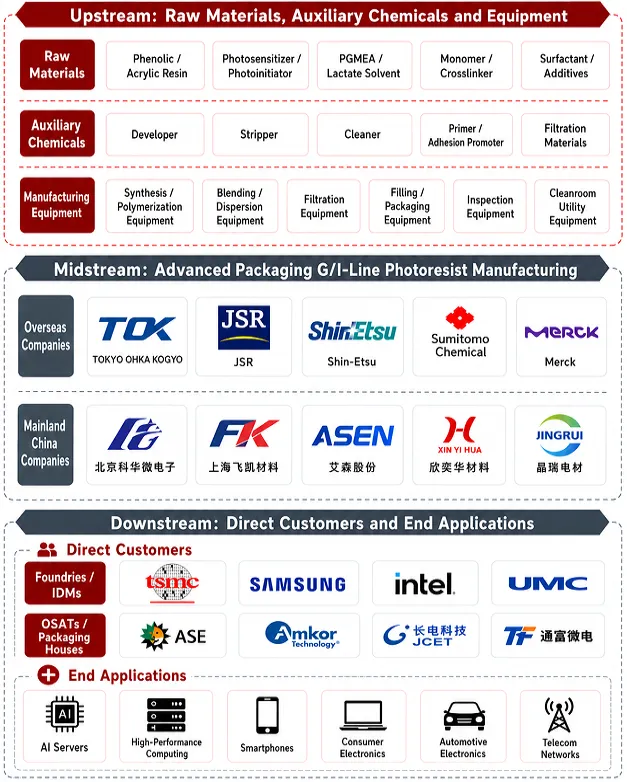
Upstream: Upstream materials mainly include novolac resins, photosensitizers, solvents, additives, adhesion promoters and filtration materials. The purity, particle control and batch stability of upstream materials directly affect photoresist performance, so supplier quality control requirements are high.
Midstream: The midstream consists of photoresist producers, mainly responsible for resin design, formulation development, dissolution and mixing, filtration, filling, testing and customer process validation. Core capabilities include thick-film formation, pattern control, low residue, electroplating resistance and mass-production stability.
Downstream: Products are used in bumping, copper pillars, redistribution layers, TSV, fan-out packaging, sensor packaging and microstructure processing. End applications include AI chips, servers, smartphones, communication equipment, automotive electronics, industrial control and consumer electronics.
Figure00002. g/i-Line Photoresists for Advanced Packaging, Value Chain Analysis
Above data is based on report from QYResearch Electronics and Semiconductors Research Center.
Competitive Landscape
The g/i-Line Photoresists for Advanced Packaging industry includes participants from Japan, the United States and China, but the high-end market is still led by international high-end suppliers. TOK, Shin-Etsu, JSR, Qnity and other companies have deep experience in photoresist technology, customer qualification and global supply, and can cover a complete product portfolio from traditional g/i-line materials to more advanced exposure materials. China-based manufacturers have accelerated their development of i-line, g-line and packaging photoresists in recent years, but still need to accumulate more experience in high-end packaging customer qualification, batch stability and long-term mass production.
Figure00003. Global g/i-Line Photoresists for Advanced Packaging Major Players
|
Region |
Company |
Product History and Market Position |
|
Japan |
Tokyo Ohka Kogyo |
OK is a leading Japanese photoresist supplier and entered the semiconductor photoresist business in 1968. The company has a relatively complete g-line and i-line photoresist portfolio, covering positive, negative, thick-film, high-sensitivity and highly reflective substrate applications. It has long served semiconductor and MEMS customers and is an important supplier in the g/i-Line Photoresists for Advanced. |
|
Japan |
JSR |
JSR has long experience in the photoresist industry. Its advanced packaging products are mainly represented by THB thick-film photoresists, focusing on metal plating, bumping, copper pillars and RDL processes. It is a representative global supplier of g/i-Line Photoresists for Advanced Packaging. |
|
United States |
Qnity |
Qnity carries forward the former DuPont Electronics materials business. Its advanced packaging photoresists cover liquid resists, dry film resists, positive and negative systems, and can be used in wafer-level packaging, 3D packaging, bumping and RDL applications. With a complete product portfolio, it is one of the global leading suppliers. |
|
Japan |
Shin-Etsu |
Shin-Etsu’s photoresist portfolio covers i-line, KrF, ArF, EUV and other product types. With a strong foundation in semiconductor materials, supported by capabilities in high-purity chemicals, resins and electronic materials, the company is highly recognized by advanced packaging and wafer manufacturing customers and is an important company in the global photoresist supply system. |
|
Japan |
Sumitomo Chemical |
Sumitomo Chemical has a broad photoresist portfolio, and its i-line products can be adapted to various applications. Its thick-film photoresists have been used in semiconductor device packaging processes. It is an international supplier with strong overall capabilities and a stable customer base. |
|
China |
Kempur |
Kempur was established in 2004 and is one of the earlier China-based companies to promote photoresist industrialization. Its products cover integrated circuits, advanced packaging and MEMS applications, making it a key company to watch in China’s g/i-line photoresist field. |
Source: QYResearch Electronics and Semiconductors Research Center.
Prospects
As demand for AI chips, HBM, Chiplet and high-performance computing chips increases, packaging processes such as redistribution layers, bumping, electroplating and thick-film patterning will expand, driving steady growth in demand for g/i-Line Photoresists for Advanced Packaging. Packaging manufacturers will increasingly require materials with higher stability, fewer defects and wider process windows, which will raise reliance on leading suppliers.
At the same time, capacity expansion in China’s advanced packaging sector and supply chain security requirements will accelerate the adoption of China-based material suppliers, although high-end customer qualification cycles remain long and international companies are expected to maintain a strong advantage in the near term. Overall, the industry will grow steadily as advanced packaging expands from high-end chips into broader applications, while high-end thick-film packaging photoresists will become a key direction for value improvement.
The report provides a detailed analysis of the market size, growth potential, and key trends for each segment. Through detailed analysis, industry players can identify profit opportunities, develop strategies for specific customer segments, and allocate resources effectively.
The g/i-Line Photoresists for Advanced Packaging market is segmented as below:
By Company
Tokyo Ohka Kogyo
JSR
Qnity
Shin-Etsu
KemLab
Sumitomo Chemical
Merck KGaA
Kempur
PhiChem
Aisen
SINEVA
Crystal Clear Electronic Material
Segment by Type
Positive Photoresists
Negative Photoresists
Segment by Application
Bumping
Redistribution Layer (RDL)
Through-Silicon Via (TSV)
Others
Each chapter of the report provides detailed information for readers to further understand the g/i-Line Photoresists for Advanced Packaging market:
Chapter 1: Introduces the report scope of the g/i-Line Photoresists for Advanced Packaging report, global total market size (valve, volume and price). This chapter also provides the market dynamics, latest developments of the market, the driving factors and restrictive factors of the market, the challenges and risks faced by manufacturers in the industry, and the analysis of relevant policies in the industry. (2021-2032)
Chapter 2: Detailed analysis of g/i-Line Photoresists for Advanced Packaging manufacturers competitive landscape, price, sales and revenue market share, latest development plan, merger, and acquisition information, etc. (2021-2026)
Chapter 3: Provides the analysis of various g/i-Line Photoresists for Advanced Packaging market segments by Type, covering the market size and development potential of each market segment, to help readers find the blue ocean market in different market segments. (2021-2032)
Chapter 4: Provides the analysis of various market segments by Application, covering the market size and development potential of each market segment, to help readers find the blue ocean market in different downstream markets.(2021-2032)
Chapter 5: Sales, revenue of g/i-Line Photoresists for Advanced Packaging in regional level. It provides a quantitative analysis of the market size and development potential of each region and introduces the market development, future development prospects, market space, and market size of each country in the world..(2021-2032)
Chapter 6: Sales, revenue of g/i-Line Photoresists for Advanced Packaging in country level. It provides sigmate data by Type, and by Application for each country/region.(2021-2032)
Chapter 7: Provides profiles of key players, introducing the basic situation of the main companies in the market in detail, including product sales, revenue, price, gross margin, product introduction, recent development, etc. (2021-2026)
Chapter 8: Analysis of industrial chain, including the upstream and downstream of the industry.
Chapter 9: Conclusion.
Other relevant reports of QYResearch:
Global g/i-Line Photoresists for Advanced Packaging Market Outlook, In‑Depth Analysis & Forecast to 2032
Global g/i-Line Photoresists for Advanced Packaging Market Research Report 2026
Global g/i-Line Photoresists for Advanced Packaging Sales Market Report, Competitive Analysis and Regional Opportunities 2026-2032
Benefits of purchasing QYResearch report:
Competitive Analysis: QYResearch provides in-depth g/i-Line Photoresists for Advanced Packaging competitive analysis, including information on key company profiles, new entrants, acquisitions, mergers, large market shear, opportunities, and challenges. These analyses provide clients with a comprehensive understanding of market conditions and competitive dynamics, enabling them to develop effective market strategies and maintain their competitive edge.
Industry Analysis: QYResearch provides g/i-Line Photoresists for Advanced Packaging comprehensive industry data and trend analysis, including raw material analysis, market application analysis, product type analysis, market demand analysis, market supply analysis, downstream market analysis, and supply chain analysis.
and trend analysis. These analyses help clients understand the direction of industry development and make informed business decisions.
Market Size: QYResearch provides g/i-Line Photoresists for Advanced Packaging market size analysis, including capacity, production, sales, production value, price, cost, and profit analysis. This data helps clients understand market size and development potential, and is an important reference for business development.

g/i-Line Photoresists for Advanced Packaging- Global Market Share and Ranking, Overall Sales and Demand Forecast 2026-2032

Published Date: 2026-07-09

Pages: 141

Report ld: 6696509
Price:USD 3950.00
(Single User License)
Global g/i-Line Photoresists for Advanced Packaging Market Outlook, In‑Depth Analysis & Forecast to 2032
Published Date: 2026-04-28
Pages: 168
Report ld: 6696511
Price:USD 4900.00
(Single User License)
Global g/i-Line Photoresists for Advanced Packaging Market Research Report 2026
Published Date: 2026-04-28
Pages: 136
Report ld: 6696510
Price:USD 2900.00
(Single User License)
Global g/i-Line Photoresists for Advanced Packaging Sales Market Report, Competitive Analysis and Regional Opportunities 2026-2032
Published Date: 2026-04-28
Pages: 144
Report ld: 6696507
Price:USD 4250.00
(Single User License)


Competition
Key players, new entrants,acquisitions, mergers and expansions,development trends and challenges.

Industry Analysis
Rawmaterial, application, product type, demand,supply,downstream, supply chain etc.

Market Size
Capacity, production, sales, revenue, price, cost etc.

Customized Information
We can offer customized survey and information to meet ourclient's need.
