Global Electricity-free Cooling Materials Market Forecast: 89.45 Million USD by 2026 – Entering a New Growth Phase


Electricity-free Cooling Materials Market Summary
Electricity-free Cooling Materials are innovative substances designed to reduce temperatures without the use of energy or active cooling systems. These materials work by reflecting sunlight and radiating heat away from the surface in the form of infrared radiation, which escapes into space. They typically have high solar reflectance and high thermal emittance properties, enabling them to maintain cooler temperatures even under direct sunlight. Applications include cooling buildings, vehicles, and electronic devices, potentially leading to significant energy savings and reduced reliance on air conditioning. These materials contribute to sustainable cooling solutions and help mitigate the urban heat island effect and global warming.
According to the new market research report “Global Electricity-free Cooling Materials Market Report 2024-2030”, published by QYResearch, the global Electricity-free Cooling Materials market size is projected to reach USD 106.64 million by 2030, at a CAGR of 28.8% during the forecast period.
Figure. Global Electricity-free Cooling Materials Market Size (US$ Million), 2019-2030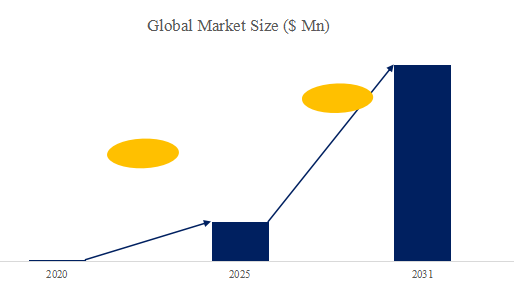
Above data is based on report from QYResearch: Global Electricity-free Cooling Materials Market Report 2024-2030 (published in 2024). If you need the latest data, plaese contact QYResearch.
Figure. Global Electricity-free Cooling Materials Top 10 Players Ranking and Market Share (Ranking is based on the revenue of 2024, continually updated)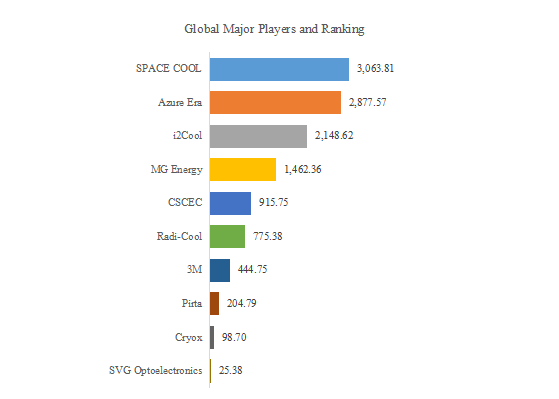
Above data is based on report from QYResearch: Global Electricity-free Cooling Materials Market Report 2024-2030 (published in 2024). If you need the latest data, plaese contact QYResearch.
According to QYResearch Top Players Research Center, the global key manufacturers of Electricity-free Cooling Materials include SPACE COOL, Azure Era, etc. In 2024, the global top three players had a share approximately 59.0% in terms of revenue.
In terms of product type, currently Membranes is the largest segment, hold a share of 65.3%.
In terms of product application, currently Construction Industry is the largest segment, hold a share of 38.5%.
Market Drivers:
Energy-saving and emission-reduction policy push: National and local carbon-reduction pathways—covering building-sector efficiency upgrades, industrial energy-saving mandates, and public procurement with low-carbon criteria—are increasingly translating into funded retrofit programs, performance-based requirements, and incentive mechanisms that accelerate adoption of passive radiative cooling across roofs, façades, and temperature-sensitive facilities.
Structural growth in cooling demand: Rising temperatures, longer cooling seasons, and broader air-conditioning penetration increase the addressable market for “cooling capacity without electricity,” especially in hot and fast-urbanizing regions.
Peak-load pressure and energy-system resilience: Utilities and large facility owners prioritize measures that shave peak demand and stabilize indoor conditions during heat events or outages; passive radiative cooling strengthens resilience without adding operational complexity.
Building energy codes and envelope performance specifications: More jurisdictions and large owners specify roof/facade thermal performance (cool surfaces, reflectance/emittance, Cryox-type metrics), directly pulling radiative cooling solutions into design standards and procurement lists.
Massive roof and facade retrofit opportunity: Existing buildings dominate floor area; roofs and exterior envelopes offer repeatable, scalable retrofit surfaces with high solar exposure, enabling volume deployment beyond new construction.
Durability, weathering, and anti-soiling performance improvements: Better UV stability, abrasion resistance, and soiling mitigation reduce real-world performance decay, enabling longer warranties and accelerating adoption by risk-sensitive owners and insurers.
Urban heat-island mitigation and public-sector programs: Cities, campuses, and infrastructure operators increasingly fund heat mitigation initiatives, creating steady demand via public procurement, pilot-to-rollout pathways, and standardized tender language.
Value-chain differentiation and premium product positioning: For manufacturers of roofing membranes, façade systems, films, coatings, and textiles, radiative cooling enables higher-performance SKUs, stronger branding, and access to green-building and resilience-led projects.
Restraint:
Limited market understanding continues to slow adoption:
As an emerging passive thermal-management approach, Electricity-free Cooling Materials still face an incomplete “awareness–understanding–trust” cycle in end markets. Many owners, designers, and procurement teams still treat these solutions as conventional reflective cool coatings or insulation auxiliaries, overlooking the core mechanism—net heat rejection via mid-infrared emission through the atmospheric window, which can deliver more stable cooling benefits under specific conditions. This conceptual confusion reduces decision efficiency during project evaluation, material selection, and system integration, ultimately delaying scaled deployment.
Immature supply chain limits large-scale delivery capability:
The sector is still transitioning from pilot-scale to mass production. Uncertainties remain in stable sourcing of key functional-layer inputs, robustness of critical process windows, and quality-control systems across multiple form factors (films, coatings, textiles, etc.). Under harsh environments—high salinity, high humidity/heat, intense UV, and abrasion—consistency and lifetime verification are not yet sufficiently standardized, which can weaken delivery certainty and customer confidence in demanding applications.
Lack of standardized frameworks hampers policy embedding and engineering conversion:
The market still lacks unified technical standards and evaluation frameworks tailored to passive radiative cooling. As a result, test methods, energy-savings quantification, acceptance criteria, and product grading systems vary widely, with many companies relying on proprietary or proxy metrics. This fragmentation makes it harder to embed radiative cooling into green-building ratings, subsidy programs, and carbon-accounting mechanisms, reducing conversion efficiency in policy-driven procurement.
Unclear business models weaken value monetization and financing support:
Today, most deployments rely on one-time material procurement or custom integrated solutions, without a mature commercialization model aligned with long-term energy savings. The absence of replicable benefit-sharing mechanisms and auditable performance quantification models makes it difficult for investors to evaluate long-term value through a “savings → cash flow → assetization” lens. If ESG claims cannot be translated into verifiable energy and carbon metrics, the willingness of financial capital to participate also weakens.
About QYResearch
QYResearch founded in California, USA in 2007.It is a leading global market research and consulting company. With over 17 years’ experience and professional research team in various cities over the world QY Research focuses on management consulting, database and seminar services, IPO consulting, industry chain research and customized research to help our clients in providing non-linear revenue model and make them successful. We are globally recognized for our expansive portfolio of services, good corporate citizenship, and our strong commitment to sustainability. Up to now, we have cooperated with more than 60,000 clients across five continents. Let’s work closely with you and build a bold and better future.
QYResearch is a world-renowned large-scale consulting company. The industry covers various high-tech industry chain market segments, spanning the semiconductor industry chain (semiconductor equipment and parts, semiconductor materials, ICs, Foundry, packaging and testing, discrete devices, sensors, optoelectronic devices), photovoltaic industry chain (equipment, cells, modules, auxiliary material brackets, inverters, power station terminals), new energy automobile industry chain (batteries and materials, auto parts, batteries, motors, electronic control, automotive semiconductors, etc.), communication industry chain (communication system equipment, terminal equipment, electronic components, RF front-end, optical modules, 4G/5G/6G, broadband, IoT, digital economy, AI), advanced materials industry Chain (metal materials, polymer materials, ceramic materials, nano materials, etc.), machinery manufacturing industry chain (CNC machine tools, construction machinery, electrical machinery, 3C automation, industrial robots, lasers, industrial control, drones), food, beverages and pharmaceuticals, medical equipment, agriculture, etc.

Global Electricity-free Cooling Materials Market Outlook, In‑Depth Analysis & Forecast to 2032

Published Date: 2026-08-29

Pages: 176

Report ld: 6205075
Price:USD 4900.00
(Single User License)
Global Electricity-free Cooling Materials Market Research Report 2026
Published Date: 2026-08-29
Pages: 153
Report ld: 5552243
Price:USD 2900.00
(Single User License)
Electricity-free Cooling Materials- Global Market Share and Ranking, Overall Sales and Demand Forecast 2026-2032
Published Date: 2026-08-29
Pages: 154
Report ld: 5552242
Price:USD 3950.00
(Single User License)
Global Electricity-free Cooling Materials Sales Market Report, Competitive Analysis and Regional Opportunities 2026-2032
Published Date: 2026-08-29
Pages: 146
Report ld: 5552240
Price:USD 4250.00
(Single User License)
Electricity-free Cooling Materials - Global Market Share and Ranking, Overall Sales and Demand Forecast 2025-2031
Published Date: 2025-04-10
Pages: 98
Report ld: 4704671
Price:USD 3950.00
(Single User License)
Global Electricity-free Cooling Materials Market Insights, Forecast to 2031
Published Date: 2025-04-10
Pages: 139
Report ld: 4704670
Price:USD 4900.00
(Single User License)


Competition
Key players, new entrants,acquisitions, mergers and expansions,development trends and challenges.

Industry Analysis
Rawmaterial, application, product type, demand,supply,downstream, supply chain etc.

Market Size
Capacity, production, sales, revenue, price, cost etc.

Customized Information
We can offer customized survey and information to meet ourclient's need.
