Ethernet Switch ICs Market Set to Hit 5854 Million USD by 2026 – What Industry Leaders Are Doing Differently


Ethernet Switch ICs Market Summary
Ethernet Switch ICs are integrated circuits designed to manage the routing and switching of Ethernet network traffic. These chips are integral components of Ethernet switches, which connect multiple network devices and ensure efficient data transmission between them. Ethernet Switch ICs operate by receiving incoming data packets, analyzing their destination addresses, and forwarding them to the appropriate output ports. This process minimizes network congestion and improves overall performance by ensuring data is only sent to its intended recipient. They support various speeds, such as 1GbE, 10GbE, 25GbE, 100GbE, and beyond, catering to different network needs from small office setups to large-scale data centers. Additionally, these ICs offer advanced features including Quality of Service (QoS) for traffic prioritization, VLAN support for network segmentation, and traffic management capabilities like packet buffering. They are essential in enhancing the efficiency and scalability of network infrastructures, providing reliable connectivity and high-speed data handling across diverse applications, including enterprise networks, data centers, and home networks.
The global Ethernet Switch ICs market continues to evolve as data infrastructure becomes increasingly central to cloud computing, AI acceleration, and hyperscale networking. According to the latest study, the market reached USD 4.86 billion in 2024 and is expected to increase to USD 8.37 billion by 2031, representing a CAGR of 7.26%. This expansion is closely aligned with the global demand for higher-speed Ethernet—from 25G/100G to 200G/400G and even 800G switch architectures—driven by AI clusters, edge computing, 5G deployments, and enterprise digital transformation. The market, historically dominated by <25G and 25G–100G devices, is now undergoing a profound shift toward higher-speed categories, fundamentally reshaping revenue distribution and competitive dynamics across the industry.
Figure. Global Ethernet Switch ICs Market Size (US$ million), 2025-2031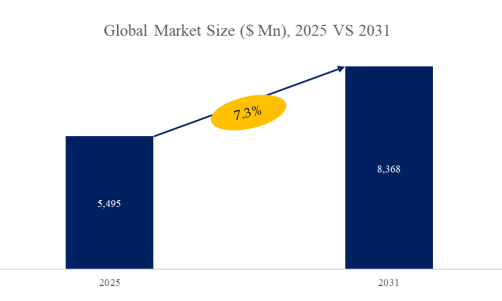
Above data is based on report from QYResearch: Global Ethernet Switch ICs Market Report 2025-2031 (published in 2025). If you need the latest data, plaese contact QYResearch.
The competitive landscape is highly concentrated. Broadcom remains the undisputed global leader, with a 54.59% revenue share in 2024, expected to rise to 58.08% by 2030. Its Tomahawk, Trident, and Jericho product families dominate hyperscale cloud deployments, offering unmatched SerDes performance and rapid generation-to-generation improvements. Marvell follows with 12.95% share in 2024, projected to expand to 14.10% by 2030, supported by its Prestera and OCTEON switching SoC platforms and design wins in carrier and enterprise markets. Cisco, with 9.60% share in 2024, is expected to decline to 5.96% by 2030 as the company shifts focus from in-house silicon toward hybrid strategies that incorporate merchant silicon. NVIDIA (Mellanox) maintains stable performance around 7–8% share, supported by its Spectrum Ethernet portfolio designed specifically for accelerated computing clusters and AI networking. Microchip and Centec Communications contribute stable but modest shares, together accounting for about 5% of the market, with strengths in industrial, SMB, and cost-optimized data center switching.
Figure. Global Ethernet Switch ICs Top 6 Players Ranking and Market Share (Ranking is based on the revenue of 2024, continually updated)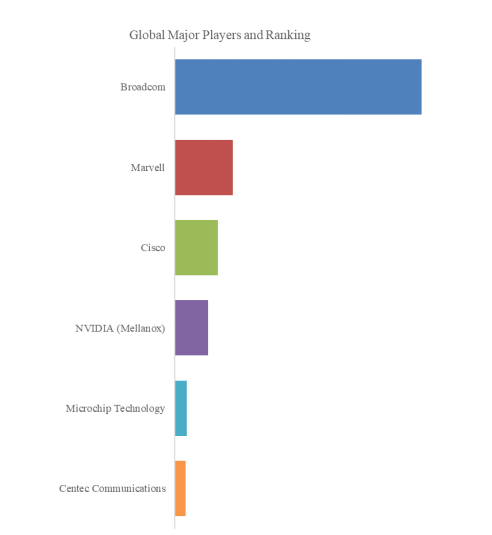
Above data is based on report from QYResearch: Global Ethernet Switch ICs Market Report 2025-2031 (published in 2025). If you need the latest data, plaese contact QYResearch.
From a product-type perspective, the Ethernet Switch IC landscape is characterized by clear technology migration cycles. In 2020, the ≤25G and 25G–100G categories accounted for more than half of global revenue (over 50% combined). However, as cloud service providers and AI data centers scaled out their infrastructure, the market has steadily transitioned toward 100G–400G and especially 400G+ switch silicon. Revenue from ≤25G ICs decreased from 25.63% of global sales in 2020 to only 18.69% in 2024, and is forecast to decline to approximately 9.34% by 2031, reflecting their commoditization and integration into low-end enterprise and industrial networking devices. The mid-tier 25G–100G segment follows a similar trajectory, declining from 25.01% in 2020 to 11.29% by 2030, as cloud data centers accelerate migration to 100G-based fabrics and spine-leaf architectures.
In contrast, the 100G–400G category remains the backbone of the switch IC market, contributing the largest revenue share from 2020 to 2026. Although its percentage share moderates slightly from 47.31% in 2020 to 41.49% in 2024, revenue continues to expand, reaching a forecasted USD 3.03 billion in 2030. This segment includes the dominant chips deployed in hyperscale data center leaf/spine layers and is supported by strong demand for 100G SerDes and 112G PAM4 SerDes–based architectures. Meanwhile, the 400G+ segment is the fastest-growing, rising from USD 55 million in 2020 to USD 921 million in 2024, and projected to reach USD 3.24 billion in 2030, representing over 40% of market revenue by that year. This rapid expansion is driven by the surge in AI networking requirements, large-scale GPU clusters, and the adoption of 25.6T and 51.2T switching platforms across cloud service providers.
On the application side, the global market is experiencing a rising divergence between Commercial and Self-developed (in-house) Ethernet Switch IC solutions. Commercial ICs—supplied by Broadcom, Marvell, Microchip, Centec, and others—continue to dominate, contributing 86.92% of total 2024 revenue and projected to reach over 92% by 2031. This reflects the growing trend of enterprises, telecom operators, and cloud providers outsourcing hardware innovation to specialized semiconductor vendors instead of relying on proprietary chip design teams. Conversely, Self-developed ICs, traditionally led by Cisco (UADP), Huawei (Solar series), and some hyperscalers experimenting with custom silicon, have gradually declined in share—from 18.37% in 2020 to only 13.08% in 2024, and expected to fall below 8% by 2031. This decline is primarily due to the escalating complexity and cost of developing advanced switching silicon (especially 7nm and 5nm SerDes-intensive ICs), which makes custom ASIC development economically challenging.
Technology evolution across the Ethernet switch silicon industry is heavily shaped by the SMCI, AI networking boom, and hyperscale cloud requirements. The shift from 100G toward 200G, 400G, and 800G Ethernet is accelerating, making high-density, low-latency SerDes the core differentiator in advanced ICs. The transition to 112G PAM4 SerDes underpins the performance leap in 12.8T, 25.6T, and 51.2T switch chips, while the next stage—224G PAM4—is beginning to emerge for 2030+ products. These developments require advanced foundry nodes (5nm, 3nm), chiplet architectures, 2.5D interposers, and co-packaged optics (CPO), all of which will further consolidate the market toward vendors capable of managing high R&D intensity. As a result, merchant silicon suppliers—especially Broadcom and Marvell—are increasingly pulling ahead of custom ASIC developers, reinforcing the observed market-share trends.
Geographically, growth is distributed across North America, Europe, and Asia-Pacific, with APAC emerging as the largest consumer of switch ICs due to China’s rapid cloud expansion, Japan’s enterprise refresh cycles, and India’s digital infrastructure development. North America remains the technological frontier, driven by hyperscalers such as Amazon, Google, Microsoft, and Meta, which are the earliest adopters of 400G/800G switching architectures. Meanwhile, Europe exhibits moderate but stable growth, with increased investment in digital sovereignty, green data centers, and 5G core networks.
In summary, the Ethernet Switch ICs market is entering a structural shift toward very-high-speed switching devices, driven by cloud-scale AI workloads and next-generation data center architectures. While legacy segments such as ≤25G and 25G–100G shrink in relative importance, the 100G–400G and 400G+ segments will dominate revenue through 2031. Competitive advantages will increasingly depend on SerDes innovation, power efficiency, optics integration, and advanced manufacturing nodes. The ecosystem is consolidating, with Broadcom, Marvell, and NVIDIA positioned as long-term winners, while self-developed solutions continue to lose share due to soaring development complexity. With a projected CAGR of 7.26%, the market will remain one of the fastest-growing semiconductor segments associated with the digital infrastructure and AI revolution.
About QYResearch
QYResearch founded in California, USA in 2007.It is a leading global market research and consulting company. With over 17 years’ experience and professional research team in various cities over the world QY Research focuses on management consulting, database and seminar services, IPO consulting (data is widely cited in prospectuses, annual reports and presentations), industry chain research and customized research to help our clients in providing non-linear revenue model and make them successful. We are globally recognized for our expansive portfolio of services, good corporate citizenship, and our strong commitment to sustainability. Up to now, we have cooperated with more than 60,000 clients across five continents. Let’s work closely with you and build a bold and better future.
QYResearch is a world-renowned large-scale consulting company. The industry covers various high-tech industry chain market segments, spanning the semiconductor industry chain (semiconductor equipment and parts, semiconductor materials, ICs, Foundry, packaging and testing, discrete devices, sensors, optoelectronic devices), photovoltaic industry chain (equipment, cells, modules, auxiliary material brackets, inverters, power station terminals), new energy automobile industry chain (batteries and materials, auto parts, batteries, motors, electronic control, automotive semiconductors, etc.), communication industry chain (communication system equipment, terminal equipment, electronic components, RF front-end, optical modules, 4G/5G/6G, broadband, IoT, digital economy, AI), advanced materials industry Chain (metal materials, polymer materials, ceramic materials, nano materials, etc.), machinery manufacturing industry chain (CNC machine tools, construction machinery, electrical machinery, 3C automation, industrial robots, lasers, industrial control, drones), food, beverages and pharmaceuticals, medical equipment, agriculture, etc.

Global Ethernet Switch ICs Sales Market Report, Competitive Analysis and Regional Opportunities 2026-2032

Published Date: 2026-01-05

Pages: 80

Report ld: 5569196
Price:USD 4250.00
(Single User License)
Global Ethernet Switch ICs Market Research Report 2026
Published Date: 2026-01-05
Pages: 132
Report ld: 5518835
Price:USD 2900.00
(Single User License)
Ethernet Switch ICs- Global Market Share and Ranking, Overall Sales and Demand Forecast 2026-2032
Published Date: 2026-01-05
Pages: 92
Report ld: 5509089
Price:USD 3950.00
(Single User License)
Ethernet Switch ICs - Global Market Share and Ranking, Overall Sales and Demand Forecast 2025-2031
Published Date: 2025-11-29
Pages: 96
Report ld: 5515499
Price:USD 3950.00
(Single User License)
Global Ethernet Switch ICs Sales Market Report, Competitive Analysis and Regional Opportunities 2025-2031
Published Date: 2025-11-29
Pages: 77
Report ld: 4931597
Price:USD 4250.00
(Single User License)
Global Ethernet Switch ICs Market Outlook, In‑Depth Analysis & Forecast to 2031
Published Date: 2025-11-29
Pages: 140
Report ld: 4808945
Price:USD 4900.00
(Single User License)


Competition
Key players, new entrants,acquisitions, mergers and expansions,development trends and challenges.

Industry Analysis
Rawmaterial, application, product type, demand,supply,downstream, supply chain etc.

Market Size
Capacity, production, sales, revenue, price, cost etc.

Customized Information
We can offer customized survey and information to meet ourclient's need.
