Everything Centers on Client Needs When Selecting Topics: QYResearch's "Client Favorite" Methodology


In the market research industry, topic selection is not only the starting point of research work but also determines whether a report can truly meet client needs.
A product may have advanced technology and a novel concept, or may attract widespread market attention, but that does not necessarily mean it has research value. Corporate managers are more concerned with market space, competitors, core technologies, downstream customers, and potential business opportunities; investment institutions focus more on industry prospects, competitive barriers, and investment value.
What clients need is not a popular product name but a research output that helps them understand the market, identify competition, and support business decisions.
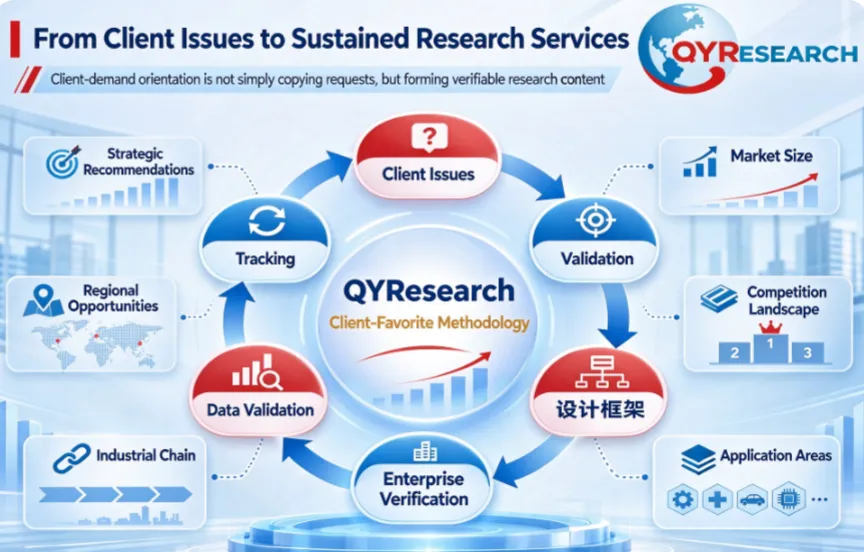
Based on this understanding, QYResearch consistently adheres to a client-demand-oriented approach to topic selection and summarizes it as the "Client Favorite" methodology: starting from the issues clients care about and their actual business needs, and seeking market topics that are truly worth researching.
I. Topic Selection Is Not About Chasing Hotspots but About Finding the Issues Clients Truly Care About
Fields such as artificial intelligence, robotics, new energy, the low-altitude economy, and commercial aerospace continue to attract attention, but simply chasing hotspots can easily lead to problems such as overly broad research scope and unclear product boundaries.
Take the robotics industry as an example. It covers upstream materials, core components, midstream complete machines, and downstream applications. If the entire robotics industry is studied directly, it may be difficult for clients to quickly find information relevant to their own business.
After further decomposition, segmented topics can be formed, such as vertical steering drive wheels, robot reducers, six-axis force sensors, robot vision systems, and industrial robot simulation platforms.
These topics are closer to the actual operational needs of enterprises. Therefore, when selecting topics, QYResearch focuses on three questions: Who needs this report? Why do clients need it? What problems can the research content solve?
II. Starting from Client Identity to Identify Different Research Needs
Different clients do not focus on the same priorities in the same market.
Manufacturing enterprises usually focus on product planning, competitive landscape, downstream demand, and market expansion; upstream suppliers focus more on raw materials, component supporting relationships, and procurement demand; investment institutions value market potential, competitive barriers, and commercialization progress; corporate strategy and marketing departments need more information on potential customers, competitors, and regional markets.
For example, research on high-purity alumina ceramics for semiconductors requires not only analysis of the ceramic components themselves but also organization of high-purity alumina powder, processing techniques, equipment applications, and downstream procurement relationships.
This means that topic selection cannot look only at the product itself; it also needs to design research directions based on client identity, business objectives, and actual information needs.
III. Finding Segmented Market Opportunities Through Industrial Chain Decomposition
Seeking research directions along the industrial chain is an important way to discover potential business opportunities.
Take the new energy industry as an example. The research scope can extend from system markets such as new energy vehicles, energy storage, and photovoltaics to key materials, power semiconductors, sensors, manufacturing equipment, and operations and maintenance services.
Take the drone industry as an example. In addition to complete machines, research can also cover infrared thermal imaging sensors, automated docking stations, inspection software, data analysis platforms, and drone thermal imaging inspection services.
Among them, the research focus of drone thermal imaging inspection services is not drone equipment sales but the use of drones equipped with infrared devices to provide temperature detection, anomaly identification, and professional inspection services for power, energy, petrochemical, and industrial facilities.
Only by clarifying product boundaries can real buyers, competing enterprises, and industrial chain relationships be further identified.
IV. Making Research Truly Land on Products and Enterprises
Whether a topic is worth researching requires judging whether it has clear research boundaries and a verifiable industrial foundation.
First, clarify product definitions and statistical scope, distinguish equipment, components, and professional services, and avoid confusion among different businesses.
Second, establish a research framework based on product characteristics, covering product classification, application fields, major enterprises, regional markets, and industrial chain relationships.
Third, verify whether enterprises truly participate in the target market, and distinguish equipment manufacturers, system integrators, and professional service providers through official websites, product materials, and project cases.
For information lacking public disclosure, it is also necessary to verify through multiple channels and conduct reasonable analysis rather than fabricating content at will to complete the report.
The client orientation emphasized by QYResearch is not simply listing the questions raised by clients but transforming them into research topics with clear research scope and a professional analytical framework.
V. Extending from One-Time Reports to Continuous Research Services
Client needs continue to change with the stage of business development.
When entering a new market, enterprises need to understand the market structure and competitive landscape; when carrying out business expansion, they need to find potential customers and regional opportunities; after product commercialization, they may focus more on technology roadmaps and competitor dynamics.
For example, research on high-purity alumina ceramics for semiconductors can be further extended to materials of different purities, key raw materials, and specific equipment components; space resource exploration services can be extended from lunar and asteroid exploration to in-situ resource utilization technologies and related commercial services.
Only when research directions continue to deepen with client business development can market research continue to create value.
VI. "Client Favorite" Is Not About Catering to Clients but About Making Research More Valuable
Being client-demand-centered does not mean catering to all market concepts or exaggerating industry prospects.
Truly valuable research requires that clients have clear needs, that the research object has clear boundaries, and that research conclusions can be supported by reliable information and professional analysis.
For products that have not yet formed an independent market, their research attribution needs to be reasonably judged; for industries in the early stage of commercialization, their development stage should also be objectively reflected.
The professionalism of research is reflected in distinguishing market hotspots from actual needs, industry concepts from specific products, and related enterprises from true market participants.
The value of market research does not lie in how many popular concepts it chases but in whether it can help clients understand the market, comprehend competition, and make business judgments.
Starting from client questions, seeking opportunities from the industrial chain, determining research scope from product boundaries, and then forming research results through enterprise verification and professional analysis—this is precisely the core logic emphasized by QYResearch's "Client Favorite" methodology.
In the future, as manufacturing upgrading, artificial intelligence, new energy, robotics, and commercial aerospace continue to develop, more segmented products and professional services will emerge in the market.
Everything centers on client needs when selecting topics, without blindly chasing hotspots, so that every research topic has a clear application scenario and every market report can answer the questions clients truly care about.
Contact Person: Zhang Jingqi
Research Field: Mechanical Equipment
Zhang Jingqi focuses on systematic research and market trend analysis in the fields of mechanical equipment and industrial equipment. In the general machinery field, he focuses on development trends in construction machinery, machine tools, transmission and hydraulic systems, industrial automation equipment, and intelligent manufacturing-related equipment, and continuously tracks the impact of global manufacturing upgrading and industrial chain restructuring on the demand structure for mechanical equipment; in the high-end equipment field, he focuses on the technological evolution and localization process of precision manufacturing equipment, industrial robots, automated production lines, and key basic components, and systematically studies the industry competitive landscape and technology substitution paths; at the same time, he pays attention to development trends in emerging directions such as new energy equipment, energy-saving and environmental protection equipment, and smart factory solutions, and analyzes their penetration and expansion of application scenarios in the industrial system.


Competition
Key players, new entrants,acquisitions, mergers and expansions,development trends and challenges.

Industry Analysis
Rawmaterial, application, product type, demand,supply,downstream, supply chain etc.

Market Size
Capacity, production, sales, revenue, price, cost etc.

Customized Information
We can offer customized survey and information to meet ourclient's need.