Industrial-grade Collaborative Robot Arm Global Market Report 2026: Pricing, Distribution, and Promotion - Strategies for Success


Industrial-grade Collaborative Robot Arm Market Summary
An industrial-grade collaborative robot arm (cobot arm) is a robotic manipulator designed to work safely alongside human operators while delivering the performance, payload, precision, and durability required in industrial environments. Unlike traditional industrial robots that operate in fenced-off areas, collaborative robots integrate force-limiting joints, collision detection, torque sensors, and advanced safety algorithms that allow operators to interact with them directly. Industrial-grade cobots combine these safety functions with higher rigidity, improved repeatability, enhanced load capacity, and robust mechanical structures suitable for demanding factory operations such as assembly, machine tending, palletizing, inspection, and packaging.
These cobots are engineered to support flexible manufacturing by offering fast deployment, easy programming, and compatibility with a wide variety of end-of-arm tooling (EOAT). Using intuitive interfaces—graphical programming, hand-guiding, drag-to-teach, and AI-assisted learning—operators with limited robotics experience can configure workflows without writing traditional code. Industrial-grade collaborative arms bridge the gap between lightweight laboratory cobots and heavy-duty industrial robots, providing both safety compliance and production-level throughput. This enables manufacturers to automate repetitive, hazardous, or ergonomically challenging processes without requiring major facility modifications.
Their rapid adoption is supported by Industry 4.0 and smart factory technologies, as industrial cobots integrate sensors, cloud connectivity, digital twins, and analytics platforms. They enable real-time monitoring, predictive maintenance, and automated quality inspection. With global labor shortages, rising wages, and the need for mass customization in consumer goods, electronics, automotive components, and logistics, collaborative robot arms have become a central automation tool. Their value lies in combining safety, flexibility, precision, and scalability—making them an essential asset in modern manufacturing transformation.
Market Size
The global Industrial-grade Collaborative Robot Arm market size is estimated to reach US$ 3150.4 million by 2025 and is anticipated to reach US$ 8635.2 million by 2031, witnessing a CAGR of 18.30% during the forecast period 2025-2031.
Figure. Global Industrial-grade Collaborative Robot Arm Market Size (US$ Million), 2020-2031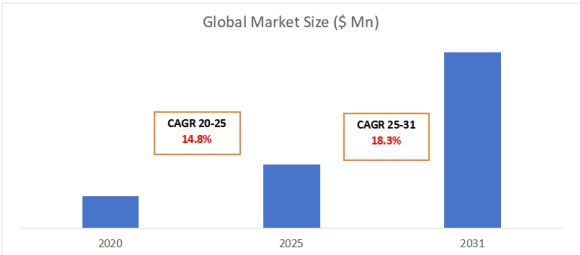
Above data is based on report from QYResearch: Global Industrial-grade Collaborative Robot Arm Market Report 2025-2031 (published in 2025). If you need the latest data, please contact QYResearch.
Figure. Global Industrial-grade Collaborative Robot Arm Top 13 Players Ranking and Market Share (Ranking is based on the revenue of 2025, continually updated)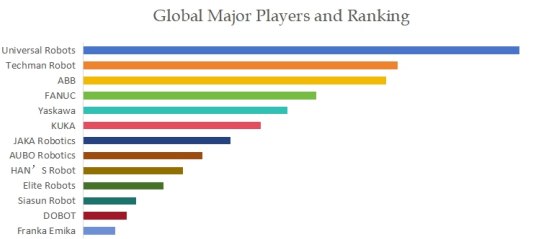
Above data is based on report from QYResearch: Global Industrial-grade Collaborative Robot Arm Market Report 2025-2031 (published in 2025). If you need the latest data, plaese contact QYResearch.
Industry Chain
The upstream segment includes suppliers of precision mechanical components, servo motors, harmonic reducers, encoders, torque sensors, industrial controllers, and safety-certified electronics. High-performance materials—lightweight alloys, carbon fiber structures, and polymer composites—are used to optimize arm rigidity and reduce inertia. Vision systems, force-torque sensors, and AI modules also come from specialized upstream providers. Industrial-grade cobot development heavily relies on advanced actuator technologies and real-time control chips, which determine motion precision, responsiveness, and safety capabilities.
In the midstream, manufacturers design and assemble collaborative robot arms, integrating mechanical systems, embedded software, motion control algorithms, and safety logic. Companies differentiate through payload range, motion smoothness, programming simplicity, human–machine interaction features, and reliability under continuous operation. Software platforms—robot operating systems, cloud dashboards, simulation environments, and digital twins—play an increasingly important role in defining product competitiveness. Many cobot makers offer standardized plug-and-play ecosystems for vision modules, grippers, conveyors, and AGVs/AMRs.
Downstream, cobots are deployed in industries such as automotive components, 3C electronics, precision machining, logistics automation, medical device assembly, consumer goods, food & beverage packaging, and metalworking. System integrators and solution providers customize cobot applications, conduct on-site commissioning, and integrate cobots with MES/ERP systems. A strong service network—training, maintenance, spare-part supply, and workflow optimization—supports adoption. Ultimately, the industry chain is driven by end-users seeking safer automation, faster deployment, and improved production flexibility.
Industry Trends
A major trend is the shift from lightweight cobots to industrial-grade high-performance models. Early cobots focused on small payloads and laboratory applications, but manufacturers now demand 10–30 kg payloads, longer reach, higher stiffness, IP-rated protection, and faster cycle times. This trend enables cobots to replace traditional industrial robots in tasks such as palletizing, welding, and machine tending. As factories pursue broader automation, cobot roles expand from auxiliary automation to core production operations.
Another trend is the deep integration of AI, vision, and force-control intelligence. Machine learning enables cobots to automatically adjust parameters, recognize objects, fine-tune trajectories, and improve performance over time. Vision-guided manipulation, tactile perception, and multimodal sensing unlock complex operations such as precision assembly, bin-picking, and adaptive polishing. Cloud platforms and digital twins allow remote diagnostics, virtual commissioning, and performance optimization—significantly reducing engineering costs and deployment time.
Additionally, the industry is moving toward human-robot collaboration 2.0, characterized by shared workspaces, mobile manipulation, and the combination of cobots with AGVs/AMRs. Mobile cobots perform autonomous logistics, inspection, and multi-station operations, enabling flexible manufacturing lines. Safety-certified speed and separation monitoring (SSM), AI-based hazard detection, and wearable sensors enhance operator-robot synergy. The overall trend shows cobots transitioning from simple cooperative tools to intelligent autonomous collaborators that contribute directly to production quality and operational resilience.
Market Drivers
A primary market driver is the global labor shortage and rising wages, especially in manufacturing-intensive regions such as China, Europe, and North America. Many tasks—machine loading, repetitive assembly, product inspection—are increasingly difficult to staff. Industrial-grade cobots offer an efficient alternative by automating processes traditionally handled by skilled operators. Their flexibility allows re-deployment in different tasks without requiring extensive reprogramming, reducing total cost of ownership.
Another strong driver is the demand for flexible, small-batch, and high-variety production. Consumer electronics, automotive components, and consumer goods industries face rapid product iteration cycles. Traditional robots require complex integration, making them less suitable for short production runs. Cobots enable quick reconfiguration, modular automation, and reduced changeover time. Manufacturers adopt cobots to support mass customization, just-in-time production, and high-mix/low-volume workflows.
Additionally, safety and regulatory incentives promote cobot adoption. Governments and industry bodies encourage safer workplaces and ergonomic improvements. Cobots reduce injury risks from lifting, repetitive strain, and hazardous environments. Their safety certification standards—ISO/TS 15066, ISO 10218—enhance user confidence. Combined with government subsidies for automation and digital transformation, cobots are increasingly viewed as essential equipment for modern factories.
Market Challenges
A key challenge is the technical trade-off between safety and performance. Collision-force limits and safety constraints can restrict cobot speed and payload compared to traditional robots. For industrial-grade tasks—heavy palletizing, high-speed pick-and-place—users expect higher throughput, forcing manufacturers to develop dynamic speed-control algorithms, stiffer arms, and enhanced torque sensors. Balancing safety compliance with industrial productivity remains a complex engineering challenge.
Another challenge is the shortage of skilled integrators and application engineers. While cobots are marketed as “easy to deploy,” real industrial environments involve complex machines, conveyors, fixtures, and vision systems. Poor integration leads to low utilization rates, production bottlenecks, or safety risks. Many factories lack expertise in workflow redesign, end-effector selection, digital calibration, and maintenance. The industry increasingly depends on system integrators, training centers, and standardized application packages to bridge the skills gap.
Additionally, cost pressure and fierce competition pose difficulties for manufacturers. As more companies enter the cobot market—particularly in China—pricing competition accelerates, compressing margins. Meanwhile, key components such as harmonic reducers, servo drivers, and sensors remain costly and sometimes imported. For global expansion, cobot manufacturers must invest in certification, service networks, and localization strategies, further increasing operational burden. These challenges require continuous innovation and strategic partnerships to maintain competitiveness.
Industry Barriers
One major entry barrier is the advanced technological capability required for developing industrial-grade cobots. High-precision mechanics, multi-axis force control, smooth trajectory planning, redundant safety architecture, and real-time motion algorithms demand deep expertise across robotics, electronics, control theory, and embedded systems. Only companies with extensive R&D infrastructure, long-term engineering talent, and proprietary motion-control IP can compete effectively.
The second significant barrier is customer qualification and reliability expectations. Industrial users require robots that perform continuously for thousands of hours with minimal downtime. Any failure in a cobot used for palletizing, welding, or assembly directly impacts production output. Therefore, manufacturers must prove reliability, provide extensive testing data, and support long-term service commitments. New entrants face long adoption cycles because customers conduct multi-month evaluations before approving a cobot for production use.
Finally, the ecosystem barrier is substantial. Competitive cobot brands offer entire application ecosystems—vision modules, grippers, welding packages, palletizing kits, software libraries—which greatly influence purchasing decisions. Without a mature ecosystem and global service network, new brands struggle to secure industrial customers. This reinforces the market leadership of established cobot companies and raises the overall difficulty for newcomers entering the industry.
About QYResearch
https://www.qyresearch.com
QYResearch founded in California, USA in 2007.It is a leading global market research and consulting company. With over 17 years’ experience and professional research team in various cities over the world QY Research focuses on management consulting, database and seminar services, IPO consulting, industry chain research and customized research to help our clients in providing non-linear revenue model and make them successful. We are globally recognized for our expansive portfolio of services, good corporate citizenship, and our strong commitment to sustainability. Up to now, we have cooperated with more than 60,000 clients across five continents. Let’s work closely with you and build a bold and better future.
QYResearch is a world-renowned large-scale consulting company. The industry covers various high-tech industry chain market segments, spanning the semiconductor industry chain (semiconductor equipment and parts, semiconductor materials, ICs, Foundry, packaging and testing, discrete devices, sensors, optoelectronic devices), photovoltaic industry chain (equipment, cells, modules, auxiliary material brackets, inverters, power station terminals), new energy automobile industry chain (batteries and materials, auto parts, batteries, motors, electronic control, automotive semiconductors, etc.), communication industry chain (communication system equipment, terminal equipment, electronic components, RF front-end, optical modules, 4G/5G/6G, broadband, IoT, digital economy, AI), advanced materials industry Chain (metal materials, polymer materials, ceramic materials, nano materials, etc.), machinery manufacturing industry chain (CNC machine tools, construction machinery, electrical machinery, 3C automation, industrial robots, lasers, industrial control, drones), food, beverages and pharmaceuticals, medical equipment, agriculture, etc.


Competition
Key players, new entrants,acquisitions, mergers and expansions,development trends and challenges.

Industry Analysis
Rawmaterial, application, product type, demand,supply,downstream, supply chain etc.

Market Size
Capacity, production, sales, revenue, price, cost etc.

Customized Information
We can offer customized survey and information to meet ourclient's need.