Interview Details: The Sharp Tool for Unlocking Value — QYResearch's Frontline Research Methodology


In the field of market research, truly valuable industry insights often do not exist only in public materials and company profiles, but are hidden in an in-depth interview, a follow-up question about a technical detail, or the different understandings of the same issue held by different participants in the industry chain. For professional research institutions, frontline interviews are not only an important way to obtain industry information, but also an important pathway to understand the logic of industrial operations, identify companies' competitive advantages, and discover potential market opportunities.
QYResearch has long focused on the development and changes of global niche industries. In its research practice, it adheres to taking the industry chain as the foundation and professional interviews as the entry point, connecting business operations, product technology, application scenarios, and customer needs. Through continuous follow-up questions and cross-validation of key details, it gradually forms deeper, more objective, and commercially valuable industry understanding.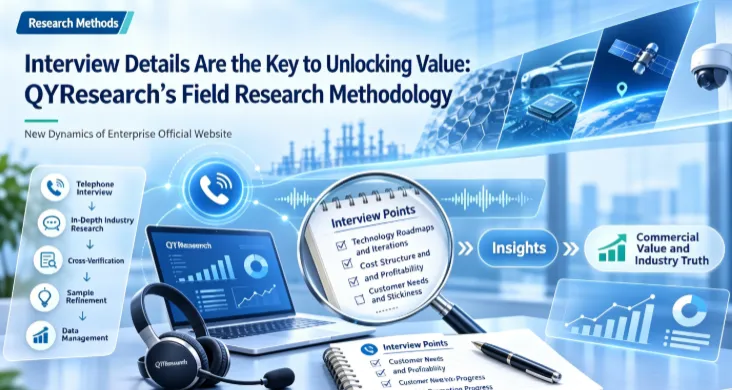
The core of frontline interviews lies in discovering the questions behind the questions
In industry research, many questions appear to have similar answers on the surface, but the business logic behind them may be completely different.
For example, when a company introduces a product as having strong market competitiveness, researchers should not stop at product performance, application fields, or the company's own evaluation, but should further consider: where exactly is this competitiveness reflected? Is it a differentiated advantage formed by technical processes, or a competitive barrier jointly constituted by customer certification, supply chain management, product stability, and after-sales service?
Take research on the aramid fiber industry for automotive rubber hoses as an example. As a high-performance fiber material, aramid fiber features high strength, high-temperature resistance, and good dimensional stability, and is widely used in automotive rubber reinforcement materials and related industrial fields. However, in actual interviews, if attention is paid only to product models, basic performance, and application scope of aramid fiber, it is often difficult to truly understand the competitive differences among different suppliers.
When conducting research on such niche products, QYResearch researchers need to extend their focus further to specific application links. For example, when selecting aramid reinforcement materials, automotive rubber hose manufacturers need to consider not only the mechanical properties of the fiber itself, but also factors such as adhesion between the fiber and the rubber matrix, dipping treatment processes, dynamic fatigue performance, long-term heat aging resistance, and product batch stability. These seemingly minor technical requirements are in fact closely related to downstream customers' product validation, material substitution, supplier selection, and long-term cooperation.
Through such a research process, a seemingly ordinary product technical detail can be extended into an in-depth understanding of customer certification barriers, difficulty of product substitution, supply chain relationships, and industry competitive structure.
Professional preparation is the foundation of high-quality interviews
A high-quality industry interview does not begin at the moment a call is connected or communication starts, but is built on sufficient preliminary preparation.
Before a formal interview, researchers need to form a systematic understanding of the target industry, including product technology routes, upstream and downstream industry chain relationships, main application scenarios, corporate business positioning, and key issues in industry development. For niche industries with strong technical attributes, it is also necessary to understand relevant professional terminology, key processes, and industry standards in advance, so as to avoid missing important information due to insufficient technical understanding. At the same time, the selection of interviewees is equally important. Corporate managers, R&D personnel, procurement personnel, sales personnel, and downstream customers often have different understandings of the industry due to differences in their positions and business links.
These differences do not necessarily mean that the information is contradictory, but reflect the focus of different participants in the industry chain. Linking the professional views of different roles helps researchers build a more complete understanding of the industry.
Deep follow-up questions turn industry information into business insights
During the interview process, obtaining answers is only the beginning of the research work.
When an interviewee says that a certain technology is already mature, it is necessary to further understand which application conditions its maturity corresponds to; when a company emphasizes that its product has substitution advantages, it is necessary to understand whether such advantages have been recognized by end customers; when downstream customers raise new procurement needs, attention should also be paid to whether this change reflects that the industry's technology route or competitive focus is adjusting.
From "what it is" to "why it is" and then to "what it means for the industry" is an important process for researchers to form professional judgments. Such follow-up questioning is not simply about increasing the number of questions, but about continuously clarifying the relationships among technology, products, customers, and business models around core research objectives.
At the same time, frontline interviews also need to maintain objectivity. Different companies may form different judgments on industry development based on their own business positioning. Researchers cannot directly regard the views of a single interviewee as overall market conclusions, but should identify consistency and differences in information through multi-party communication, verification of public materials, and analysis of industry chain logic.
Only information built on professional understanding, reasonable follow-up questioning, and prudent verification can truly become a reliable basis for industry research.
Starting from details, making research closer to the real industry
As industrial technology continues to iterate, the competitive logic of niche markets is also constantly changing. Differences among products may increasingly be reflected in specific application conditions, system compatibility, customer certification processes, and long-term service capabilities.
This means that industry research cannot remain only at the surface information displayed in public materials, but needs to go deep into the real industrial environment to understand why companies adopt certain technical solutions, why customers choose specific suppliers, and which factors in the industry chain are changing.
QYResearch regards frontline interviews as an important foundation of industry research and emphasizes the combination of professional knowledge and practical investigation. By continuously focusing on technical details, product applications, and business operation mechanisms, it provides industry insights with reference value for corporate strategic planning, market entry, competitive research, and investment decisions.
True research depth comes from continuous attention to details; true business value comes from an accurate understanding of the industrial logic behind details. Interview details are the sharp tool for unlocking value. This is not only a research technique, but also a professional methodology that QYResearch consistently adheres to in niche industry research.
Analyst Profile
Shi Yuanyuan, industry research analyst at QYResearch, whose research fields cover automotive and transportation, communications and networking, and consumer electronics, among multiple industries, and who has rich experience in cross-industry market research and niche sector analysis. Representative research topics include: aramid fiber (para-aramid and meta-aramid), aramid fiber for automotive rubber hoses, aramid fiber for rubber belts, EV battery recycling services, automotive NAD (network access device) and wireless communication modules, roadside units (RSU) for vehicle-road coordination, L7 and L6 quadricycles, automotive cabin comfort systems, automotive seat heating-ventilation-lumbar support systems, automotive seat sensors, automotive precision ball screws, ball screw shafts for medical equipment, ball screw shafts, GNSS correction services, home security cameras, etc.


Competition
Key players, new entrants,acquisitions, mergers and expansions,development trends and challenges.

Industry Analysis
Rawmaterial, application, product type, demand,supply,downstream, supply chain etc.

Market Size
Capacity, production, sales, revenue, price, cost etc.

Customized Information
We can offer customized survey and information to meet ourclient's need.