Global Rail Transit Brake Pads Market Report 2026-2032


Rail Transit Brake Pads Product Introduction
Rail transit brake pads are friction pad assemblies installed on disc brakes of rail vehicles. They are core safety components and consumables in the braking systems of railway passenger cars, locomotives, freight cars, EMUs/high-speed trains, and subways/light rail. During braking, the brake caliper clamps the brake disc, converting the vehicle's kinetic energy into heat energy through friction, thereby achieving deceleration and stopping. A typical brake pad structure consists of a metal backing plate and a layer of heat-resistant friction material. The friction material can use organic/low-metal formulations or sintered systems and must maintain a stable coefficient of friction, resistance to heat fade, controllable wear, and compatibility with the brake disc throughout its service life. Rail transit brake pads are an indispensable key component for ensuring safe train operation, precise braking, and improved transportation efficiency.
Figure. Global Rail Transit Brake Pads Product Picture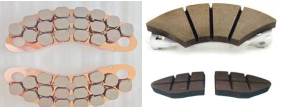
Rail Transit Brake Pads Market Summary
According to the new market research report “Global Rail Transit Brake Pads Market Report 2026-2032”, published by QYResearch, the global Rail Transit Brake Pads market size is projected to reach USD 1.67 billion by 2031, at a CAGR of 1.69% during the forecast period.
Figure. Global Rail Transit Brake Pads Market Size (US$ Million), 2021-2032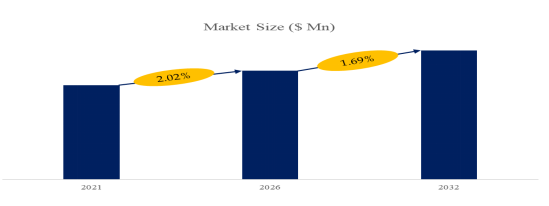
Above data is based on report from QYResearch: Global Rail Transit Brake Pads Market Report 2026-2032 (published in 2025). If you need the latest data, plaese contact QYResearch
Figure. Global Rail Transit Brake Pads Top 15 Players Ranking and Market Share (Ranking is based on the revenue of 2025, continually updated)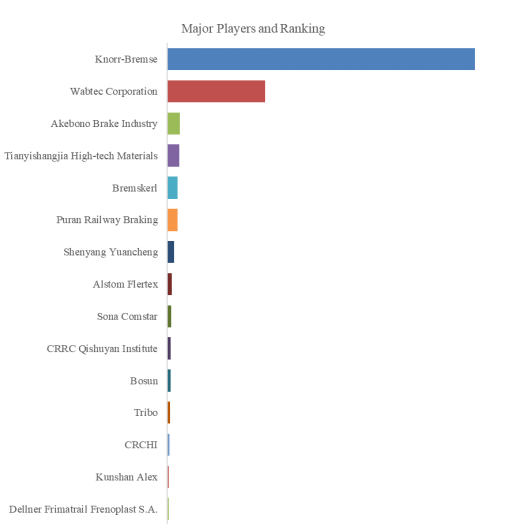
Above data is based on report from QYResearch: Global Rail Transit Brake Pads Market Report 2026-2032 (published in 2026). If you need the latest data, plaese contact QYResearch.
According to QYResearch Top Players Research Center, the global key manufacturers of Rail Transit Brake Pads include Knorr-Bremse, Wabtec Corporation, Akebono Brake Industry, Tianyishangjia High-tech Materials, Bremskerl, etc. In 2025, the global top five players had a share approximately 77.60% in terms of revenue, the global top 10 players had a share approximately 82.39% in terms of revenue.
Main Development Trends
Noise reduction is the primary driver for upgrading tread brakes (freight brake shoes): Under the European system, noise control for freight vehicles has long promoted the replacement of cast iron brake shoes with composite brake shoes. Composite brake shoes are widely used to reduce wheel-rail noise, and relevant interoperability/noise technology documents and guidelines explicitly cite UIC 541-4, LL brake shoe usage guidelines, etc., and manage "quieter brake shoes" in the WAG/NOI system.
Low-emission materials and "source capture" technologies are beginning industrial pilot projects: In addition to changing the formula (low metal/low dust/stable friction), the industry has seen a more direct approach: source capture and filtration of brake dust, especially for semi-enclosed spaces such as platforms/tunnels. In the future, "brake pads" may no longer be independent consumables, but rather an integrated subsystem of "friction materials + structure/air circuit/control," requiring suppliers to have system integration and verification capabilities.
Material route upgrade: "Stable friction—low wear—disc friendly" under higher speeds, higher axle loads, and higher heat loads. For disc brake pads used in passenger trains, high-speed trains, and locomotives, the core trends are focused on controlling the risks of thermal fade and hot cracking, as well as lifespan and total lifecycle cost. Products relying solely on "higher friction coefficients" are losing their competitive edge in bidding; "stability, predictable wear, and resistance to brake disc corrosion" are increasingly becoming key performance indicators.
Standards and type testing are becoming more "systematic": Disc brake pads and tread brake shoes are both following mandatory/semi-mandatory standardized verification paths. The market threshold has upgraded from "being able to supply" to "being able to stably pass verification according to standards and maintain consistent production."
Maintenance is shifting from "periodic replacement" to "condition monitoring + predictive maintenance" (roadside/vehicle-mounted monitoring and data platforms): An increasing number of roadside detection and visual measurement systems can automatically measure brake disc, brake pad/block thickness and uneven wear at normal speeds, and provide replacement windows based on historical wear rates; simultaneously, data-driven wear condition identification and prediction models are being rapidly implemented in academia and engineering.
Key Driving Factors
Infrastructure Investment and Fleet Upgrades: Globally, the advancement of projects such as China's “Eight Vertical and Eight Horizontal” high-speed rail network, European railway modernization, and Southeast Asian transnational railways has directly driven demand for new train braking systems. Simultaneously, over 30% of existing train braking systems worldwide are nearing the end of their service life, entering a peak replacement period, forming a stable replacement market.
Regulatory and Safety Standard Upgrades: Strict regulations act as a technological "guide" for the industry. For example, Europe mandates the use of specific composite material brake pads for freight vehicles and has stringent certification standards for passenger vehicles (such as UIC 541-3), raising technical barriers and maintaining continuous demand for certified materials. Meanwhile, the increasing global requirements for train operation safety directly drive the development of braking systems towards greater reliability and faster response (e.g., reducing the response time of electro-pneumatic braking systems by more than 60%).
Technological Iteration and Material Innovation: New materials, represented by carbon-ceramic composite materials, although expensive per unit, offer significant advantages in life-cycle cost and are penetrating from high-speed rail to urban rail and other fields. Meanwhile, the integration of braking systems with the Internet of Things (IoT) and big data enables real-time wear monitoring and predictive maintenance, effectively reducing operation and maintenance costs.
The Rise of the Aftermarket Maintenance Market: Compared to original equipment manufacturer (OEM) parts, the aftermarket (AM) is showing enormous potential. As a consumable, brake pad replacement demand far exceeds initial installation demand. With the continuous increase in the global rail vehicle fleet, a large and stable maintenance service market is emerging.
"Green Braking" and the Circular Economy: Under the "dual carbon" goal, regenerative braking energy recovery technology has become a hot topic. Operators will tend to choose solutions that can significantly reduce brake wear preventative maintenance (PM) values and have acceptable lifecycle performance. Furthermore, the high-purity recovery of rare metals such as tungsten and cobalt from brake pads is also forming a professional resource recycling industry.
Challenges and Obstacles
Long Certification Cycle and Strong Platform Lock-in: Rail system brake pads are safety-critical components, and customers typically require multi-level testing, including bench/inertial testing and project-based/in-service verification. Once on the qualified supplier list, long-term framework contracts are usually signed with OEMs or operators. This customer loyalty, stemming from safety responsibilities and system integration, makes it extremely difficult for new entrants to break into the market.
Technological Substitution and Changing Braking Strategies Compress Consumable Demand: Electric/regenerative braking is being maximized in more vehicles, with one goal being to reduce mechanical braking friction wear and dust. UIC's solutions explicitly state that maximizing electric braking reduces brake pad/disc wear and dust emissions.
Customer-Side Bidding and Price Pressure: Rail operators and OEMs often use framework agreements/centralized procurement, with bidding increasingly emphasizing life-cycle cost (LCC) and availability KPIs (reliability, lifespan, noise, dust, wheel-rail impact).
Raw material and manufacturing cost fluctuations: The phenolic resin system commonly used in friction materials is related to the upstream petrochemical chain, and industry research indicates that its price is affected by fluctuations in crude oil and petrochemical raw material prices.
Geopolitics and global supply chain restructuring: Taking the US tariff policy in 2025 as an example, it directly affects Sino-US trade and may also trigger retaliatory measures from other countries, disrupting the global supply chain layout and bringing significant uncertainty to companies' market planning and cost control.
About QYResearch
QYResearch specialises in providing segmented data analysis reports for businesses since 2007. Headquartered in Los Angeles, USA and Beijing, China. and has locations in 11 countries including the US, Japan, Korea, Germany, Switzerland, India, Portugal, Canada, Indonesia, Vietnam and China. QYResearch's website is available in 6 languages, providing global enterprises with barrier-free communication in English, Japanese, Korean, German and Chinese. QYResearch understands the value of consulting and accumulates innovative methods in a variety of high-quality market research surveys. With access to multiple paid databases, we have managed to prepare our own internal database which has been updated on a quarterly basis to ensure the most latest and updated data for our customers. Today, we are well known for our extensive service portfolio, professional research team and the best services to assist customers in making business decisions and solving problems in the business. "Customer first" service tailored to the actual business needs of the customer to provide a fast, high quality service. Committed to management consulting, IPO consulting, industrial chain and customized research, database and seminar services, QYResearch focuses on providing customers with in-depth research reports, professional analysis and market forecast.
QYResearch is a world-renowned large-scale consulting company. The industry covers various high-tech industry chain market segments, spanning the semiconductor industry chain (semiconductor equipment and parts, semiconductor materials, ICs, Foundry, packaging and testing, discrete devices, sensors, optoelectronic devices), photovoltaic industry chain (equipment, cells, modules, auxiliary material brackets, inverters, power station terminals), new energy automobile industry chain (batteries and materials, auto parts, batteries, motors, electronic control, automotive semiconductors, etc.), communication industry chain (communication system equipment, terminal equipment, electronic components, RF front-end, optical modules, 4G/5G/6G, broadband, IoT, digital economy, AI), advanced materials industry Chain (metal materials, polymer materials, ceramic materials, nano materials, etc.), machinery manufacturing industry chain (CNC machine tools, construction machinery, electrical machinery, 3C automation, industrial robots, lasers, industrial control, drones), food, beverages and pharmaceuticals, medical equipment, agriculture, etc.


Competition
Key players, new entrants,acquisitions, mergers and expansions,development trends and challenges.

Industry Analysis
Rawmaterial, application, product type, demand,supply,downstream, supply chain etc.

Market Size
Capacity, production, sales, revenue, price, cost etc.

Customized Information
We can offer customized survey and information to meet ourclient's need.