RF Front End MMIC Market Development Strategy Report 2026: Expanding Reach and Impact


RF Front End MMIC Product Definition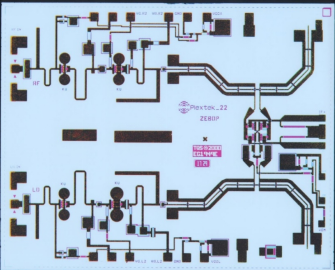
MMIC is a type of integrated circuit (IC) device that operates at microwave frequencies (300 MHz to 300 GHz). MMICs contain active, passive, and interconnect components. These devices typically perform functions such as microwave mixing, power amplification, low-noise amplification, and high-frequency switching. Most of MMICs are fabricated on III-V compound substrates such as GaAs, InP, and GaN, silicon and SiGe MMICs are also becoming commonplace, especially where complex mixed signal systems need to be integrated on the same chip. MMICs are the components of choice for most of high-frequency applications. They offer several advantages over their discrete or hybrid counterparts, such as reduced size, low cost, and high reproducibility and repeatable performance.
RF Front End MMIC Market Summary
Research Background:
RF Front End Monolithic Microwave Integrated Circuits are essential components in modern wireless communication systems, enabling efficient transmission and reception of high-frequency signals across a wide range of applications. These circuits integrate multiple functions such as amplification, filtering, and switching into compact, high-performance semiconductor devices, reducing system size and power consumption while enhancing reliability. With the rapid evolution of 5G, satellite communications, radar, and emerging Internet of Things networks, the demand for advanced RF front end MMICs has grown significantly, driving continuous innovation in materials and design. This market has become a focal point for both technological advancement and strategic investment, as it underpins the performance and scalability of next-generation connectivity solutions.
Development Status:
The development status of RF Front End MMIC is characterized by steady technological advancements and increasing diversification across materials, architectures, and applications. GaAs-based MMICs remain widely adopted for their mature performance in high-frequency operations, while GaN is gaining momentum due to its superior power handling and efficiency in demanding environments such as radar and defense. SiGe technologies continue to evolve as a cost-effective solution for high-volume markets, particularly in consumer electronics and telecommunications. Industry players are actively pursuing innovations in miniaturization, integration, and thermal management to meet the requirements of 5G, satellite communication, and emerging IoT ecosystems. Overall, the market has transitioned from early-stage adoption to a phase of accelerated optimization and commercialization, supported by expanding application fields and ongoing investment in R&D.
Future Trends:
Advancement of Materials and Technologies: The future of the RF Front End MMIC market will be strongly shaped by the adoption of advanced semiconductor materials. GaN is gaining prominence for its ability to deliver higher power density and efficiency at high frequencies, while GaAs continues to serve critical high-performance applications. At the same time, SiGe remains attractive for large-volume, cost-sensitive markets, ensuring that multiple material platforms coexist to meet diverse industry needs.
Expansion Through 5G and 6G Networks: With the global rollout of 5G and ongoing research into 6G, MMICs are increasingly required to support millimeter-wave and ultra-high-frequency bands. These developments are driving demand for front-end solutions that can manage higher bandwidth and faster data transmission. The evolution of communication networks will continue to position MMICs as vital components for smartphones, base stations, and satellite links.
Miniaturization and System Integration: As electronic systems become smaller and more power-efficient, the integration of multiple RF front-end functions into compact MMIC modules is becoming a key trend. This miniaturization not only reduces overall device size but also enhances reliability and lowers power consumption. It is particularly important in consumer electronics, IoT devices, and aerospace systems where space and energy efficiency are critical.
Innovation in Thermal Management and Packaging: Thermal management is emerging as a decisive factor for the performance and longevity of RF Front End MMICs, especially in high-power and high-frequency applications. Future designs will emphasize advanced packaging methods and heat dissipation techniques to overcome reliability challenges. These innovations will enable wider deployment of MMICs in demanding environments such as defense, radar, and satellite communications.
SWOT Analysis:
Strengths
The RF Front End MMIC market benefits from its critical role in enabling high-frequency performance for advanced communication systems, radar, and satellite applications. Mature semiconductor technologies such as GaAs and SiGe, along with the growing adoption of GaN, provide a wide spectrum of solutions balancing efficiency, power, and cost. High levels of integration reduce device size and enhance reliability, making MMICs indispensable for compact and high-performance electronic systems.
Weaknesses
The industry faces challenges related to high manufacturing complexity and costs, especially in GaN-based devices where production processes are still evolving. Thermal management issues at high power densities remain a technical bottleneck, while dependence on specialized foundries and advanced packaging technologies increases supply-side risks. Furthermore, integration with legacy systems and compatibility across diverse frequency bands can slow down adoption in certain applications.
Opportunities
The transition to 5G and future 6G networks presents strong growth potential, as demand for high-frequency and millimeter-wave solutions continues to accelerate. Expanding adoption in aerospace, defense, and satellite communication further widens the application scope. Emerging IoT ecosystems and consumer electronics markets are expected to create high-volume demand for low-power, cost-effective MMICs. Advances in AI-driven design automation and novel materials offer additional pathways for performance optimization and innovation.
Threats
Global supply chain disruptions and geopolitical uncertainties pose risks to material sourcing and semiconductor manufacturing. Intense competition among established players and new entrants may drive pricing pressures, potentially reducing margins. Rapid technological shifts, including the emergence of alternative architectures or disruptive wireless technologies, could challenge the long-term dominance of current MMIC solutions. Additionally, stringent regulatory requirements in defense and communication sectors may delay commercialization in some regions.
According to the new market research report "Global RF Front End MMIC Market Report 2025-2031", published by QYResearch, the global RF Front End MMIC market size is projected to grow from USD 8,339.27 million in 2024 to USD 14,125.95 million by 2031, at a CAGR of 8.31% during the forecast period.
Figure. Global RF Front End MMIC Market Size (US$ Million), 2020-2031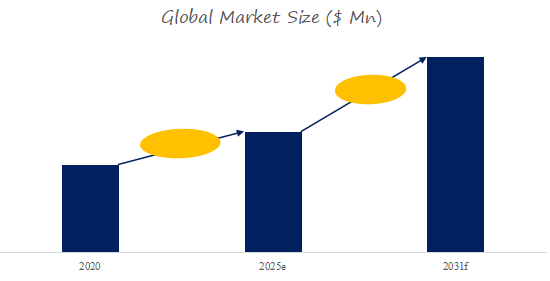
Above data is based on report from QYResearch: Global RF Front End MMIC Market Report 2025-2031 (published in 2025). If you need the latest data, plaese contact QYResearch.
Figure. Global RF Front End MMIC Top 16 Players Ranking and Market Share (Ranking is based on the revenue of 2024, continually updated)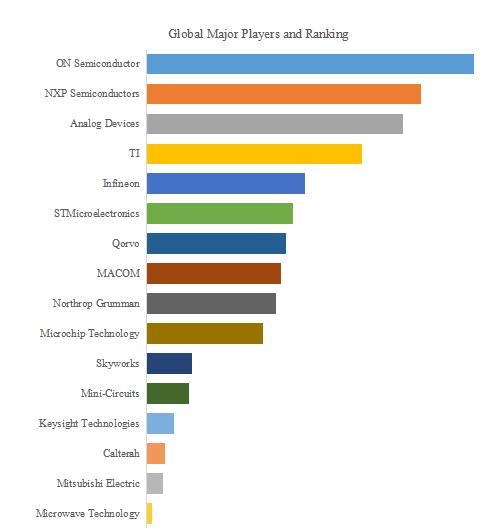
Above data is based on report from QYResearch: Global RF Front End MMIC Market Report 2025-2031 (published in 2025). If you need the latest data, plaese contact QYResearch.
This report profiles key players of RF Front End MMIC such as ON Semiconductor, NXP Semiconductors, Analog Devices, TI, Infineon, etc.
In 2024, the global top five RF Front End MMIC players account for 30.20% of market share in terms of revenue. Above figure shows the key players ranked by revenue in RF Front End MMIC.
Figure. RF Front End MMIC, Global Market Size, Split by Product Segment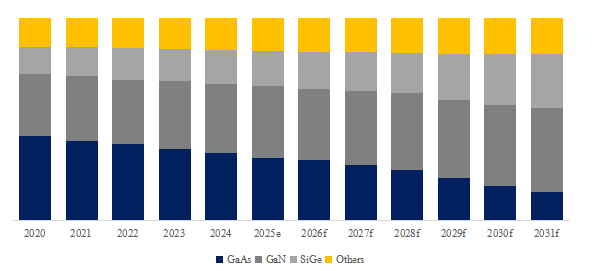
Based on or includes research from QYResearch: Global RF Front End MMIC Market Report 2025-2031.
In terms of product type, GaN is the largest segment, hold a share of 33.94%.
Figure. RF Front End MMIC, Global Market Size, Split by Application Segment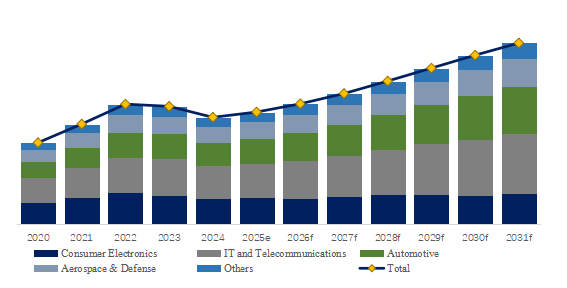
Based on or includes research from QYResearch: Global RF Front End MMIC Market Report 2025-2031.
In terms of product application, IT and Telecommunications is the largest application, hold a share of 30.34%.
About QYResearch
QYResearch founded in California, USA in 2007.It is a leading global market research and consulting company. With over 17 years’ experience and professional research team in various cities over the world QY Research focuses on management consulting, database and seminar services, IPO consulting (data is widely cited in prospectuses, annual reports and presentations), industry chain research and customized research to help our clients in providing non-linear revenue model and make them successful. We are globally recognized for our expansive portfolio of services, good corporate citizenship, and our strong commitment to sustainability. Up to now, we have cooperated with more than 60,000 clients across five continents. Let’s work closely with you and build a bold and better future.
QYResearch is a world-renowned large-scale consulting company. The industry covers various high-tech industry chain market segments, spanning the semiconductor industry chain (semiconductor equipment and parts, semiconductor materials, ICs, Foundry, packaging and testing, discrete devices, sensors, optoelectronic devices), photovoltaic industry chain (equipment, cells, modules, auxiliary material brackets, inverters, power station terminals), new energy automobile industry chain (batteries and materials, auto parts, batteries, motors, electronic control, automotive semiconductors, etc.), communication industry chain (communication system equipment, terminal equipment, electronic components, RF front-end, optical modules, 4G/5G/6G, broadband, IoT, digital economy, AI), advanced materials industry Chain (metal materials, polymer materials, ceramic materials, nano materials, etc.), machinery manufacturing industry chain (CNC machine tools, construction machinery, electrical machinery, 3C automation, industrial robots, lasers, industrial control, drones), food, beverages and pharmaceuticals, medical equipment, agriculture, etc.

Global RF Front End MMIC Sales Market Report, Competitive Analysis and Regional Opportunities 2026-2032

Published Date: 2026-01-05

Pages: 105

Report ld: 5572384
Price:USD 4250.00
(Single User License)
Global RF Front End MMIC Market Research Report 2026
Published Date: 2026-01-05
Pages: 151
Report ld: 5520268
Price:USD 2900.00
(Single User License)
RF Front End MMIC- Global Market Share and Ranking, Overall Sales and Demand Forecast 2026-2032
Published Date: 2026-01-05
Pages: 145
Report ld: 5510522
Price:USD 3950.00
(Single User License)
RF Front End MMIC - Global Market Share and Ranking, Overall Sales and Demand Forecast 2025-2031
Published Date: 2025-10-14
Pages: 150
Report ld: 5053310
Price:USD 3950.00
(Single User License)
Global RF Front End MMIC Market Outlook, In‑Depth Analysis & Forecast to 2031
Published Date: 2025-09-25
Pages: 180
Report ld: 5053311
Price:USD 4900.00
(Single User License)
Global RF Front End MMIC Sales Market Report, Competitive Analysis and Regional Opportunities 2025-2031
Published Date: 2025-09-25
Pages: 108
Report ld: 5053308
Price:USD 4250.00
(Single User License)


Competition
Key players, new entrants,acquisitions, mergers and expansions,development trends and challenges.

Industry Analysis
Rawmaterial, application, product type, demand,supply,downstream, supply chain etc.

Market Size
Capacity, production, sales, revenue, price, cost etc.

Customized Information
We can offer customized survey and information to meet ourclient's need.
