Carbon Nanotube CNT Market Insight Report: Understanding the Needs and Trends in the Industry 2026-2032


Carbon Nanotube (CNT) Market Summary
Carbon Nanotubes (CNTs) are cylindrical nanostructures composed entirely of carbon atoms, arranged in a hexagonal (honeycomb) lattice that rolls into a tube shape. Their diameter typically ranges from a few nanometers to tens of nanometers, while their length can extend from micrometers to millimeters—creating an extremely high aspect ratio (length-to-diameter ratio) that underpins their unique properties.
According to the new market research report “Global Carbon Nanotube (CNT) Market Report 2025-2031”, published by QYResearch, the global Carbon Nanotube (CNT) market size is projected to reach USD 4.86 billion by 2031, at a CAGR of 34.7% during the forecast period.
Figure. Global Carbon Nanotube (CNT) Market Size (US$ Million), 2020-2031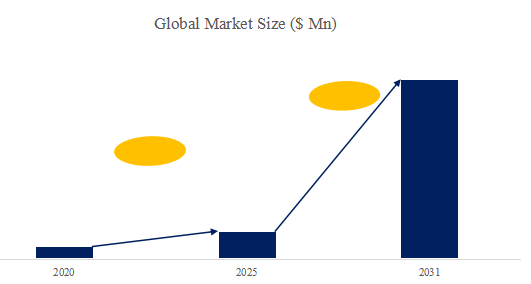
Above data is based on report from QYResearch: Global Carbon Nanotube (CNT) Market Report 2025-2031 (published in 2025). If you need the latest data, plaese contact QYResearch.
Figure. Global Carbon Nanotube (CNT) Top 10 Players Ranking and Market Share (Ranking is based on the revenue of 2024, continually updated)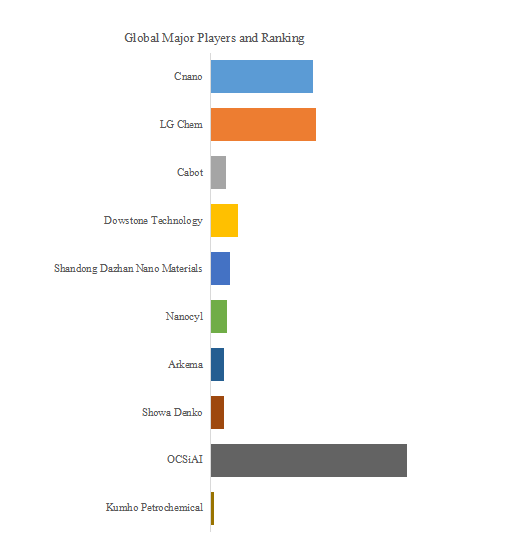
Above data is based on report from QYResearch: Global Carbon Nanotube (CNT) Market Report 2025-2031 (published in 2025). If you need the latest data, plaese contact QYResearch.
According to QYResearch Top Players Research Center, the global key manufacturers of Carbon Nanotube (CNT) include Cnano, LG Chem, Cabot, Dowstone Technology, etc. In 2024, the global top four players had a share approximately 38.0% in terms of revenue.
In terms of product type, currently MWNTs is the largest segment, hold a share of 55.0%.
In terms of product application, currently Lithium Battery is the largest segment, hold a share of 91.5%.
Market Drivers
1. Demand for High-Performance Materials in Advanced Industries
Industries such as aerospace, automotive, and electronics increasingly require materials that balance light weight, mechanical strength, and functional performance (e.g., conductivity, heat resistance). CNTs, when added as a filler to polymers, metals, or ceramics, enhance the composite’s strength while reducing weight—ideal for aerospace components (e.g., aircraft panels) or automotive parts (e.g., lightweight structural materials). In electronics, their high electrical conductivity supports the development of smaller, more efficient components (e.g., flexible circuits, conductive adhesives).
2. Growth in Energy Storage and Conversion Applications
The global shift toward renewable energy and electric vehicles (EVs) drives demand for high-performance energy storage systems (e.g., lithium-ion batteries, supercapacitors). CNTs improve battery performance by enhancing electrode conductivity, increasing charge/discharge rates, and extending cycle life. They also enable the development of thinner, lighter supercapacitors for portable electronics or EV regenerative braking systems. Additionally, CNT-based catalysts show promise for fuel cells, further expanding their role in clean energy technologies.
3. Advancements in Electronics and Flexible Devices
The rise of flexible electronics (e.g., foldable smartphones, wearable sensors) and miniaturized components requires materials that combine flexibility with electrical conductivity. SWCNTs, in particular, can be integrated into flexible films or inks to create conductive pathways that withstand bending without losing performance. They also hold potential for next-generation transistors and quantum computing components, as their nanoscale size and electronic properties enable faster, more energy-efficient device operation.
4. Research and Development (R&D) Investments
Governments, academic institutions, and private enterprises worldwide are investing heavily in CNT R&D to unlock new applications and improve production processes. Funding for nanotechnology initiatives (e.g., national research programs focused on advanced materials) supports innovations in CNT synthesis, purification, and functionalization—addressing historical limitations like scalability and cost. These investments accelerate the transition of CNT-based technologies from lab prototypes to commercial products.
5. Environmental and Sustainability Goals
CNTs contribute to sustainability in multiple ways: they enable lighter, more fuel-efficient vehicles (reducing carbon emissions); enhance the efficiency of renewable energy systems (e.g., solar panels with CNT-based coatings for better light absorption); and can replace toxic materials (e.g., lead-based solders in electronics) with safer, more durable alternatives. As industries align with global carbon neutrality targets, the demand for sustainable, high-performance materials like CNTs continues to grow.
Market Challenges
1. High Production Costs and Scalability Issues
Traditional CNT synthesis methods (e.g., chemical vapor deposition, arc discharge) are often expensive and difficult to scale for mass production, especially for high-purity SWCNTs. Purification processes to remove impurities (e.g., carbon nanoparticles, metal catalysts) add further costs, limiting adoption in price-sensitive applications. While MWCNTs are more scalable, their performance is often lower than SWCNTs, creating a trade-off between cost and functionality.
2. Safety and Regulatory Uncertainties
The potential health and environmental impacts of CNTs (e.g., inhalation risks for workers, accumulation in ecosystems) remain a subject of ongoing research. Regulatory bodies in some regions have imposed strict testing or labeling requirements for CNT-based products, and uncertainty about future regulations can deter manufacturers from investing in CNT integration. Additionally, standardization of safety protocols for handling and disposing of CNTs is still evolving, creating compliance challenges for businesses.
3. Technical Barriers to Integration
Integrating CNTs into existing manufacturing processes (e.g., composite fabrication, electronics assembly) requires specialized equipment and expertise. For example, ensuring uniform dispersion of CNTs in polymer matrices is technically challenging—poor dispersion reduces the composite’s performance and can lead to product defects. Additionally, CNTs’ high aspect ratio can cause agglomeration, and their compatibility with other materials (e.g., adhesives, coatings) may require costly modifications to existing formulas.
4. Competition from Alternative Nanomaterials
CNTs face competition from other advanced nanomaterials, such as graphene (a 2D carbon nanostructure), carbon nanofibers, and metal-organic frameworks (MOFs). Graphene, in particular, offers similar or superior properties (e.g., thermal conductivity, flexibility) in some applications and has received significant commercial attention. For end-users, choosing between these materials depends on cost, performance, and availability—creating pressure for CNT manufacturers to differentiate their products.
5. Limited Commercialization of High-Value Applications
While CNTs have shown promise in lab-scale tests for high-value applications (e.g., quantum computing, advanced medical devices), many of these use cases remain in early development. Translating lab results to commercial products requires overcoming technical hurdles (e.g., precise control of CNT structure, compatibility with industrial workflows) and demonstrating long-term reliability. For example, in medical applications (e.g., drug delivery, biosensors), proving biocompatibility and regulatory approval can take years, delaying market adoption.
About QYResearch
QYResearch founded in California, USA in 2007.It is a leading global market research and consulting company. With over 17 years’ experience and professional research team in various cities over the world QY Research focuses on management consulting, database and seminar services, IPO consulting (data is widely cited in prospectuses, annual reports and presentations), industry chain research and customized research to help our clients in providing non-linear revenue model and make them successful. We are globally recognized for our expansive portfolio of services, good corporate citizenship, and our strong commitment to sustainability. Up to now, we have cooperated with more than 60,000 clients across five continents. Let’s work closely with you and build a bold and better future.
QYResearch is a world-renowned large-scale consulting company. The industry covers various high-tech industry chain market segments, spanning the semiconductor industry chain (semiconductor equipment and parts, semiconductor materials, ICs, Foundry, packaging and testing, discrete devices, sensors, optoelectronic devices), photovoltaic industry chain (equipment, cells, modules, auxiliary material brackets, inverters, power station terminals), new energy automobile industry chain (batteries and materials, auto parts, batteries, motors, electronic control, automotive semiconductors, etc.), communication industry chain (communication system equipment, terminal equipment, electronic components, RF front-end, optical modules, 4G/5G/6G, broadband, IoT, digital economy, AI), advanced materials industry Chain (metal materials, polymer materials, ceramic materials, nano materials, etc.), machinery manufacturing industry chain (CNC machine tools, construction machinery, electrical machinery, 3C automation, industrial robots, lasers, industrial control, drones), food, beverages and pharmaceuticals, medical equipment, agriculture, etc.

Global Carbon Nanotube CNT Market Outlook, In‑Depth Analysis & Forecast to 2032

Published Date: 2026-07-09

Pages: 151

Report ld: 5648345
Price:USD 4900.00
(Single User License)
Global Carbon Nanotube CNT Sales Market Report, Competitive Analysis and Regional Opportunities 2026-2032
Published Date: 2026-07-09
Pages: 136
Report ld: 5556213
Price:USD 4250.00
(Single User License)
Global Carbon Nanotube CNT Market Research Report 2026
Published Date: 2026-07-09
Pages: 140
Report ld: 5533788
Price:USD 2900.00
(Single User License)
Carbon Nanotube CNT- Global Market Share and Ranking, Overall Sales and Demand Forecast 2026-2032
Published Date: 2026-07-09
Pages: 143
Report ld: 5494178
Price:USD 3950.00
(Single User License)
Carbon Nanotube CNT - Global Market Share and Ranking, Overall Sales and Demand Forecast 2025-2031
Published Date: 2025-10-21
Pages: 106
Report ld: 4924168
Price:USD 3950.00
(Single User License)
Global Carbon Nanotube CNT Market Outlook, In‑Depth Analysis & Forecast to 2031
Published Date: 2025-09-11
Pages: 141
Report ld: 4924171
Price:USD 4900.00
(Single User License)


Competition
Key players, new entrants,acquisitions, mergers and expansions,development trends and challenges.

Industry Analysis
Rawmaterial, application, product type, demand,supply,downstream, supply chain etc.

Market Size
Capacity, production, sales, revenue, price, cost etc.

Customized Information
We can offer customized survey and information to meet ourclient's need.
