Vision-Guided Robotic for Palletizing Solutions Industry Research: at a CAGR of approximately 9.4% during 2026-2032


Vision-Guided Robotic for Palletizing Solutions Market Summary
Vision-guided robotic for palletizing solutions are integrated automation systems that use industrial robots or collaborative robots together with 2D/3D vision, lighting, end-of-arm tooling, conveyors, pallet dispensers, safety devices, control software, and PLC, WMS, MES or ERP connectivity to stack cartons, bags, cases, trays, pails and mixed SKU products onto pallets. The vision module detects product dimensions, position, orientation, labels, barcodes and pallet status, then guides the robot to select the right gripping point, generate a stable layer pattern and adjust the stacking sequence in real time. These solutions are especially valuable where incoming products shift on conveyors, bags deform, pack sizes change frequently, or manual loading creates inconsistent placement. Compared with fixed mechanical palletizers or manual palletizing, vision-guided robotic systems offer higher flexibility, shorter changeover, smaller or more configurable footprints, better traceability and reduced ergonomic risk. They are widely used in food and beverage, consumer goods, pharmaceuticals, e-commerce fulfillment, building materials and industrial packaging as manufacturers upgrade factories toward flexible automation and intelligent logistics.
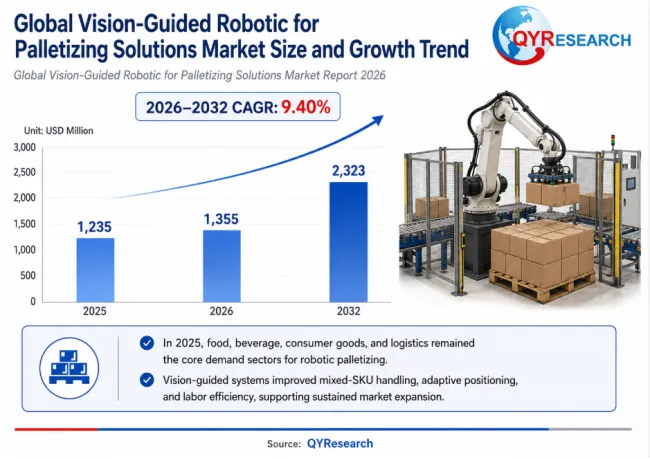
According to the new market research report "Global Vision-Guided Robotic for Palletizing Solutions Market Report 2026-2032", published by QYResearch, the global Vision-Guided Robotic for Palletizing Solutions market size was estimated at approximately USD 1,235 million in 2025. It is projected to grow from USD 1,355 million in 2026 to around USD 2,323 million by 2032, at a CAGR of approximately 9.4% during 2026-2032.
Vision-Guided Robotic Palletizing Solutions combine industrial robots, machine vision, grippers, conveyors, sensors, and control software to automatically identify, pick, orient, and stack cartons, bags, trays, cases, or irregular packages onto pallets. The market is expanding as manufacturers face labor shortages, rising logistics costs, SKU diversification, and demand for flexible end-of-line automation. Future development will focus on AI vision recognition, mixed-SKU palletizing, collaborative robots, quick-change grippers, digital twin simulation, compact robotic cells, and integration with warehouse management and production execution systems, enabling factories to shift from fixed mechanical palletizers to flexible intelligent palletizing platforms.
Figure00001. Global Vision-Guided Robotic for Palletizing Solutions Market Size and Growth Trend
Above data is based on report from QYResearch: Global Vision-Guided Robotic for Palletizing Solutions Market Report 2026-2032 (published in 2026). If you need the latest data, please contact QYResearch.
Figure00002. Global Vision-Guided Robotic for Palletizing Solutions Competitive Landscape and Leading Companies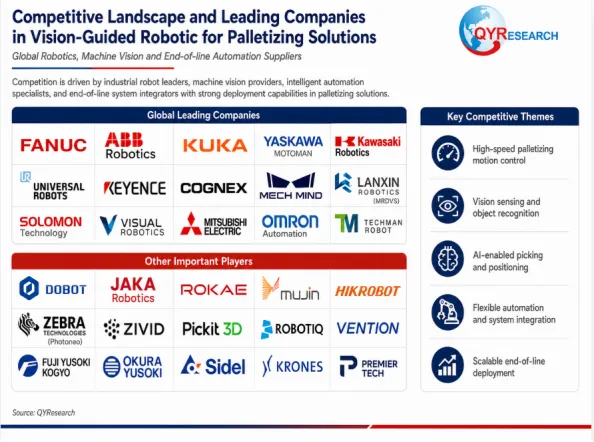
Above data is based on report from QYResearch: Global Vision-Guided Robotic for Palletizing Solutions Market Report 2026-2032 (published in 2026). If you need the latest data, please contact QYResearch.
The market is shaped by industrial robot leaders, machine vision technology providers, intelligent automation specialists, and end-of-line packaging and palletizing system integrators. Key competitive themes include high-speed palletizing motion control, vision sensing and object recognition, AI-enabled picking and positioning, flexible automation and system integration, and scalable end-of-line deployment. FANUC, ABB Robotics, KUKA, Yaskawa Motoman, Kawasaki Robotics, Universal Robots, KEYENCE, Cognex, Mech-Mind Robotics, Lanxin Robotics (MRDVS), Solomon Technology, Visual Robotics, Mitsubishi Electric, OMRON Automation, and Techman Robot represent the global leading group, supported by strong capabilities in robot platforms, vision recognition, control systems, and automation technologies. DOBOT, JAKA Robotics, ROKAE, Mujin, Hikrobot, Zebra Technologies (Photoneo), Zivid, Pickit 3D, Robotiq, Vention, Fuji Yusoki Kogyo, Okura Yusoki, Sidel, Krones, and Premier Tech form an important group of additional players, contributing through collaborative robots, 3D vision, end-effectors, line integration, packaging equipment, and palletizing system deployment. Together, these companies are driving the market toward more intelligent, flexible, and efficient palletizing automation.
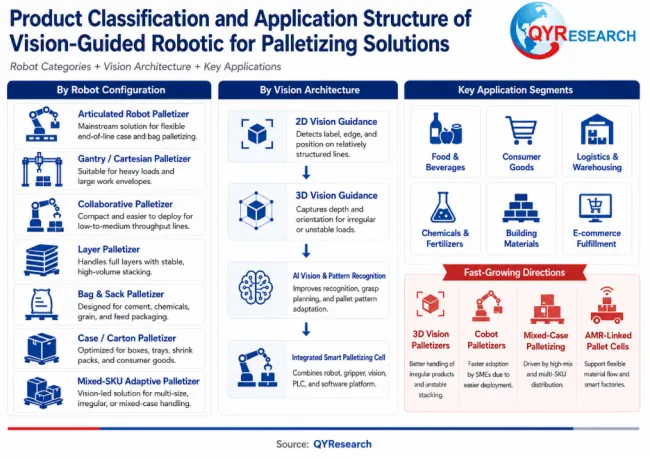
Figure00003. Vision-Guided Robotic for Palletizing Solutions, Product Classification and Application Structure
Based on or includes research from QYResearch: Global Vision-Guided Robotic for Palletizing Solutions Market Report 2026-2032.
In terms of product type, 3D vision-guided robotic palletizing cells are becoming the largest and fastest-growing segment because mixed packaging lines increasingly need random item localization, flexible gripper control, layer-pattern optimization and automatic changeover without extensive mechanical adjustment.
In terms of product application, food and beverage packaging remains the largest application; e-commerce fulfillment, pharmaceuticals and consumer goods are expected to grow faster due to SKU proliferation, labor shortages, warehouse automation investment and higher requirements for safe, traceable handling.
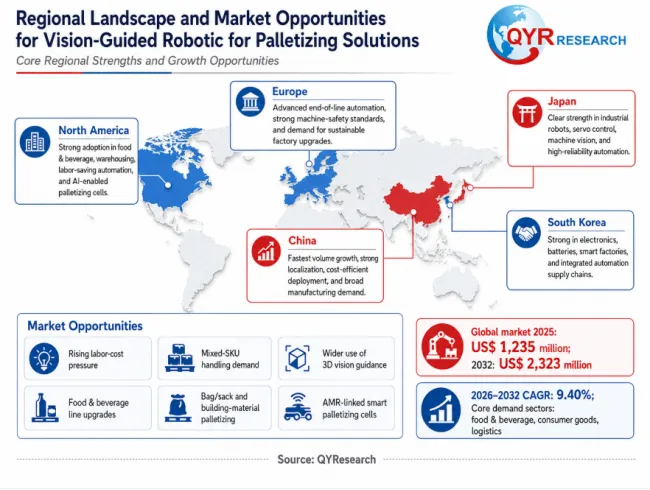
Figure00004. Vision-Guided Robotic for Palletizing Solutions, Regional Landscape and Market Opportunities
Based on or includes research from QYResearch: Global Vision-Guided Robotic for Palletizing Solutions Market Report 2026-2032.
North America and Europe have strong demand for robotic palletizing due to high labor costs, mature automation adoption, and strict workplace safety requirements. Japan and South Korea emphasize compact, high-precision, and reliable robotic cells for limited factory space, while China has broad opportunities in food, beverage, chemicals, e-commerce logistics, and manufacturing automation upgrades. Southeast Asia, India, Latin America, and the Middle East are emerging markets where rising industrialization, export manufacturing, and warehouse automation create demand for cost-effective and modular robotic palletizing systems.
Figure00005. Vision-Guided Robotic for Palletizing Solutions Industry Chain Analysis
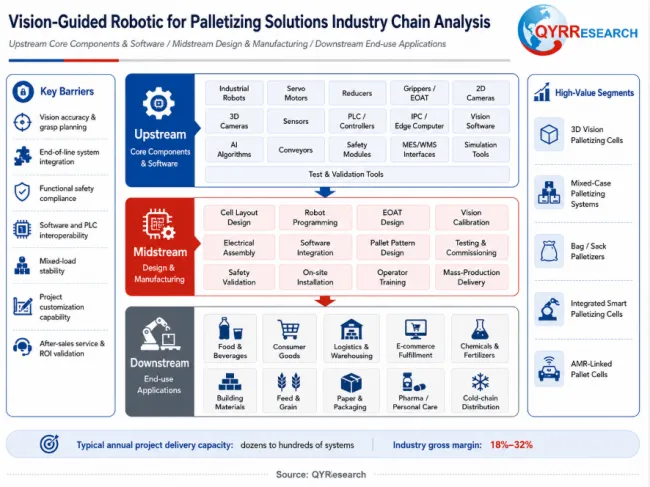
Source: Secondary Sources, Press Releases, Expert Interviews and QYResearch, 2026
The upstream of this industry includes industrial robots, servo motors, reducers, vision cameras, lenses, lighting, sensors, grippers, conveyors, safety components, controllers, and robot software. Midstream suppliers include robotic system integrators, palletizing cell designers, machine vision algorithm developers, end-of-arm tooling manufacturers, and automation engineering companies. Downstream applications include food and beverage, chemicals, pharmaceuticals, building materials, consumer goods, e-commerce logistics, warehousing, and third-party logistics, where value is created through palletizing speed, flexibility, uptime, safety, and integration with upstream packaging lines and downstream warehouse systems.
Table 1. Vision-Guided Robotic for Palletizing Solutions Industry Policy Analysis
|
|
Policy |
Description |
|
1 |
Smart manufacturing and robot adoption policies |
Policies supporting smart manufacturing, robotics, industrial internet platforms and factory automation are directly raising the willingness of manufacturers to invest in flexible palletizing cells. A vision-guided robotic palletizing solution does more than move cartons or bags: it can connect product batches, case codes, pallet IDs, cycle time, downtime events and equipment status to MES or WMS platforms, creating a traceable data loop between production and logistics. Government incentives for automation, productivity improvement, energy efficiency and high-quality manufacturing encourage food, beverage, consumer goods, pharmaceutical, building-material and warehouse operators to replace manual palletizing or fixed mechanical palletizers with robot vision systems. This also makes supplier selection more dependent on proven reference projects, commissioning speed, application engineering depth and measurable operational results. |
|
2 |
Occupational safety and ergonomic regulation |
Palletizing jobs often involve repetitive lifting, bending, twisting, dust exposure, noise and the handling of heavy or awkward packages. Markets such as Europe, Japan, China and North America continue to strengthen occupational health, safety production, injury prevention and human-machine separation requirements. Vision-guided robotic palletizers reduce direct manual handling and, when combined with guarding, light curtains, safety scanners, torque limits and collaborative robot functions, lower the probability of accidents. Aging workforces, difficulty recruiting for physically demanding shifts and rising compensation costs make safety policy and corporate responsibility goals important drivers for automated palletizing investment. This also makes supplier selection more dependent on proven reference projects, commissioning speed, application engineering depth and measurable operational results. |
|
3 |
Food, pharmaceutical and traceability compliance |
Food, beverage, pharmaceutical and medical-supply supply chains increasingly require batch traceability, label consistency, case-code association and error-proof shipment control. As a result, palletizing is no longer only a material-handling step; it is becoming a quality-control and logistics-data collection point. Vision systems can read barcodes or QR codes, confirm case orientation, detect label position and verify pallet stacking status, helping avoid mixed pallets, inverted cases, missing cases and wrong SKUs entering downstream warehousing. Regulatory audits and brand-owner requirements push suppliers to strengthen code reading, data retention, exception alarms, automatic rechecking and software interfaces. This also makes supplier selection more dependent on proven reference projects, commissioning speed, application engineering depth and measurable operational results. |
Source: Secondary Sources, Press Releases, Expert Interviews and QYResearch, 2026
Table 2. Vision-Guided Robotic for Palletizing Solutions Industry Development Trends
|
|
Development Trends |
Description |
|
1 |
Fusion of 3D vision and AI gripping logic |
Conventional palletizers rely on fixed infeed positions and predefined layer patterns, but mixed lines, deformable bags, shrink-wrapped packs and e-commerce order volatility make purely mechanical solutions less adaptable. 3D cameras, point-cloud localization, deep-learning recognition and AI path planning are being integrated more deeply with robot controllers. They allow the system to identify case posture, bag wrinkles, surface height variation and feasible gripping zones, then adjust vacuum zones, gripping force and stacking order dynamically. This trend improves handling of non-standard packaging and shifts supplier competition toward algorithms, application data, commissioning know-how and industry-specific model libraries rather than only hardware supply. This also makes supplier selection more dependent on proven reference projects, commissioning speed, application engineering depth and measurable operational results. |
|
2 |
From standalone palletizers to line-wide logistics nodes |
Customers increasingly want palletizing cells to work with case packing, sealing, weighing, labeling, code reading, conveyors, sorters, stretch wrappers, AGVs, AMRs and automated warehouses instead of operating as isolated end-of-line machines. Vision-guided robotic palletizing is therefore becoming an internal logistics node that can switch pallet patterns according to WMS orders, pallet specifications, product dimensions and shipping rules. This trend requires suppliers to provide mechanical engineering, electrical controls, software integration, simulation, project management and after-sales support. It also strengthens the position of automation integrators that can deliver the complete material-flow architecture around the robot. This also makes supplier selection more dependent on proven reference projects, commissioning speed, application engineering depth and measurable operational results. |
|
3 |
Modular, fast-deployment and collaborative designs |
Small and mid-sized factories, regional warehouses and high-mix production sites often do not have the budget or time for long customized automation projects. Demand is increasing for standardized robotic palletizing cells, preconfigured vision packages, movable bases, compact safety layouts and low-fence collaborative configurations. Modular design shortens installation and commissioning time while letting users select robot payload, gripper type, software template and pallet specification according to line speed, package weight and floor-space constraints. Collaborative robots are entering low- and medium-speed palletizing scenarios where customers want automation without a major facility rebuild, especially for secondary packaging and seasonal production. This also makes supplier selection more dependent on proven reference projects, commissioning speed, application engineering depth and measurable operational results. |
|
4 |
Higher value from digital twins and remote service |
As customers deploy more robot cells across multiple plants, they pay greater attention to cycle-time monitoring, fault prediction, stack stability analysis, energy consumption and remote support. Suppliers are adding offline simulation, digital twins, cloud alarms, remote vision-model updates and predictive maintenance to validate throughput before installation and reduce trial-and-error on site. After start-up, these tools help customers optimize OEE, compare shifts, identify packaging changes that cause instability and plan maintenance windows. Digital service capability changes palletizing from a one-time equipment sale into a lifecycle platform, increasing revenue from software licenses, service contracts, spare parts and upgrade projects. This also makes supplier selection more dependent on proven reference projects, commissioning speed, application engineering depth and measurable operational results. |
Source: Secondary Sources, Press Releases, Expert Interviews and QYResearch, 2026
Table 3. Vision-Guided Robotic for Palletizing Solutions Industry Development Opportunities
|
|
Development Opportunities |
Description |
|
1 |
Automation expansion in food, beverage and consumer goods |
Beverages, dairy, snacks, condiments, pet food and household products have high shipment volumes, frequent packaging changes and strong requirements for stable outbound logistics, making them core demand sources for vision-guided robotic palletizing. As factories expand and older end-of-line equipment is replaced, customers want to handle more SKUs with fewer operators while maintaining throughput during promotions, seasonal peaks and new-product launches. Suppliers that can combine high-speed picking, carton-and-bag compatibility, rapid changeover, pallet stability verification and data integration are well positioned to enter full packaging-line projects and win repeat orders across multiple plants. This also makes supplier selection more dependent on proven reference projects, commissioning speed, application engineering depth and measurable operational results. |
|
2 |
Growth in e-commerce fulfillment and multi-SKU logistics |
E-commerce, retail distribution and third-party logistics centers face fragmented orders, non-uniform carton sizes and large peak-season swings, which fixed palletizers struggle to handle efficiently. Vision-guided robots can identify different case sizes, read destination labels and build pallets according to route, store or order requirements, making them suitable for mixed palletizing, cross-docking and automated sortation environments. As warehouse operators pursue lower labor dependency, night-shift operation and better process visibility, solutions that integrate vision algorithms, WMS interfaces, mixed-case layer optimization and coordination with AMRs or conveyor systems can capture higher value than simple robot cells. This also makes supplier selection more dependent on proven reference projects, commissioning speed, application engineering depth and measurable operational results. |
|
3 |
Error-proofing demand in pharma and high-value industrial goods |
Pharmaceuticals, medical devices, electronic components, specialty chemicals and high-value industrial products require strong control over batch accuracy, package orientation, case-code association and pallet completeness. A palletizing error can lead to recalls, delayed shipments, quarantine of inventory or compliance issues. Vision-guided robotic systems can confirm barcodes, inspect visible package attributes, correct orientation and record handling data before and after each pick. Although the line speed may be lower than in beverage applications, project value, validation requirements and customer stickiness are often higher, creating opportunities for suppliers with compliant software architecture, documentation support and reliable long-term service. This also makes supplier selection more dependent on proven reference projects, commissioning speed, application engineering depth and measurable operational results. |
|
4 |
Automation catch-up in emerging manufacturing regions |
Southeast Asia, India, Latin America, the Middle East and secondary manufacturing clusters in China are expanding food, consumer-goods, building-material and export packaging capacity, while labor availability and quality consistency remain challenging. Vision-guided robotic palletizing can be deployed as a modular end-of-line solution before customers invest in a complete automated warehouse, allowing them to solve manual handling bottlenecks step by step. Suppliers with local service teams, standardized product packages, quick delivery, multilingual software and attractive price-performance ratios can gain share as these regions upgrade from manual or semi-automatic palletizing to flexible robotic systems. This also makes supplier selection more dependent on proven reference projects, commissioning speed, application engineering depth and measurable operational results. |
Source: Secondary Sources, Press Releases, Expert Interviews and QYResearch, 2026
Table 4. Vision-Guided Robotic for Palletizing Solutions Obstacles/Challenges to Industry Development
|
|
Obstacles/Challenges |
Description |
|
1 |
High customization caused by diverse package formats |
Palletized products may include corrugated cartons, shrink-wrapped bundles, powder bags, woven sacks, pails, trays, pallet boxes or irregular industrial components. Their weight, surface texture, rigidity, center of gravity and usable gripping areas differ substantially. Each factory may also have different infeed orientation, conveyor height, available floor space, pallet specification, safety rules and washdown requirements. These variations require sample testing, gripper engineering, simulation and on-site commissioning. Without strong application experience, suppliers may face inadequate cycle time, dropped products, unstable stacks, difficult maintenance or repeated customer acceptance delays, all of which can erode project margins. This also makes supplier selection more dependent on proven reference projects, commissioning speed, application engineering depth and measurable operational results. |
|
2 |
Capital expenditure and payback concerns |
A vision-guided robotic palletizing system usually includes the robot, vision hardware, gripper, safety package, conveyors, controls, software interface and installation services, so the initial investment is higher than a manual station or a simple mechanical device. Some small and mid-sized customers recognize the labor problem but remain cautious about ROI, production downtime during retrofit, operator training and after-sales response. Suppliers must explain the total value created by labor savings, fewer injuries, more stable shipping, lower rework, reduced product damage and support for high-mix production. Standardized products, phased deployment or rental models may be needed to lower the adoption threshold. This also makes supplier selection more dependent on proven reference projects, commissioning speed, application engineering depth and measurable operational results. |
|
3 |
Integration capability and lifecycle service barriers |
Vision-guided palletizing is not a single robot sale; it is a combined project involving mechanical design, electrical controls, vision algorithms, robot programming, information-system interfaces and field service. A weakness in any part can reduce line throughput or delay acceptance. Regional integrators may offer competitive prices, but their capabilities in complex applications, multi-plant replication, global service and long-term software maintenance vary widely. Larger suppliers need to balance standardization with customer-specific engineering while building training systems, spare-parts availability and remote support networks. The challenge is to deliver predictable performance and still keep integration projects profitable. This also makes supplier selection more dependent on proven reference projects, commissioning speed, application engineering depth and measurable operational results. |
|
4 |
Data interfaces and cybersecurity requirements |
As palletizing cells connect to MES, WMS, ERP, SCADA and cloud platforms, customers are asking more detailed questions about data formats, user permissions, event logs, remote access, backup rules and network segmentation. Interfaces among different robot brands, vision systems and warehouse software are not always standardized, and retrofit projects may involve legacy PLCs or non-standard databases. Suppliers without information-technology and cybersecurity competence can face delays during factory acceptance or final validation. Future competition will depend not only on mechanical accuracy and cycle time, but also on whether the system can be safely, reliably and auditably integrated into the customer’s digital architecture. |
Source: Secondary Sources, Press Releases, Expert Interviews and QYResearch, 2026
The report provides a detailed analysis of the market size, growth potential, and key trends for each segment. Through detailed analysis, industry players can identify profit opportunities, develop strategies for specific customer segments, and allocate resources effectively.
The Vision-Guided Robotic for Palletizing Solutions market is segmented as below:
By Company
FANUC
ABB Robotics
KUKA
Yaskawa Motoman
Kawasaki Robotics
Universal Robots
KEYENCE
Cognex
Mech-Mind Robotics
Lanxin Robotics(MRDVS)
Solomon Technology
Visual Robotics
Mitsubishi Electric
OMRON Automation
Techman Robot
DOBOT
JAKA Robotics
ROKAE
Mujin
Hikrobot
Zebra Technologies(Photoneo)
Zivid
Pickit 3D
Robotiq
Vention
Fuji Yusoki Kogyo
Okura Yusoki
Sidel
Krones
Premier Tech
Segment by Type
2D Vision Type
3D Vision Type
Hybrid Vision Type
Segment by Application
Logistics and Warehousing
Food and Beverage
Chemical Industry
Building Materials
Automotive Parts
3C Electronics
Others
Each chapter of the report provides detailed information for readers to further understand the Vision-Guided Robotic for Palletizing Solutions market:
Chapter 1: Introduces the report scope of the Vision-Guided Robotic for Palletizing Solutions report, global total market size (valve, volume and price). This chapter also provides the market dynamics, latest developments of the market, the driving factors and restrictive factors of the market, the challenges and risks faced by manufacturers in the industry, and the analysis of relevant policies in the industry. (2021-2032)
Chapter 2: Detailed analysis of Vision-Guided Robotic for Palletizing Solutions manufacturers competitive landscape, price, sales and revenue market share, latest development plan, merger, and acquisition information, etc. (2021-2026)
Chapter 3: Provides the analysis of various Vision-Guided Robotic for Palletizing Solutions market segments by Type, covering the market size and development potential of each market segment, to help readers find the blue ocean market in different market segments. (2021-2032)
Chapter 4: Provides the analysis of various market segments by Application, covering the market size and development potential of each market segment, to help readers find the blue ocean market in different downstream markets.(2021-2032)
Chapter 5: Sales, revenue of Vision-Guided Robotic for Palletizing Solutions in regional level. It provides a quantitative analysis of the market size and development potential of each region and introduces the market development, future development prospects, market space, and market size of each country in the world..(2021-2032)
Chapter 6: Sales, revenue of Vision-Guided Robotic for Palletizing Solutions in country level. It provides sigmate data by Type, and by Application for each country/region.(2021-2032)
Chapter 7: Provides profiles of key players, introducing the basic situation of the main companies in the market in detail, including product sales, revenue, price, gross margin, product introduction, recent development, etc. (2021-2026)
Chapter 8: Analysis of industrial chain, including the upstream and downstream of the industry.
Chapter 9: Conclusion.
Other relevant reports of QYResearch:
Global Vision-Guided Robotic for Palletizing Solutions Sales Market Report, Competitive Analysis and Regional Opportunities 2026-2032
Global Vision-Guided Robotic for Palletizing Solutions Market Research Report 2026
Global Vision-Guided Robotic for Palletizing Solutions Market Outlook, In‑Depth Analysis & Forecast to 2032
Benefits of purchasing QYResearch report:
Competitive Analysis: QYResearch provides in-depth Vision-Guided Robotic for Palletizing Solutions competitive analysis, including information on key company profiles, new entrants, acquisitions, mergers, large market shear, opportunities, and challenges. These analyses provide clients with a comprehensive understanding of market conditions and competitive dynamics, enabling them to develop effective market strategies and maintain their competitive edge.
Industry Analysis: QYResearch provides Vision-Guided Robotic for Palletizing Solutions comprehensive industry data and trend analysis, including raw material analysis, market application analysis, product type analysis, market demand analysis, market supply analysis, downstream market analysis, and supply chain analysis.
and trend analysis. These analyses help clients understand the direction of industry development and make informed business decisions.
Market Size: QYResearch provides Vision-Guided Robotic for Palletizing Solutions market size analysis, including capacity, production, sales, production value, price, cost, and profit analysis. This data helps clients understand market size and development potential, and is an important reference for business development.

Vision-Guided Robotic for Palletizing Solutions - Global Market Share and Ranking, Overall Sales and Demand Forecast 2026-2032

Published Date: 2026-07-09

Pages: 176

Report ld: 6699855
Price:USD 3950.00
(Single User License)
Global Vision-Guided Robotic for Palletizing Solutions Sales Market Report, Competitive Analysis and Regional Opportunities 2026-2032
Published Date: 2026-05-02
Pages: 161
Report ld: 6699872
Price:USD 4250.00
(Single User License)
Global Vision-Guided Robotic for Palletizing Solutions Market Research Report 2026
Published Date: 2026-05-02
Pages: 173
Report ld: 6699854
Price:USD 2900.00
(Single User License)
Global Vision-Guided Robotic for Palletizing Solutions Market Outlook, In‑Depth Analysis & Forecast to 2032
Published Date: 2026-05-02
Pages: 185
Report ld: 6699852
Price:USD 4900.00
(Single User License)


Competition
Key players, new entrants,acquisitions, mergers and expansions,development trends and challenges.

Industry Analysis
Rawmaterial, application, product type, demand,supply,downstream, supply chain etc.

Market Size
Capacity, production, sales, revenue, price, cost etc.

Customized Information
We can offer customized survey and information to meet ourclient's need.
