Global High Purity SiC Powder Market Forecast: 192 Million USD by 2026 – Entering a New Growth Phase


High Purity SiC Powder Market Summary
Silicon carbide powder was synthesized by mixing high-purity silicon powder and high-purity carbon powder in a certain proportion at a high temperature.
In the report, high-purity silicon carbide powder with the purity no less than 5N is researched.
Figure. High Purity SiC Powder Product Picture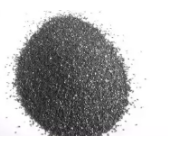
Above data is based on report from QYResearch: Global High Purity SiC Powder Market Report 2024-2031 (published in 2024). If you need the latest data, plaese contact QYResearch.
According to the new market research report “Global High Purity SiC Powder Market Report 2025-2031”, published by QYResearch, the global High Purity SiC Powder market size is projected to reach USD 0.55 billion by 2031, at a CAGR of 19.6% during the forecast period.
Figure. Global High Purity SiC Powder Market Size (US$ Million), 2020-2031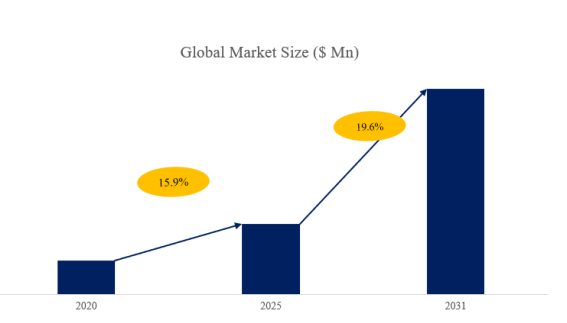
Above data is based on report from QYResearch: Global High Purity SiC Powder Market Report 2024-2031 (published in 2024). If you need the latest data, plaese contact QYResearch.
Figure. Global High Purity SiC Powder Top 14 Players Ranking and Market Share (Ranking is based on the revenue of 2024, continually updated)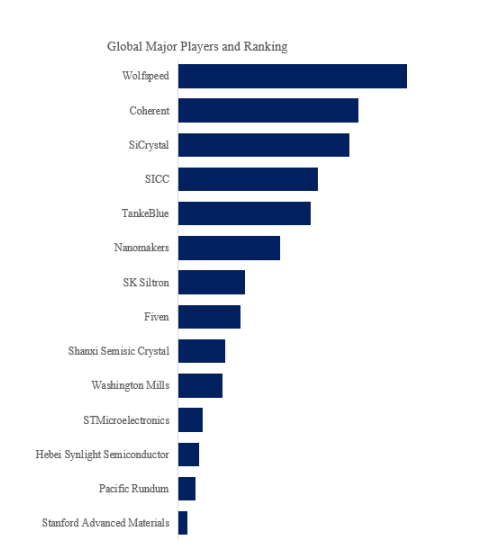
Above data is based on report from QYResearch: Global High Purity SiC Powder Market Report 2024-2031 (published in 2024). If you need the latest data, plaese contact QYResearch.
According to QYResearch Top Players Research Center, the global key manufacturers of High Purity SiC Powder include Wolfspeed, Coherent, SiCrystal, SICC, TankeBlue, Nanomakers, SK Siltron, Fiven, Shanxi Semisic Crystal, Washington Mills, etc. In 2024, the global top 10 players had a share approximately 67.0% in terms of revenue.
In terms of product type, currently SHS Method is the largest segment, hold a share of 65.3%.
In terms of product application, currently SiC Wafer is the largest segment, hold a share of 78.6%.
Market Drivers:
D1: One of the most important drivers is the rapid growth in demand for SiC-based power semiconductor devices, particularly in electric vehicles (EVs), renewable energy systems, and industrial power supplies. Compared to traditional silicon, SiC devices offer higher voltage resistance, faster switching, and superior thermal conductivity. To manufacture these high-performance components, ultra-pure SiC substrates and epitaxial layers are essential, creating strong demand for 5N+ SiC powder used in crystal growth processes such as PVT (Physical Vapor Transport). With the global shift toward energy efficiency and electrification, this sector is expected to see sustained long-term demand growth.
D2: High-purity SiC is increasingly used in radio frequency (RF) and millimeter-wave components for 5G infrastructure, aerospace, and satellite communications. These high-frequency applications require wide bandgap materials with minimal defects, low loss, and high thermal stability—all characteristics supported by ultra-high-purity SiC substrates. As the demand for higher data throughput and more reliable communication networks grows, particularly in harsh or high-power environments, the need for ultrapure SiC powder for these electronic applications is expected to accelerate.
D3: The aerospace, defense, and nuclear energy sectors are adopting advanced SiC-based ceramics and ceramic matrix composites (CMCs) due to their lightweight, radiation resistance, and ability to withstand temperatures exceeding 1500°C. In these applications, high-purity SiC powder is required to ensure phase stability, uniform sintering, and mechanical integrity under extreme conditions. The expanding use of such materials in jet engines, hypersonic vehicles, and next-generation reactors drives steady demand for ultrapure starting powders.
D4: National governments and industry coalitions—particularly in the U.S., EU, and China—are increasingly investing in the development of domestic SiC supply chains to reduce reliance on imported critical materials. High-purity SiC powder is now viewed as a strategic input, not only for semiconductor self-sufficiency but also for defense and energy security. These policy tailwinds, including subsidies, public–private partnerships, and R&D funding, are driving new investment into purification technologies, powder production capacity, and vertical integration across the SiC value chain.
Restraint:
R1: Producing high-purity (5N and above) SiC powder requires precise control over raw material purity, reaction conditions, and post-synthesis purification techniques such as halogen refining, chemical leaching, and high-temperature recrystallization. Even minor contamination—such as metallic elements, oxygen, or boron—can degrade the electronic properties of SiC substrates and devices. These technical challenges pose significant entry barriers for new manufacturers and limit the scalability of production, especially in regions without established know-how or equipment for ultra-high-purity ceramic processing.
R2: The production of 5N and 6N grade SiC powders involves energy-intensive processes, specialized equipment (e.g., high-purity furnaces, cleanrooms), and stringent environmental controls. These factors lead to high capital expenditure (CapEx) and operating costs (OpEx), making cost competitiveness a major challenge—particularly for small and mid-sized companies. As global demand for SiC increases, producers are under pressure to scale up capacity while maintaining ultra-high purity, which is difficult without significant investment in automation and process optimization.
R3: The manufacturing process for high-purity SiC powder, especially using SHS, carbothermal, or CVD methods, generates significant emissions and solid waste. These include greenhouse gases (e.g., CO, CO₂), halogenated byproducts (e.g., Cl₂, HCl), and spent acids from purification stages. Increasing global emphasis on environmental sustainability, stricter emission limits, and hazardous material regulations can impose compliance burdens on SiC powder manufacturers, particularly in countries with tightening environmental laws. These regulations may also slow down capacity expansion or force process redesigns to reduce environmental impact.
Trend:
One of the most prominent trends in the high-purity SiC industry is the push toward vertical integration by wafer and device manufacturers. Companies such as Wolfspeed, SK Siltron, and several Chinese players (e.g., SICC, TankeBlue) are investing heavily in in-house powder synthesis and crystal growth capabilities to secure consistent, ultra-pure feedstock. This strategy reduces reliance on third-party suppliers, enhances quality control, and improves cost competitiveness across the value chain—from powder synthesis to epitaxial wafers and power modules. It also reflects growing strategic importance of SiC as a critical material for semiconductors and electrification.
Driven by the surging demand for SiC power devices in electric vehicles (EVs), charging infrastructure, and renewable energy systems, manufacturers of high-purity SiC powder are aggressively expanding production capacity. New production lines, often supported by national or regional semiconductor initiatives, are being designed to support higher throughput, more automation, and tighter purity specifications. At the same time, suppliers are localizing production to improve supply chain resilience, with major expansions underway in the U.S., Europe, Japan, and China.
Sustainability is becoming a central concern in the SiC powder industry. Manufacturers are under pressure to reduce carbon emissions, manage chemical waste (especially acids and halogen gases), and improve energy efficiency across production lines. In response, many leading producers are adopting cleaner energy sources, closed-loop recycling systems, and environmentally friendly purification processes. Additionally, ESG (Environmental, Social, and Governance) compliance is increasingly becoming a prerequisite for partnerships with automotive, aerospace, and semiconductor OEMs, further reinforcing sustainability as a key industry trend.
About QYResearch
QYResearch founded in California, USA in 2007.It is a leading global market research and consulting company. With over 17 years’ experience and professional research team in various cities over the world QY Research focuses on management consulting, database and seminar services, IPO consulting, industry chain research and customized research to help our clients in providing non-linear revenue model and make them successful. We are globally recognized for our expansive portfolio of services, good corporate citizenship, and our strong commitment to sustainability. Up to now, we have cooperated with more than 60,000 clients across five continents. Let’s work closely with you and build a bold and better future.
QYResearch is a world-renowned large-scale consulting company. The industry covers various high-tech industry chain market segments, spanning the semiconductor industry chain (semiconductor equipment and parts, semiconductor materials, ICs, Foundry, packaging and testing, discrete devices, sensors, optoelectronic devices), photovoltaic industry chain (equipment, cells, modules, auxiliary material brackets, inverters, power station terminals), new energy automobile industry chain (batteries and materials, auto parts, batteries, motors, electronic control, automotive semiconductors, etc.), communication industry chain (communication system equipment, terminal equipment, electronic components, RF front-end, optical modules, 4G/5G/6G, broadband, IoT, digital economy, AI), advanced materials industry Chain (metal materials, polymer materials, ceramic materials, nano materials, etc.), machinery manufacturing industry chain (CNC machine tools, construction machinery, electrical machinery, 3C automation, industrial robots, lasers, industrial control, drones), food, beverages and pharmaceuticals, medical equipment, agriculture, etc.

Global High Purity SiC Powder Market Outlook, In‑Depth Analysis & Forecast to 2032

Published Date: 2026-07-26

Pages: 178

Report ld: 6982430
Price:USD 4900.00
(Single User License)
Global High Purity SiC Powder Sales Market Report, Competitive Analysis and Regional Opportunities 2026-2032
Published Date: 2026-07-26
Pages: 149
Report ld: 5569759
Price:USD 4250.00
(Single User License)
Global High Purity SiC Powder Market Research Report 2026
Published Date: 2026-07-26
Pages: 152
Report ld: 5519399
Price:USD 2900.00
(Single User License)
High Purity SiC Powder- Global Market Share and Ranking, Overall Sales and Demand Forecast 2026-2032
Published Date: 2026-07-26
Pages: 155
Report ld: 5509653
Price:USD 3950.00
(Single User License)
Global High Purity SiC Powder Sales Market Report, Competitive Analysis and Regional Opportunities 2025-2031
Published Date: 2025-09-10
Pages: 100
Report ld: 4803155
Price:USD 4250.00
(Single User License)
Global High Purity SiC Powder Market Outlook, In‑Depth Analysis & Forecast to 2031
Published Date: 2025-07-31
Pages: 158
Report ld: 4803156
Price:USD 4900.00
(Single User License)


Competition
Key players, new entrants,acquisitions, mergers and expansions,development trends and challenges.

Industry Analysis
Rawmaterial, application, product type, demand,supply,downstream, supply chain etc.

Market Size
Capacity, production, sales, revenue, price, cost etc.

Customized Information
We can offer customized survey and information to meet ourclient's need.
