From the 48V Route Decision to Technology Strategy: How QYResearch Helps Auto Parts Companies Reduce Decision-Making Costs


When automotive parts companies face new technologies, the real challenge is often not "can we do it," but "when to do it, what to prioritize, and how much to invest." Recently, an automotive parts company, while planning its future product roadmap, wanted to further assess the development pace of 48V low-voltage architecture: which motors are more worthwhile to deploy early, which products should stick with the proven 12V solution in the short term, and how OEM platform changes would cascade down to the component level. For such questions, simply looking up a few vehicle models or providing a market size number is insufficient to support R&D and investment decisions.
In our projects, QYResearch focuses more on how to transform a "technical question" into a verifiable and comparable "market decision question." Our research does not just look at 48V in isolation; we simultaneously examine vehicle E/E architectures, motor and actuator compatibility, OEMs' published technology roadmaps, Tier 1 and component supplier product layouts, supply chain maturity, and the commercial value across different application scenarios—forming judgments through public sources, primary interviews, and cross-validation. For information that clients truly care about—such as internal R&D progress, specific vehicle program awards, and undisclosed supply relationships—we clearly distinguish between publicly available market information and corporate trade secrets, avoiding the substitution of unverified information for facts.NY5X2X5V_6X)QPYVK.webp)
What Clients Truly Need Is Not Just an Answer to "Will 48V Grow?"
For technology roadmap projects, QYResearch typically starts by defining the research scope. Taking 48V as an example, traditional 48V mild hybrids, 12V+48V dual-voltage systems, and architectures where 48V plays a more significant low-voltage power supply role all have different technical implications and market maturities. Likewise, "a motor can be designed for 48V" and "this motor has large-scale commercial value for 48V adoption" are two very different questions. Only after aligning the research subject, application boundaries, and judgment criteria can subsequent analyses of market size, technology roadmaps, competitive landscape, and potential customers become comparable.
On this foundation, the research further breaks down "technical adaptability" and "commercial introduction priority." Factors such as power rating, duty cycle, wiring harness length, efficiency requirements, thermal management pressure, cost sensitivity, control complexity, and the maturity of the existing 12V supply chain all influence whether a product is worth migrating to 48V first. QYResearch does not simply group all automotive motors into a single upgrade path; instead, we assess, based on the actual operating characteristics of different systems, which areas are more likely to generate demand earlier, which are better suited for technology reserves, and which products will continue to coexist with 12V over the long term.
Taking 48V Motors as an Example: The Same Technology Trend Can Have Entirely Different Commercial Value
A typical judgment from one of our projects came from cooling fan motors. Compared to body motors that operate briefly, such as window lifters and door locks, cooling fans generally have higher power ratings, longer operating times, and more pronounced speed control requirements. Under traditional 12V systems, as vehicle cooling demands increase, operating current, wiring harness burden, heat generation, and power distribution pressure all rise accordingly—making it easier to demonstrate the technical value of 48V power supply. At the same time, cooling fans themselves are evolving toward brushless designs, intelligent speed control, and integrated control, which align well with the 48V platform. However, QYResearch does not jump to the conclusion that "cooling fans will definitely fully transition to 48V." Instead, we trace upward to vehicle low-voltage architectures, thermal management system solutions, and OEM platform plans to determine when demand might truly shift from technology reserve to practical application.
When the perspective expands from a single motor to the broader vehicle low-voltage electrical architecture, the platform effect becomes more apparent. Tesla Cybertruck provides a representative public example: when the vehicle's low-voltage platform changes, the impact of 48V may propagate from high-power loads to more body, cockpit, and zone actuators. The value of this case study is not to prove that all vehicles will follow the same path, but to illustrate that when parts companies assess 48V opportunities, they cannot look at motor parameters in isolation—they must simultaneously track customer platform roadmaps, zone control approaches, power supply architectures, and the prioritization of their own products within the vehicle system.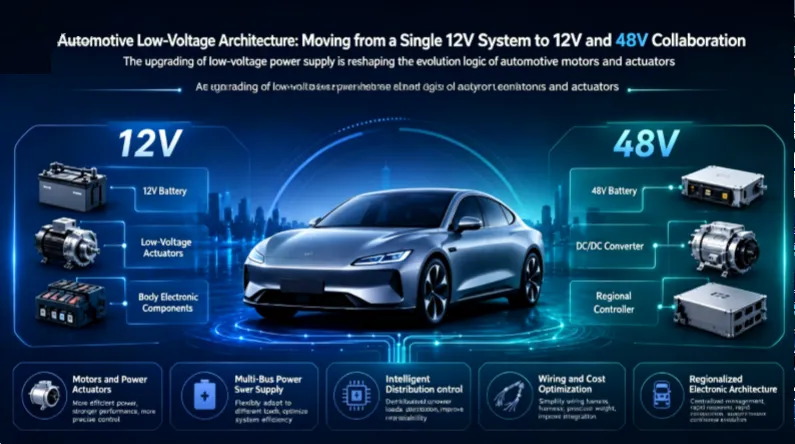
From Technical Information to Business Decisions: QYResearch Provides a Judgment Framework
Technology roadmap research ultimately must feed into business decisions. QYResearch translates fragmented technical data, product information, and vehicle case studies into actionable dimensions for clients, such as: whether a technology is currently in concept exploration, prototype validation, project introduction, or scaled application; which products deserve priority R&D investment; which products are better off retaining proven solutions; which OEMs and Tier 1 suppliers are worth ongoing monitoring; and whether the supply chain is ready to support cost reduction and scaling. The goal of our research is not to do engineering design for clients, but to help companies reduce the risk of misjudging technology roadmaps caused by information asymmetry.
For automotive motor companies, this kind of judgment is particularly critical. Having mature R&D capabilities does not mean every 48V product is worth immediate investment. Different motors have different power levels, operating frequencies, customer structures, and replacement costs—and therefore different R&D windows. By analyzing vehicle platform trends, product adaptability, customer demand, competitor positioning, and supply chain changes within a unified framework, companies can more clearly distinguish between "products that need immediate development," "products that require technology reserves," and "products that don't need to switch in the short term"—directing limited R&D resources toward areas more likely to generate commercial returns.
This is also the core capability of QYResearch in automotive parts research: not just answering "how big is the market," but further assessing "why the market will form, which products and customers will drive it, how the technology roadmap will evolve, how the competitive landscape will change, and at what stage the company should take action." For technology directions like 48V that are still in rapid evolution, the value of research is not simply to produce a forecast number, but more importantly to determine whether there is already a reliable basis for quantification. When market samples are still limited, or when key parameters involve OEM internal R&D, vehicle BOM, or engineering design, rather than offering a seemingly precise but unverifiable result based on numerous assumptions, it is better to clarify the boundaries of data and evidence—telling clients what can be reliably judged at present and which issues still require ongoing tracking. A third-party research provider needs to know not only "how to calculate," but also "when not to calculate." Only on this basis can research results truly serve a company's R&D planning, product portfolio adjustment, customer development, and medium-to-long-term strategic decisions.
Defining Research Boundaries Is Also Part of Third-Party Research Capability
Real R&D progress in the automotive industry, future vehicle platform plans, specific component awards, and undisclosed supply relationships often involve internal corporate projects and confidentiality agreements. For such information, the professionalism of a third-party research provider is not reflected in "guessing the internal answer," but in clearly delineating which conclusions can be supported by publicly available information and interviews, which issues fall within the realm of vehicle engineering, corporate R&D, or trade secrets, and providing verifiable judgments within the boundaries of evidence.
Therefore, QYResearch's role is not to replace OEM engineers in designing electrical architectures, but to help clients build the connection from technology trends to market opportunities through long-term database accumulation, industry chain interviews, corporate research, public information validation, and multi-dimensional cross-analysis. Beyond 48V low-voltage architecture, the same methodology applies to other rapidly evolving automotive component topics, including brushless micro-motors, integrated thermal management, intelligent door controls, brake-by-wire chassis, zone control, and more.
For companies, what is truly costly is often not commissioning a study, but investing prematurely with insufficient information, or playing catch-up only after the industry window has already opened. QYResearch aims to help clients reduce decision-making costs in complex new technology cycles through more granular product research, closer industry chain engagement, and clearer technology roadmap assessments. From single-product market sizing to technology roadmaps, customer demand, supply chains, competitive landscapes, and entry timing for medium-to-long-term strategies, QYResearch continues to provide market research, custom studies, and decision support for clients across the automotive and transportation industry chain. We will continue to track automotive electrification, intelligence, and E/E architecture evolution, conducting segment-specific research on automotive motors, thermal management, low-voltage power supply, body actuators, and new energy vehicle components—offering third-party research support for product planning, market entry, competitive analysis, and customer decision-making.
Analyst Profile
Wang Airong, Automotive & Transportation Industry Chain Analyst at QYResearch, has long focused on research covering automotive parts and the new energy vehicle industry chain, with a primary emphasis on automotive motors, thermal management, low-voltage electrical systems, body actuators, and E/E architectures. Major research topics include automotive 48V low-voltage architecture, automotive components, and intelligent power distribution; in the motor segment, coverage includes window lift motors, cooling fan motors, seat motors, and more. She also monitors related topics such as integrated thermal management, intelligent door controls, brake-by-wire chassis, and active suspension systems. Her research primarily involves market, competitive, industry chain, and technology trend analysis.


Competition
Key players, new entrants,acquisitions, mergers and expansions,development trends and challenges.

Industry Analysis
Rawmaterial, application, product type, demand,supply,downstream, supply chain etc.

Market Size
Capacity, production, sales, revenue, price, cost etc.

Customized Information
We can offer customized survey and information to meet ourclient's need.