Industrial SSD Market Report :reached US$6209.5 million in 2025


Industrial SSD Market Overview
Product Definition
Industrial solid-state drives are data storage devices specifically designed for industrial-grade environments, with a primary focus on reliability, durability, and stable performance under demanding operating conditions. Compared with consumer-grade SSDs, industrial SSDs prioritize long service life, environmental resilience, and data integrity, making them suitable for applications where continuous operation and system stability are critical.
Structure and Technology
Structurally, an industrial SSD typically consists of flash memory media, a controller chip, cache and power management modules, embedded firmware, and a protective enclosure or packaging design. The flash memory is usually carefully selected and validated to ensure consistent endurance and long-term reliability. The controller chip manages data flow, error correction, bad block handling, and fault response, serving as a central component that determines overall stability. Firmware plays a vital role by implementing wear leveling, error correction algorithms, and health monitoring functions that help extend product lifespan and reduce the risk of data loss. Many industrial SSDs also incorporate power-loss protection mechanisms, allowing critical data to be preserved during unexpected power interruptions.
From a technological perspective, industrial SSDs are engineered around reliability and controllability rather than peak performance. They are designed to operate consistently under harsh conditions such as extreme temperatures, vibration, electromagnetic interference, and unstable power supply. Firmware optimization ensures predictable performance throughout the device lifecycle by managing write amplification, error rates, and memory wear. In addition, industrial SSDs typically offer extended product lifecycles with stable hardware configurations, addressing the industrial demand for long-term availability and system maintainability.
Application
In terms of application, industrial SSDs are widely used in industrial automation and smart manufacturing systems, including industrial PCs, programmable logic controllers, human–machine interfaces, and edge computing platforms, where they store operating systems, control programs, and real-time data. In transportation and rail systems, industrial SSDs support onboard control units, signaling equipment, and monitoring systems that require reliable storage during prolonged operation. The energy, power, and infrastructure sectors rely on industrial SSDs for data acquisition, logging, and local analytics, where storage reliability is closely tied to operational safety. Additionally, industrial SSDs are commonly deployed in medical devices, security surveillance systems, communication equipment, and certain defense or specialized applications as mission-critical storage components.
Overall, industrial SSDs function not merely as data storage devices but as integral elements of reliable industrial systems. Their design philosophy emphasizes long-term stability, predictable performance, and risk mitigation rather than short-term speed benchmarks. As industrial digitalization, edge computing, and the industrial Internet of Things continue to expand, industrial SSDs are expected to play an increasingly important role as foundational hardware supporting the stable operation of critical systems.
Multidimensional Classification and Parameters
|
Dimension |
Category / Parameter |
Typical Specification |
Description |
|
Interface |
SATA III |
6 Gb/s |
Industrial mainstream |
|
PCIe NVMe |
PCIe 3.0/4.0 x4 |
High performance |
|
|
PATA / mSATA |
Legacy interfaces |
Legacy systems |
|
|
USB |
USB 3.2 Gen1 |
External/module |
|
|
Form Factor |
2.5″ |
100×69.85×7 mm |
Industrial PCs |
|
M.2 |
2242 / 2280 |
Embedded systems |
|
|
mSATA |
Full size |
Industrial boards |
|
|
BGA |
Custom package |
Module design |
|
|
NAND Type |
SLC |
Ultra-high endurance |
Extreme industrial |
|
pSLC |
SLC emulation |
Balanced |
|
|
MLC |
Medium endurance |
Mainstream |
|
|
Capacity |
TLC |
High density |
Cost-oriented |
|
Low |
8–64 GB |
Boot drive |
|
|
Medium |
128–512 GB |
Data storage |
|
|
High |
1–4 TB |
Edge computing |
|
|
Performance |
Sequential Read |
500–3500 MB/s |
Interface dependent |
|
Sequential Write |
300–3000 MB/s |
|
|
|
Random Read |
50k–500k IOPS |
4K |
|
|
Endurance |
Random Write |
40k–450k IOPS |
|
|
DWPD |
3–60 |
NAND dependent |
|
|
TBW |
300–10,000 TB |
Capacity dependent |
|
|
Reliability |
P/E Cycles |
3k–100k |
Highest for SLC |
|
MTBF |
≥2,000,000 hours |
Industrial grade |
Market Size
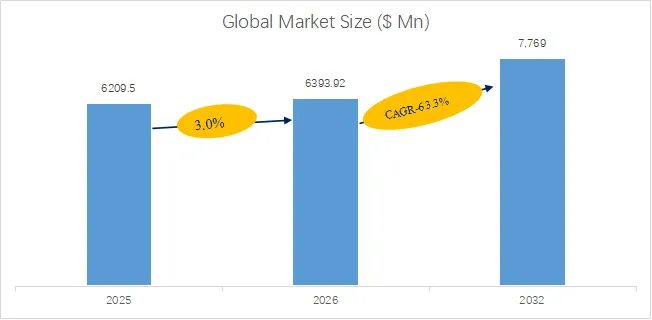
According to research by the QYResearch, the Industrial SSD market size reached US$6209.5 million in 2025 and is expected to reach US$6393.9 million in 2026, with a CAGR-6 of 3.3% in the next six years.
Global Industrial SSDs Market Size
Industrial SSDs Industry Chain, Industry Policies, Development Trends and Barriers to Entry
Industrial Chain
In the upstream segment of the industry chain, key elements include storage media materials, controller chip design, low-level firmware technology, and supporting electronic components related to reliability. Critical upstream factors include consistency and endurance of flash memory, controller capability for error handling and power-loss protection, and firmware functions such as wear leveling, bad block management, and data integrity protection, all of which determine long-term operational stability.
On the downstream side, demand for industrial SSDs is diversified across industries but structurally well defined, with core applications in sectors that require continuous operation, data security, and environmental robustness. Industrial automation and smart manufacturing represent the most significant downstream markets, where industrial SSDs are widely deployed in industrial PCs, programmable logic controllers, edge computing nodes, and human–machine interfaces to store operating systems, control programs, and real-time data. In these applications, users prioritize endurance, power-loss protection, and stable performance under high temperature, vibration, and electrical noise. Transportation and rail systems also constitute an important downstream segment, including onboard control systems, signaling equipment, and monitoring platforms that demand reliable data storage under long operating hours and frequent power fluctuations.
Energy, power utilities, and critical infrastructure form another major downstream group. In power automation systems, substations, oil and gas exploration, and renewable energy installations, industrial SSDs support data acquisition, logging, and edge analytics, where storage reliability is directly linked to system safety. In addition, medical equipment, security surveillance, and communication infrastructure increasingly rely on industrial SSDs due to requirements for long product lifecycles, stable supply availability, and traceability. Across these downstream industries, industrial SSDs are typically regarded as system-critical components rather than interchangeable consumer products, leading to purchasing decisions that emphasize long-term reliability and risk mitigation.
Industry Policies
From a policy perspective, the development of industrial SSDs is closely associated with industrial digitalization, smart manufacturing initiatives, and critical information infrastructure protection policies. As governments promote industrial automation and digital transformation, regulatory frameworks increasingly emphasize system reliability, operational safety, and data integrity, indirectly driving demand for industrial-grade storage solutions. At the same time, policies related to data security, supply chain resilience, and strategic component localization encourage downstream industries to prioritize stable and controllable industrial storage solutions. Although policies do not usually target specific storage products, they contribute to market standardization and higher expectations for industrial SSD performance.
Development Trends
In terms of development trends, industrial SSDs are evolving toward higher endurance, extended lifespan, and stronger adaptation to specific application scenarios. The growing adoption of edge computing and industrial IoT increases reliance on local high-speed storage for real-time processing, creating new opportunities for industrial SSD deployment. Meanwhile, product form factors and interfaces continue to diversify to meet the design requirements of embedded and industrial systems. Growth opportunities are primarily driven by smart manufacturing upgrades, digital transformation of transportation and energy systems, and ongoing modernization of medical and security equipment, all of which require reliable industrial-grade storage over extended periods.
However, the industry also faces notable challenges. Industrial SSDs carry higher unit costs compared with consumer-grade products, requiring downstream users to balance performance, reliability, and budget constraints, which may limit adoption in cost-sensitive projects. Rapid technological evolution in storage media and controller architectures also creates challenges for long-term product availability and model continuity. In addition, insufficient awareness among some downstream users regarding the distinction between industrial and consumer SSDs may slow market education and adoption.
Barriers to Entry
Barriers to entry in the industrial SSD market are therefore multi-dimensional. Technically, suppliers must demonstrate strong capabilities in controller firmware development, endurance management, power-loss protection, and comprehensive validation processes. From a quality and compliance perspective, downstream industries often require extensive reliability testing and long-term operational verification, extending the qualification period for new entrants. Commercially, industrial customers place high value on supply continuity and technical support, and once a product is designed into a system, replacement costs are high. As a result, new entrants must invest significant time and resources to establish credibility and long-term partnerships. Overall, the industrial SSD market favors companies with deep technical expertise, robust quality systems, and the ability to provide stable long-term supply and support.
The report provides a detailed analysis of the market size, growth potential, and key trends for each segment. Through detailed analysis, industry players can identify profit opportunities, develop strategies for specific customer segments, and allocate resources effectively.
The Industrial SSD market is segmented as below:
By Company
Samsung
Intel
Micron
Western Digital
Longsys
Innodisk
Apacer
ATP Electronics
Swissbit
Transcend
ADATA Industrial
TEAMGROUP Industrial
SMART Modular Technologies
Virtium
Cactus Technologies
Delkin Devices
Advantech
Foremay
Netac
Kingtiger
Goke
Kingston
TOPSSD
Sanwang Communication
SSSTC
Flexxon
Renice
YANSEN
Fortasa Memory Systems
IEI
Avalue
AAEON
Biwin
Segment by Type
SATA
NVMe PCIe 3.0
NVMe PCIe 4.0
mSATA
M.2
DOM
U.2
Segment by Application
Industrial Control and Automation
Automotive Electronics
Energy and Power
Rail Transportation
Medical Electronics
Military and Aerospace
Others
Each chapter of the report provides detailed information for readers to further understand the Industrial SSD market:
Chapter 1: Introduces the report scope of the Industrial SSD report, global total market size (valve, volume and price). This chapter also provides the market dynamics, latest developments of the market, the driving factors and restrictive factors of the market, the challenges and risks faced by manufacturers in the industry, and the analysis of relevant policies in the industry. (2021-2032)
Chapter 2: Detailed analysis of Industrial SSD manufacturers competitive landscape, price, sales and revenue market share, latest development plan, merger, and acquisition information, etc. (2021-2026)
Chapter 3: Provides the analysis of various Industrial SSD market segments by Type, covering the market size and development potential of each market segment, to help readers find the blue ocean market in different market segments. (2021-2032)
Chapter 4: Provides the analysis of various market segments by Application, covering the market size and development potential of each market segment, to help readers find the blue ocean market in different downstream markets.(2021-2032)
Chapter 5: Sales, revenue of Industrial SSD in regional level. It provides a quantitative analysis of the market size and development potential of each region and introduces the market development, future development prospects, market space, and market size of each country in the world..(2021-2032)
Chapter 6: Sales, revenue of Industrial SSD in country level. It provides sigmate data by Type, and by Application for each country/region.(2021-2032)
Chapter 7: Provides profiles of key players, introducing the basic situation of the main companies in the market in detail, including product sales, revenue, price, gross margin, product introduction, recent development, etc. (2021-2026)
Chapter 8: Analysis of industrial chain, including the upstream and downstream of the industry.
Chapter 9: Conclusion.
Other relevant reports of QYResearch:
Global Industrial SSD Market Outlook, In‑Depth Analysis & Forecast to 2032
Global Industrial SSD Sales Market Report, Competitive Analysis and Regional Opportunities 2026-2032
Global Industrial SSD Market Research Report 2026
Benefits of purchasing QYResearch report:
Competitive Analysis: QYResearch provides in-depth Industrial SSD competitive analysis, including information on key company profiles, new entrants, acquisitions, mergers, large market shear, opportunities, and challenges. These analyses provide clients with a comprehensive understanding of market conditions and competitive dynamics, enabling them to develop effective market strategies and maintain their competitive edge.
Industry Analysis: QYResearch provides Industrial SSD comprehensive industry data and trend analysis, including raw material analysis, market application analysis, product type analysis, market demand analysis, market supply analysis, downstream market analysis, and supply chain analysis.
and trend analysis. These analyses help clients understand the direction of industry development and make informed business decisions.
Market Size: QYResearch provides Industrial SSD market size analysis, including capacity, production, sales, production value, price, cost, and profit analysis. This data helps clients understand market size and development potential, and is an important reference for business development.

Global Industrial SSD Market Outlook, In‑Depth Analysis & Forecast to 2032

Published Date: 2026-03-31

Pages: 221

Report ld: 5707860
Price:USD 4900.00
(Single User License)
Global Industrial SSD Sales Market Report, Competitive Analysis and Regional Opportunities 2026-2032
Published Date: 2026-03-31
Pages: 132
Report ld: 5707856
Price:USD 4250.00
(Single User License)
Industrial SSD- Global Market Share and Ranking, Overall Sales and Demand Forecast 2026-2032
Published Date: 2026-01-19
Pages: 202
Report ld: 5707858
Price:USD 3950.00
(Single User License)
Global Industrial SSD Market Research Report 2026
Published Date: 2026-01-19
Pages: 179
Report ld: 5707857
Price:USD 2900.00
(Single User License)
Global Industrial SSD Market Outlook, In‑Depth Analysis & Forecast to 2031
Published Date: 2025-10-02
Pages: 200
Report ld: 5056326
Price:USD 4900.00
(Single User License)
Industrial SSD - Global Market Share and Ranking, Overall Sales and Demand Forecast 2025-2031
Published Date: 2025-09-29
Pages: 154
Report ld: 5056325
Price:USD 3950.00
(Single User License)


Competition
Key players, new entrants,acquisitions, mergers and expansions,development trends and challenges.

Industry Analysis
Rawmaterial, application, product type, demand,supply,downstream, supply chain etc.

Market Size
Capacity, production, sales, revenue, price, cost etc.

Customized Information
We can offer customized survey and information to meet ourclient's need.
