Non-Food and Non-Beverages Metal Cans Research:expected to reach approximately US$ 8,160 million by 2032


Non-Food and Non-Beverages Metal Cans:Circular Metal Packaging Drives Steady Growth and Premiumization in Non-Food Can Markets
Non-food and non-beverage metal cans are rigid metal packaging containers used to hold, protect, transport, store or dispense non-edible products. They are generally made from tinplate, tin-free steel, aluminum sheet or impact-extrusion aluminum slugs and are produced through two-piece, three-piece, impact-extrusion or deep-drawing processes, then completed with internal coatings, external printing, seams, closures, valves and dispensing components. Key technical characteristics include barrier performance, pressure resistance, hermetic sealing, chemical compatibility, impact strength, decoration capability and recyclability.
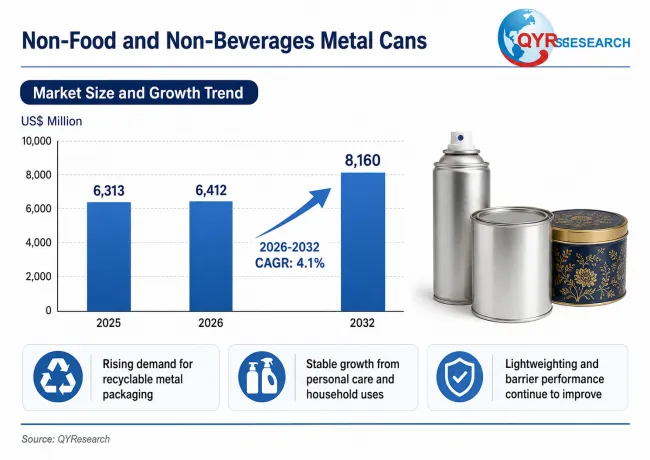
According to QYResearch preliminary research, the global Non-Food and Non-Beverages Metal Cans market was approximately US$ 6,313 million in 2025 and US$ 6,412 million in 2026, and is expected to reach approximately US$ 8,160 million by 2032, representing a CAGR of about 4.1% from 2026 to 2032. The market scope primarily covers aerosol metal cans, general-line metal cans, and decorative and specialty tins sold into personal care and cosmetics, pharmaceutical and medical, household, automotive and industrial, and other non-food applications. Demand growth is being supported by the wider use of spray and dispensing formats in personal care, stable consumption of household cleaning and disinfection products, expansion of automotive aftermarket and industrial maintenance products, packaging upgrades in paints and specialty chemicals, growing medical and pharmaceutical aerosol applications, and brand-owner interest in highly recyclable metal packaging. On the supply side, leading manufacturers are investing in lightweight structures, higher recycled-metal content, low-carbon aluminum and steel, BPA-non-intent internal coatings, high-definition decoration, shaped cans, regional capacity and co-development with strategic customers. The industry is therefore characterized by steady upgrading in mature markets and faster penetration in growth markets, with future additions expected from monobloc aluminum aerosols, bag-on-valve-compatible cans, premium decorated tins, industrial safety packaging and localized supply in Asia and Latin America.
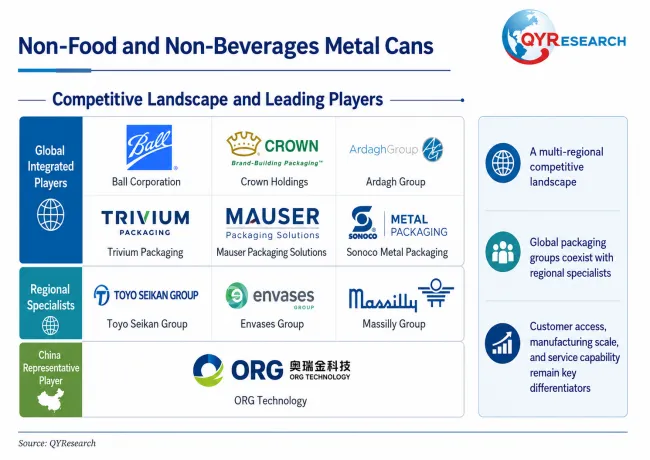
The global market has a three-layer structure: diversified multinational groups lead high-volume categories, specialist manufacturers compete through material and process expertise, and regional producers serve local customers with faster delivery and customization. Overall concentration is moderate, although it is higher in monobloc aluminum aerosols, steel aerosols and high-specification industrial cans because of capital intensity, pressure-safety requirements, coating compatibility, customer qualification and multi-region supply obligations. Representative first-tier suppliers include Ball Corporation, Crown Holdings, Trivium Packaging, Mauser Packaging Solutions, Sonoco Metal Packaging and Toyo Seikan Group, which combine broad manufacturing networks, forming and decoration know-how, key-account relationships and mature quality systems. A second tier of specialized and regional suppliers includes CCL Containers, Colep Packaging, Envases Group, Massilly Group, Montebello Packaging and DS Containers, with differentiated positions in aluminum aerosols, industrial cans, decorative tins or regional service. Competition is shifting from capacity and price alone toward lightweighting and low-carbon materials, compliant internal coatings, complex shapes and premium printing, flexible short-run production, reliable regional delivery and joint packaging-system development with brand owners. Consolidation and capacity optimization are likely to continue.
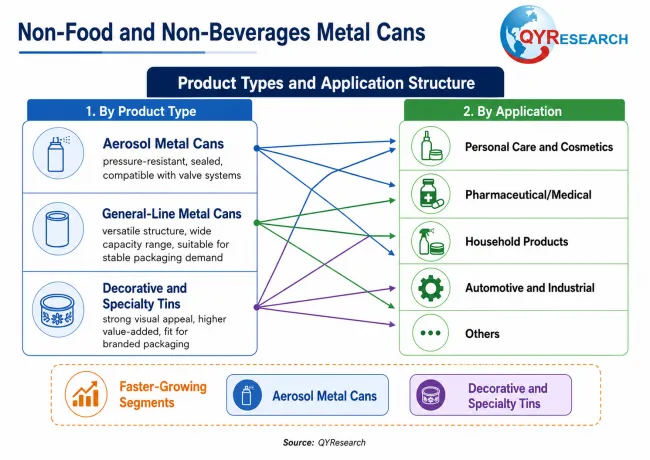
By product format, aerosol metal cans include two-piece or three-piece steel cans and monobloc impact-extruded aluminum cans. They work with valves, actuators and propellant or compressed-gas systems to deliver sprays, foams or controlled doses and are widely used in personal care, household cleaning, automotive care, spray paints, pharmaceutical and medical products. This is one of the most technology-intensive and higher-value categories. General-line metal cans include paint cans, oil cans, F-style cans, cone-top cans, rectangular containers and other industrial formats, with emphasis on chemical resistance, stacking and transport performance, secure closures and, where applicable, UN-compliant designs. Their demand is tied to paints, solvents, adhesives, lubricants, construction products and industrial chemicals. Decorative and specialty tins use premium printing, embossing, shaped structures, reusability and strong shelf impact for cosmetics, health kits, gifts, tools, stationery and promotional packaging. By end use, personal care and household products are major aerosol applications; automotive and industrial markets are important for both general-line cans and technical aerosols; pharmaceutical and medical products require tighter control of cleanliness, coating compatibility, dose consistency and traceability. Faster-growing directions include lightweight aluminum aerosols, bag-on-valve and compressed-gas-compatible containers, BPA-NI and low-migration coatings, premium decoration and digital printing, rapid short-run customization, and industrial cans designed for dangerous-goods transport and circular-economy requirements.
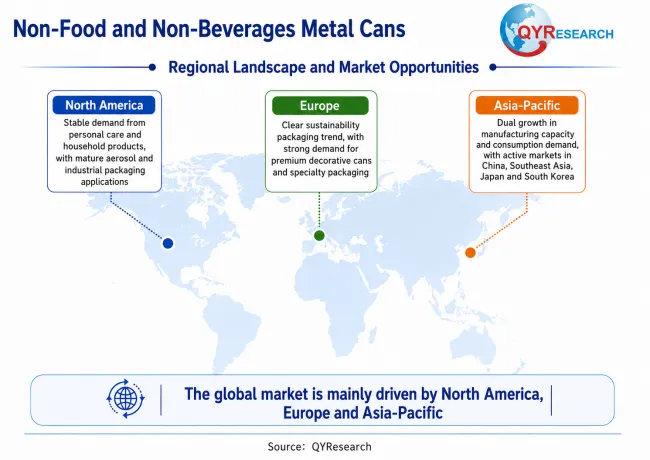
North America is a mature, high-value core market supported by personal care, household cleaning, automotive care, spray paint, lubricants and industrial chemicals, with established local supply for steel aerosols, aluminum aerosols and general-line cans. Europe has strong capabilities in aerosol manufacturing, decoration and circular-packaging regulation. Asia-Pacific is expected to be the principal source of incremental demand: China, Japan, South Korea and Southeast Asia have broad exposure to personal care, household products, automotive manufacturing, paints and chemicals; Japan is strong in high-specification aerosols and precision packaging, China has extensive materials, metal-printing and can-making capabilities, and Southeast Asia benefits from localization by multinational brands and consumption upgrading. Latin America, led by Brazil and Mexico, offers growth in beauty, household and industrial packaging. The Middle East and Africa remain smaller but offer structural opportunities in urban consumer products, construction paints, personal care and automotive maintenance. Regional opportunities will increasingly depend on proximity to customer clusters, local raw-material supply, certification, transport radius and responsive delivery, reinforcing a “regional capacity plus global customer standards” model.
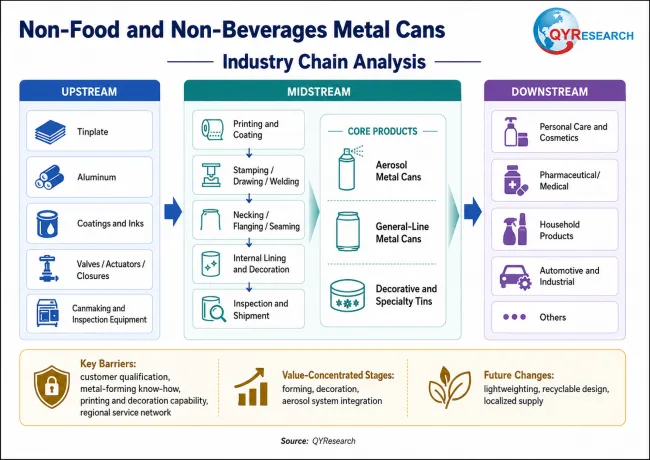
Upstream inputs include tinplate, tin-free steel, cold-rolled sheet, aluminum sheet and impact-extrusion slugs, together with internal coating resins, inks, varnishes, sealing compounds, valves, actuators, spray heads, caps, gaskets and transport packaging. Core equipment and enabling technologies include presses and drawing systems, three-piece body welders, impact-extrusion presses, DWI/DRD forming lines, necking, flanging and seaming systems, internal and external coating and printing lines, curing ovens, online vision inspection, leak and pressure testing, tooling and digital quality control. Midstream manufacturers undertake structural design, metal forming, welding or drawing, coating, decoration, seaming and component assembly, performance validation and delivery; some extend into aerosol filling, contract manufacturing and complete packaging-system development. Downstream users include personal care and cosmetics, pharmaceutical and medical, household cleaning, automotive aftermarket, paints and coatings, lubricants, adhesives, solvents, industrial chemicals, construction products, stationery and gift markets. Entry barriers are concentrated in stable high-speed forming, thin-wall lightweighting, pressure safety, product-coating compatibility, complex decoration and shaping, customer audits and regulatory qualifications, capital intensity and regional supply reliability. Higher-value links include high-specification aluminum aerosol cans, valve and actuator systems, functional internal coatings, precision tooling, premium decoration and customer co-development. Future supply chains will move toward low-carbon and recycled metals, downgauging, BPA-NI and low-migration coatings, digital printing and short-run flexibility, online traceability, regional sourcing and closed-loop recycling, with closer cooperation among can makers, material suppliers, valve producers, fillers and brand owners.
The report provides a detailed analysis of the market size, growth potential, and key trends for each segment. Through detailed analysis, industry players can identify profit opportunities, develop strategies for specific customer segments, and allocate resources effectively.
The Non-Food and Non-Beverages Metal Cans market is segmented as below:
By Company
Ball Corporation
Ardagh Group
Mauser Packaging Solutions
CCL Containers
Crown Holdings
Grupo Zapata
Trivium Packaging
DS Containers
Alltub Group
Montebello Packaging
Allied Cans Limited
Sonoco Metal Packaging
Colep Packaging
Envases Group
Massilly Group
Toyo Seikan Group
Nampak
ORG Technology
Chumboon
Guangdong Sihai
Euro Asia Packaging
Oriental Tech
Shanghai Jiatian
Segment by Type
Aerosol Metal Cans
General-Line Metal Cans
Decorative and Specialty Tins
Segment by Application
Personal Care and Cosmetics
Pharmaceutical/Medical
Household Products
Automotive and Industrial
Others
Each chapter of the report provides detailed information for readers to further understand the Non-Food and Non-Beverages Metal Cans market:
Chapter 1: Introduces the report scope of the Non-Food and Non-Beverages Metal Cans report, global total market size (valve, volume and price). This chapter also provides the market dynamics, latest developments of the market, the driving factors and restrictive factors of the market, the challenges and risks faced by manufacturers in the industry, and the analysis of relevant policies in the industry. (2021-2032)
Chapter 2: Detailed analysis of Non-Food and Non-Beverages Metal Cans manufacturers competitive landscape, price, sales and revenue market share, latest development plan, merger, and acquisition information, etc. (2021-2026)
Chapter 3: Provides the analysis of various Non-Food and Non-Beverages Metal Cans market segments by Type, covering the market size and development potential of each market segment, to help readers find the blue ocean market in different market segments. (2021-2032)
Chapter 4: Provides the analysis of various market segments by Application, covering the market size and development potential of each market segment, to help readers find the blue ocean market in different downstream markets.(2021-2032)
Chapter 5: Sales, revenue of Non-Food and Non-Beverages Metal Cans in regional level. It provides a quantitative analysis of the market size and development potential of each region and introduces the market development, future development prospects, market space, and market size of each country in the world..(2021-2032)
Chapter 6: Sales, revenue of Non-Food and Non-Beverages Metal Cans in country level. It provides sigmate data by Type, and by Application for each country/region.(2021-2032)
Chapter 7: Provides profiles of key players, introducing the basic situation of the main companies in the market in detail, including product sales, revenue, price, gross margin, product introduction, recent development, etc. (2021-2026)
Chapter 8: Analysis of industrial chain, including the upstream and downstream of the industry.
Chapter 9: Conclusion.
Other relevant reports of QYResearch:
Global Non-Food and Non-Beverages Metal Cans Market Outlook, In‑Depth Analysis & Forecast to 2032
Global Non-Food and Non-Beverages Metal Cans Sales Market Report, Competitive Analysis and Regional Opportunities 2026-2032
Global Non-Food and Non-Beverages Metal Cans Market Research Report 2026
Benefits of purchasing QYResearch report:
Competitive Analysis: QYResearch provides in-depth Non-Food and Non-Beverages Metal Cans competitive analysis, including information on key company profiles, new entrants, acquisitions, mergers, large market shear, opportunities, and challenges. These analyses provide clients with a comprehensive understanding of market conditions and competitive dynamics, enabling them to develop effective market strategies and maintain their competitive edge.
Industry Analysis: QYResearch provides Non-Food and Non-Beverages Metal Cans comprehensive industry data and trend analysis, including raw material analysis, market application analysis, product type analysis, market demand analysis, market supply analysis, downstream market analysis, and supply chain analysis.
and trend analysis. These analyses help clients understand the direction of industry development and make informed business decisions.
Market Size: QYResearch provides Non-Food and Non-Beverages Metal Cans market size analysis, including capacity, production, sales, production value, price, cost, and profit analysis. This data helps clients understand market size and development potential, and is an important reference for business development.

Global Non-Food and Non-Beverages Metal Cans Market Outlook, In‑Depth Analysis & Forecast to 2032

Published Date: 2026-07-18

Pages: 186

Report ld: 6978262
Price:USD 4900.00
(Single User License)
Global Non-Food and Non-Beverages Metal Cans Sales Market Report, Competitive Analysis and Regional Opportunities 2026-2032
Published Date: 2026-07-18
Pages: 159
Report ld: 5558760
Price:USD 4250.00
(Single User License)
Global Non-Food and Non-Beverages Metal Cans Market Research Report 2026
Published Date: 2026-07-18
Pages: 143
Report ld: 5528284
Price:USD 2900.00
(Single User License)
Non-Food and Non-Beverages Metal Cans- Global Market Share and Ranking, Overall Sales and Demand Forecast 2026-2032
Published Date: 2026-07-18
Pages: 164
Report ld: 5496716
Price:USD 3950.00
(Single User License)
Global Non-Food and Non-Beverages Metal Cans Market Outlook, In‑Depth Analysis & Forecast to 2031
Published Date: 2025-09-11
Pages: 158
Report ld: 5038553
Price:USD 4900.00
(Single User License)
Global Non-Food and Non-Beverages Metal Cans Market Size, Manufacturers, Supply Chain, Sales Channel and Clients, 2025-2031
Published Date: 2025-03-28
Pages: 159
Report ld: 4669812
Price:USD 5900.00
(Single User License)


Competition
Key players, new entrants,acquisitions, mergers and expansions,development trends and challenges.

Industry Analysis
Rawmaterial, application, product type, demand,supply,downstream, supply chain etc.

Market Size
Capacity, production, sales, revenue, price, cost etc.

Customized Information
We can offer customized survey and information to meet ourclient's need.
