Bio-Based Composites Industry Research: Based on a CAGR of 8.20% from 2026 to 2032


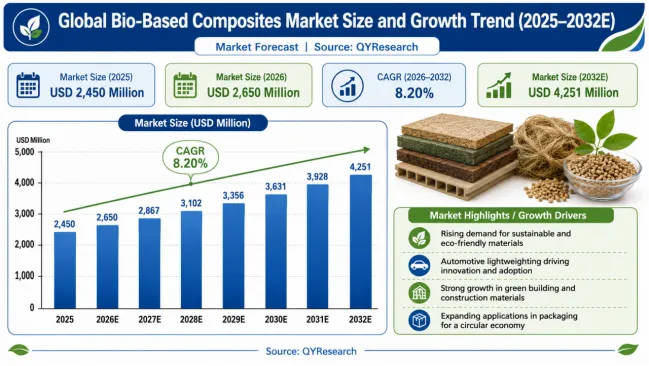
Bio-based composites are environmentally oriented materials made from natural fibers, bio-based resins, bio-based polymers, or other renewable resources through reinforcement, compounding, modification, and molding processes. Compared with traditional petroleum-based composites, bio-based composites offer advantages in lightweighting, renewable content, lower carbon footprint, and improved structural performance. They are increasingly used in automotive, construction, packaging, consumer goods, furniture, and infrastructure-related applications.
The global bio-based composites market is estimated at approximately USD 2450 million in 2025 and is expected to reach USD 2650 million in 2026. Based on a CAGR of 8.20% from 2026 to 2032, the market size is projected to reach around USD 4252 million by 2032. Growth is mainly driven by rising global demand for sustainable materials, automotive lightweighting, green building expansion, eco-friendly packaging upgrades, and increasing consumer acceptance of low-carbon products.
Future market development will focus on material performance improvement, cost optimization, large-scale production, and downstream application expansion. Natural fiber reinforced composites, wood-plastic bio-based composites, bio-based polymer composites, and high-performance bio-based engineering composites will all gain broader application potential. Companies with capabilities in raw material supply, formulation design, compounding, molding, and customer validation will be better positioned to build competitive advantages in mid-to-high-end applications.
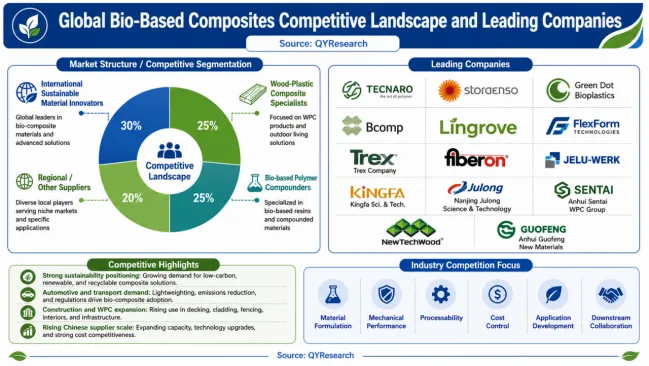
The competitive landscape of the bio-based composites market is shaped by European sustainable material innovators, North American wood-plastic and composite material suppliers, and Chinese large-scale material companies. TECNARO, Stora Enso, Green Dot Bioplastics, Bcomp, Lingrove, and FlexForm Technologies focus on natural fibers, bio-based resins, lightweight materials, and high-performance composite solutions. These companies have strong technology innovation capability and differentiated positioning.
Trex Company, Fiberon, and JELU-WERK have strong market foundations in wood-plastic composites, outdoor building materials, decking, fencing, cladding, and construction profiles. Chinese companies such as Kingfa Sci. & Tech, Nanjing Julong Science & Technology, Anhui Sentai WPC Group, NewTechWood, and Anhui Guofeng New Materials are strengthening their competitiveness through supply chain integration, scale production, cost control, and strong domestic market demand.
Overall, competition in this industry is not only determined by company scale, but also by formulation capability, mechanical performance, processing stability, environmental certification, application development, and cost control. As automotive, construction, packaging, and consumer goods customers raise requirements for low-carbon materials, leading companies need to combine R&D, mass production, customer collaboration, and sustainability positioning. Future competition will move from single material supply toward integrated material solutions, application validation, and long-term supply capability.
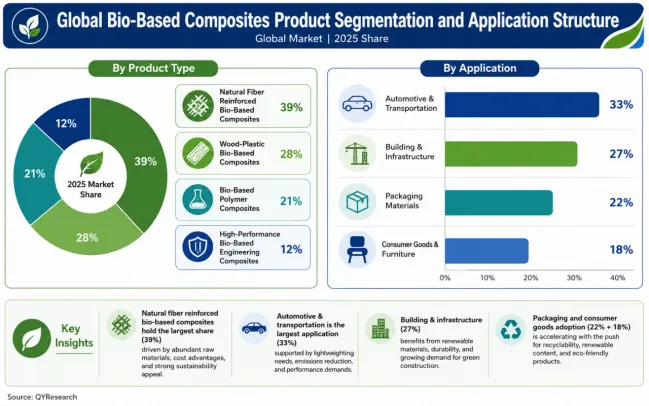
By product type, natural fiber reinforced bio-based composites hold the largest share at 39%, making them the most important product category in the current market. These materials usually use hemp fiber, flax fiber, bamboo fiber, wood flour, or agricultural waste fibers as reinforcement. They offer lightweighting, renewable content, and good mechanical performance, making them suitable for automotive interiors, panels, consumer products, and selected structural components. Wood-plastic bio-based composites account for 28% and have relatively mature applications in construction and outdoor products.
Bio-based polymer composites account for 21% and mainly include PLA, PHA, bio-based PE, bio-based PP, and other resin systems compounded with fibers or fillers. They are suitable for packaging, consumer goods, and some industrial components. High-performance bio-based engineering composites account for 12%. Although smaller in market share, this category targets higher-demand automotive, transportation, electronics, and engineering applications where strength, heat resistance, dimensional stability, and long-term durability are critical.
From the application perspective, automotive and transportation is the largest segment, accounting for 33% of demand. It is mainly driven by lightweighting, emissions reduction, and fuel-efficiency improvement. Building and infrastructure account for 27%, mainly supported by WPC decking, cladding, profiles, and green construction materials. Packaging materials account for 22%, supported by renewable-content and sustainable packaging trends. Consumer goods and furniture account for 18%, driven by material substitution in household products, office furniture, leisure goods, and low-carbon lifestyle applications.
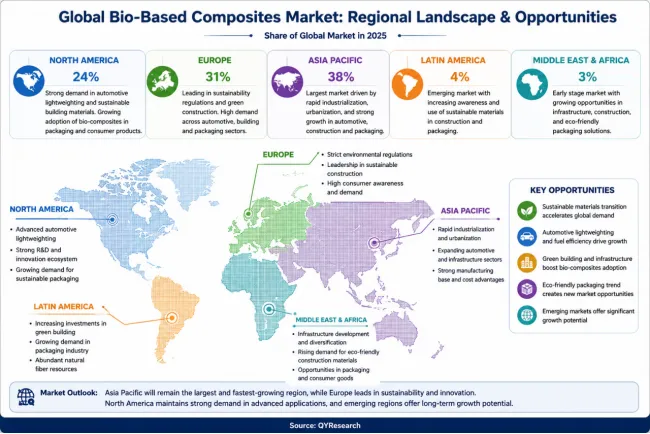
From a regional perspective, Asia-Pacific holds the largest share at 38% and is the biggest market for bio-based composites. China Mainland, Japan, South Korea, Taiwan, and Southeast Asia are seeing rapid demand growth in automotive manufacturing, consumer electronics, packaging materials, building infrastructure, and home products. The region also has a relatively complete manufacturing supply chain and cost advantages, supporting the expansion of bio-based composites in both premium and mass-market applications.
Europe accounts for 31% and is the region most strongly driven by sustainability policies and low-carbon transition. EU green regulations, circular economy policies, automotive lightweighting requirements, and building energy-efficiency standards continue to support the adoption of bio-based composites in automotive, construction, packaging, and consumer goods. North America accounts for 24%, where wood-plastic composites and outdoor building materials are mature, and consumers show strong acceptance of eco-friendly and durable materials.
Latin America accounts for 4%, while the Middle East & Africa account for 3%. Their current market sizes are relatively small, but long-term growth opportunities exist as infrastructure development, sustainable packaging promotion, resource utilization, and local manufacturing advance. Overall, Asia-Pacific contributes the main incremental growth, Europe provides policy and technology leadership, North America supports mature application scenarios, and emerging markets are expected to gradually release demand through construction, packaging, and basic material substitution.
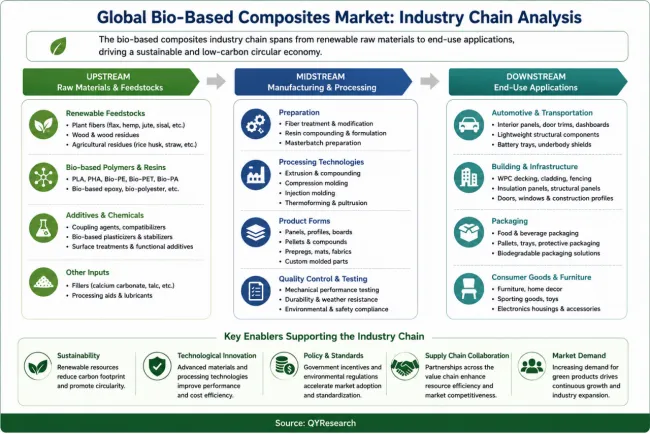
The upstream segment of the bio-based composites industry chain mainly includes natural fibers, bio-based resins, bio-based polymers, wood flour, bamboo fibers, hemp fibers, agricultural waste fibers, fillers, compatibilizers, coupling agents, stabilizers, and processing aids. Stable raw material supply, cost level, moisture control, fiber treatment quality, and resin performance directly affect the mechanical properties, processing stability, surface quality, and long-term durability of final composite materials.
The midstream segment includes material modification, compounding, pelletizing, extrusion, injection molding, compression molding, panel and profile forming, quality inspection, and performance validation. This stage is the core value-creation part of the industry chain. It requires formulation design, fiber dispersion, resin compatibility improvement, processing-window control, and scalable manufacturing capability. Since different applications have different requirements for strength, heat resistance, weatherability, flame retardancy, moisture resistance, and surface texture, customized development capability is especially important.
Downstream applications cover automotive and transportation, building and infrastructure, packaging materials, consumer goods, and furniture. Through upstream renewable resource supply, midstream composite material manufacturing, and downstream application development, the bio-based composites industry chain forms a complete value flow from low-carbon resources to green end products. In the future, lightweighting, sustainability, performance improvement, cost efficiency, and circular economy development will become the core drivers of industry chain upgrading.
The report provides a detailed analysis of the market size, growth potential, and key trends for each segment. Through detailed analysis, industry players can identify profit opportunities, develop strategies for specific customer segments, and allocate resources effectively.
The Bio-Based Composites market is segmented as below:
By Company
TECNARO
Stora Enso
Green Dot Bioplastics
Bcomp
Lingrove
FlexForm Technologies
Trex Company
Fiberon
JELU-WERK
Kingfa Sci. & Tech
Nanjing Julong Science & Technology
Anhui Sentai WPC Group
NewTechWood
Anhui Guofeng New Materials
Segment by Type
Bio-Based Thermoplastic Composites
Bio-Based Thermoset Composites
Hybrid Bio-Based Composites
Segment by Application
Automotive and Transportation
Building and Construction
Consumer Goods
Other
Each chapter of the report provides detailed information for readers to further understand the Bio-Based Composites market:
Chapter 1: Introduces the report scope of the Bio-Based Composites report, global total market size (valve, volume and price). This chapter also provides the market dynamics, latest developments of the market, the driving factors and restrictive factors of the market, the challenges and risks faced by manufacturers in the industry, and the analysis of relevant policies in the industry. (2021-2032)
Chapter 2: Detailed analysis of Bio-Based Composites manufacturers competitive landscape, price, sales and revenue market share, latest development plan, merger, and acquisition information, etc. (2021-2026)
Chapter 3: Provides the analysis of various Bio-Based Composites market segments by Type, covering the market size and development potential of each market segment, to help readers find the blue ocean market in different market segments. (2021-2032)
Chapter 4: Provides the analysis of various market segments by Application, covering the market size and development potential of each market segment, to help readers find the blue ocean market in different downstream markets.(2021-2032)
Chapter 5: Sales, revenue of Bio-Based Composites in regional level. It provides a quantitative analysis of the market size and development potential of each region and introduces the market development, future development prospects, market space, and market size of each country in the world..(2021-2032)
Chapter 6: Sales, revenue of Bio-Based Composites in country level. It provides sigmate data by Type, and by Application for each country/region.(2021-2032)
Chapter 7: Provides profiles of key players, introducing the basic situation of the main companies in the market in detail, including product sales, revenue, price, gross margin, product introduction, recent development, etc. (2021-2026)
Chapter 8: Analysis of industrial chain, including the upstream and downstream of the industry.
Chapter 9: Conclusion.
Other relevant reports of QYResearch:
Global Bio-Based Composites Market Outlook, In‑Depth Analysis & Forecast to 2032
Global Bio-Based Composites Sales Market Report, Competitive Analysis and Regional Opportunities 2026-2032
Global Bio-Based Composites Market Research Report 2026
Global 3D Printing Bio-based Composite Materials Market Outlook, In‑Depth Analysis & Forecast to 2032
Global 3D Printing Bio-based Composite Materials Sales Market Report, Competitive Analysis and Regional Opportunities 2026-2032
Global 3D Printing Bio-based Composite Materials Market Research Report 2026
3D Printing Bio-based Composite Materials- Global Market Share and Ranking, Overall Sales and Demand Forecast 2026-2032
Benefits of purchasing QYResearch report:
Competitive Analysis: QYResearch provides in-depth Bio-Based Composites competitive analysis, including information on key company profiles, new entrants, acquisitions, mergers, large market shear, opportunities, and challenges. These analyses provide clients with a comprehensive understanding of market conditions and competitive dynamics, enabling them to develop effective market strategies and maintain their competitive edge.
Industry Analysis: QYResearch provides Bio-Based Composites comprehensive industry data and trend analysis, including raw material analysis, market application analysis, product type analysis, market demand analysis, market supply analysis, downstream market analysis, and supply chain analysis.
and trend analysis. These analyses help clients understand the direction of industry development and make informed business decisions.
Market Size: QYResearch provides Bio-Based Composites market size analysis, including capacity, production, sales, production value, price, cost, and profit analysis. This data helps clients understand market size and development potential, and is an important reference for business development.

Bio-Based Composites- Global Market Share and Ranking, Overall Sales and Demand Forecast 2026-2032

Published Date: 2026-06-10

Pages: 137

Report ld: 6727966
Price:USD 3950.00
(Single User License)
Global Bio-Based Composites Market Outlook, In‑Depth Analysis & Forecast to 2032
Published Date: 2026-06-10
Pages: 164
Report ld: 6727965
Price:USD 4900.00
(Single User License)
Global Bio-Based Composites Sales Market Report, Competitive Analysis and Regional Opportunities 2026-2032
Published Date: 2026-06-10
Pages: 137
Report ld: 6727964
Price:USD 4250.00
(Single User License)
Global Bio-Based Composites Market Research Report 2026
Published Date: 2026-06-10
Pages: 139
Report ld: 6502739
Price:USD 2900.00
(Single User License)
Global Bio-Based Composites Sales Market Report, Competitive Analysis and Regional Opportunities 2025-2031
Published Date: 2025-11-09
Pages: 100
Report ld: 5404363
Price:USD 4250.00
(Single User License)
Global Bio-Based Composites Market Outlook, In‑Depth Analysis & Forecast to 2031
Published Date: 2025-11-09
Pages: 167
Report ld: 5391066
Price:USD 4900.00
(Single User License)


Competition
Key players, new entrants,acquisitions, mergers and expansions,development trends and challenges.

Industry Analysis
Rawmaterial, application, product type, demand,supply,downstream, supply chain etc.

Market Size
Capacity, production, sales, revenue, price, cost etc.

Customized Information
We can offer customized survey and information to meet ourclient's need.
