Biofuels Catalysts Market Trends: the global market is projected to reach US$ 206 million


2026 Global Biofuels Catalysts Market Research Report
QYResearch has recently released the industry report “2026 Global Biofuels Catalysts Market Research Report”, focusing on product definition, technology routes, market size, competitive landscape, application scenarios, regional structure and value-chain changes of Biofuels Catalysts. This brief highlights demand shifts, technology evolution and supply-chain opportunities in renewable diesel, sustainable aviation fuel (SAF) and advanced biofuel production.
Biofuels catalysts are functional catalytic materials used in the conversion of biomass, waste oils and fats, vegetable oils, animal fats, lignocellulosic resources and other renewable carbon sources into liquid fuels. They mainly include hydrodeoxygenation (HDO) catalysts, isomerization catalysts and catalyst systems used in transesterification, esterification, denitrification, desulfurization, cracking and upgrading processes. Their core function is to accelerate reactions, improve selectivity, raise fuel yield and stabilize final fuel quality under controlled operating conditions, enabling renewable diesel, sustainable aviation fuel (SAF), biodiesel and other advanced biofuels to meet blending, logistics and end-use requirements.
From a technical perspective, biofuels catalysts combine materials science with process engineering. Active metals, support materials, pore structures, acid/base sites and poison resistance determine catalyst lifetime and efficiency across feedstocks, while process design integrates HDO, isomerization, hydrocracking, HEFA/HVO, co-processing and dedicated renewable fuel units. As the industry increases the use of waste oils, animal fats, agricultural residues and algae-derived intermediates, catalyst tolerance to impurities, moisture, oxygen content and carbon-chain distribution has become a key determinant of project economics.
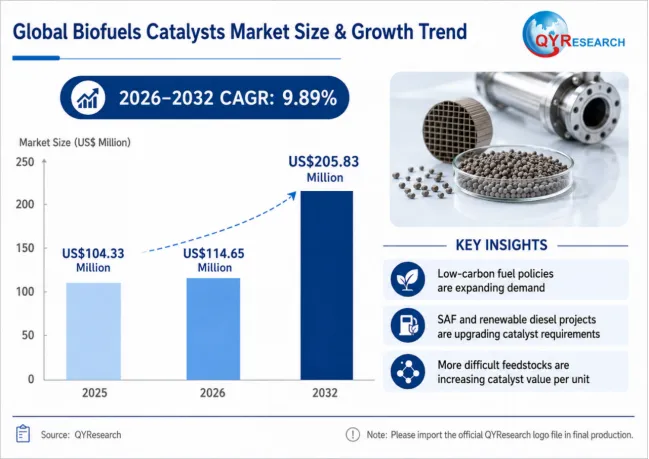
According to QYResearch preliminary research, the global Biofuels Catalysts market was approximately US$104.33 million in 2025 and is expected to reach approximately US$205.83 million by 2032, representing a CAGR of approximately 9.89% during 2026-2032. This scope mainly covers HDO catalysts, isomerization catalysts and related catalytic materials used in the production of renewable diesel, sustainable aviation fuel (SAF) and other biofuels. On the demand side, growth is driven by low-carbon fuel policies, refinery transition, SAF blending requirements, higher utilization of waste oils and fats, and the shift toward non-food feedstocks. On the supply side, leading suppliers are investing in higher activity, longer catalyst lifetime, impurity tolerance, process-license bundling, regional service networks and catalyst regeneration. According to the IEA Renewables 2024 outlook, biofuels in total liquid transport fuel demand are expected to increase from 5.6% in 2023 to 6.4% in 2030, reaching around 215 billion liters per year. Overall, the industry is moving from policy-led demand creation to commercial-scale unit deployment and deeper supply-chain integration, with incremental market value coming from renewable diesel capacity, SAF projects, refinery co-processing and higher catalyst value per unit of fuel output.
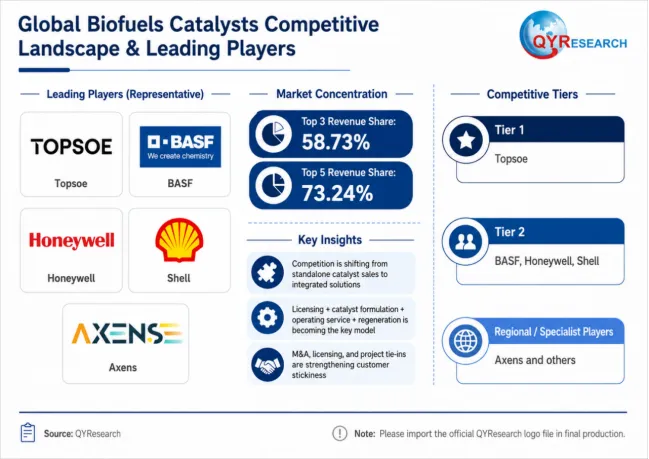
Under the report scope, representative global Biofuels Catalysts manufacturers include Topsoe, BASF, Honeywell, Shell and Axens. In 2025, the top three suppliers accounted for approximately 58.73% of global revenue, while the top five accounted for approximately 73.24%, indicating a relatively concentrated market. Topsoe is positioned in the first tier, supported by renewable fuel process packages and combined HDO/isomerization catalyst capabilities. BASF, Honeywell and Shell form the second tier, leveraging chemical catalyst portfolios, UOP process licensing and established refining catalyst customer bases. Axens and other specialized or regional suppliers differentiate through catalyst services, revamps, recycling and route-specific innovation. Competition is shifting from standalone catalyst supply toward integrated capability covering process licensing, catalyst formulation, operational support and regeneration/recycling. Honeywell’s planned acquisition of Johnson Matthey’s Catalyst Technologies business, Axens’ move to strengthen Eurecat catalyst services, and Topsoe’s HydroFlex supply for a SAF project in China all indicate that leading players are reinforcing full-solution capabilities through M&A, licensing and project bundling.
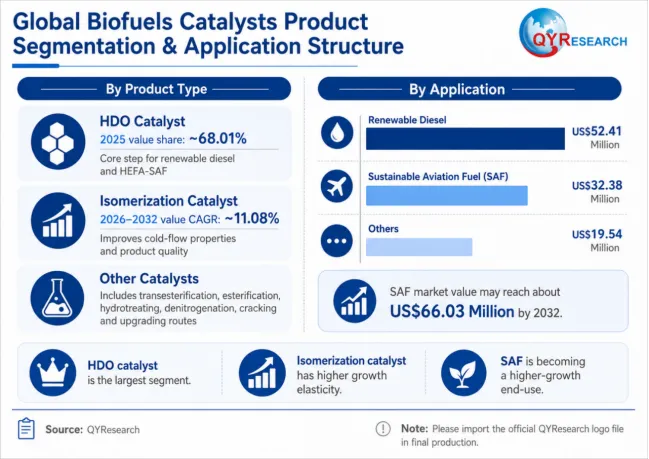
By type, the report segments Biofuels Catalysts into HDO catalysts, isomerization catalysts and others. HDO catalysts are used to remove oxygen from renewable feedstocks and convert them into hydrocarbon fuels; they are foundational in renewable diesel and HEFA-based SAF production and represented approximately 68.01% of market value in 2025. Isomerization catalysts improve cold-flow properties, adjust carbon-chain structures and enhance diesel or jet fuel component quality; while smaller in base size, this segment is expected to grow at a CAGR of around 11.08% during 2026-2032, showing stronger growth elasticity. Other catalysts include materials related to transesterification, esterification, hydrodenitrogenation, upgrading, solid acid/base catalysis and enzyme-based routes. By application, renewable diesel is currently the largest market, with a value of approximately US$52.41 million in 2025. SAF is supported by aviation decarbonization and blending mandates, increasing from approximately US$32.38 million in 2025 to approximately US$66.03 million by 2032, with its application share expected to continue rising.
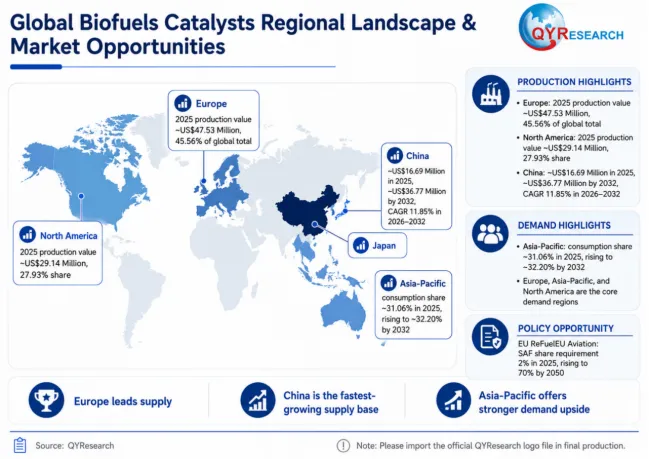
In terms of production value, Europe, North America and China are the major supply regions for Biofuels Catalysts. Europe recorded approximately US$47.53 million in 2025, accounting for about 45.56% of global production value, supported by mature catalyst suppliers, energy-transition policy and project experience. North America reached approximately US$29.14 million, or about 27.93% of the global total, benefiting from renewable diesel capacity, low-carbon fuel standards and domestic supply-chain redesign. China reached approximately US$16.69 million in 2025 and is expected to rise to approximately US$36.77 million by 2032, with a CAGR of around 11.85% during 2026-2032, making it one of the faster-growing production bases. On the consumption side, Europe, Asia-Pacific and North America are the key regions. Asia-Pacific accounted for approximately 31.06% of consumption volume in 2025 and is expected to rise to around 32.20% by 2032, reflecting refinery upgrades, energy-security concerns and regional SAF project development. Under ReFuelEU Aviation, the EU requires a 2% SAF share in aviation fuel at EU airports from 2025, rising to 70% by 2050, creating a clear long-term demand signal for SAF projects and related catalysts.
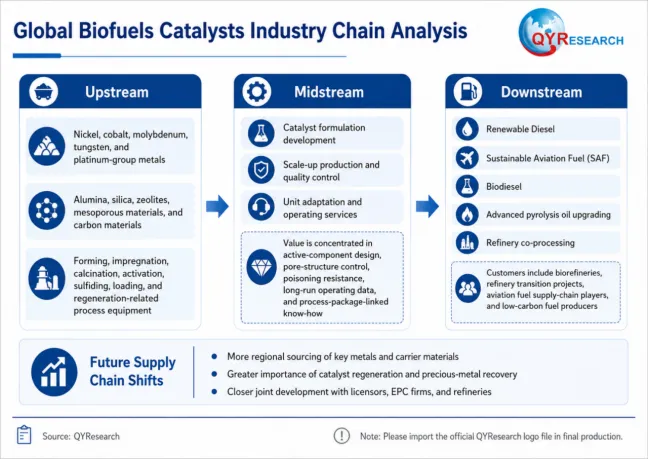
The upstream side of the Biofuels Catalysts value chain includes active metals such as nickel, cobalt, molybdenum, tungsten and platinum group metals, as well as support materials such as alumina, silica, zeolites, mesoporous materials, carbon materials and other engineered porous substrates. It also involves shaping, impregnation, calcination, activation, sulfiding, loading and regeneration equipment. The midstream covers catalyst formulation, scale-up production, quality control, unit adaptation and operating services, with value concentrated in active-site design, pore-structure control, poison resistance, long-cycle operating data and proprietary know-how tied to process packages. Downstream applications include renewable diesel, SAF, biodiesel, advanced pyrolysis-oil upgrading and refinery co-processing, with customers mainly being biorefineries, converted refineries, aviation fuel supply-chain players and low-carbon fuel producers. Future supply-chain shifts will focus on regional sourcing of critical metals and supports, catalyst regeneration and precious-metal recovery, and tighter collaboration among catalyst suppliers, licensors, EPC contractors and refinery customers.
Low-carbon fuel standards, renewable fuel mandates, SAF blending requirements and aviation decarbonization targets provide a long-term demand foundation, but project deployment remains exposed to subsidy stability, feedstock availability, certification rules and the price gap versus fossil fuels. IATA expects global SAF output to reach around 1.9 million tonnes in 2025, representing only about 0.6% of total jet fuel consumption, and around 2.4 million tonnes in 2026, or about 0.8% of total jet fuel consumption. This indicates that SAF remains constrained by supply gaps, cost pressure and limited scale. For catalyst suppliers, key entry barriers include high-activity metal systems, impurity-resistant catalyst design, long-cycle validation, alignment with fuel certification, unit-specific adaptation and project delivery experience. Key challenges include critical metal price volatility, tariffs and trade-policy changes, delayed downstream projects, competition from alternative routes and cost pressure on biofuels relative to fossil fuels.
In the coming years, Biofuels Catalysts will evolve from single-function materials toward multifunctional, longer-life, regenerable and route-specific catalyst systems. HDO and isomerization optimization will remain centered on yield, cold-flow properties and hydrogen efficiency. Catalysts for waste oils, animal fats and lignocellulosic derivatives will increasingly emphasize resistance to metals, nitrogen, phosphorus and other poisons, as well as regenerability. Nanostructured supports, hierarchical zeolites, bifunctional metal-acid systems and recyclable catalyst services will extend product value from the material itself to lifecycle economics. As renewable diesel maintains scale, SAF becomes the high-growth application, and refinery co-processing expands retrofit demand, competition is likely to concentrate further among leading players, while specialized suppliers with capabilities in specific feedstocks, catalyst regeneration or regional project services will still find entry opportunities.
The report provides a detailed analysis of the market size, growth potential, and key trends for each segment. Through detailed analysis, industry players can identify profit opportunities, develop strategies for specific customer segments, and allocate resources effectively.
The Biofuels Catalysts market is segmented as below:
By Company
Topsoe
BASF
Honeywell
Shell
Axens
Segment by Type
HDO Catalyst
Isomerization Catalyst
Others
Segment by Application
Renewable Diesel
Sustainable Aviation Fuel (SAF)
Others
Each chapter of the report provides detailed information for readers to further understand the Biofuels Catalysts market:
Chapter 1: Introduces the report scope of the Biofuels Catalysts report, global total market size (valve, volume and price). This chapter also provides the market dynamics, latest developments of the market, the driving factors and restrictive factors of the market, the challenges and risks faced by manufacturers in the industry, and the analysis of relevant policies in the industry. (2021-2032)
Chapter 2: Detailed analysis of Biofuels Catalysts manufacturers competitive landscape, price, sales and revenue market share, latest development plan, merger, and acquisition information, etc. (2021-2026)
Chapter 3: Provides the analysis of various Biofuels Catalysts market segments by Type, covering the market size and development potential of each market segment, to help readers find the blue ocean market in different market segments. (2021-2032)
Chapter 4: Provides the analysis of various market segments by Application, covering the market size and development potential of each market segment, to help readers find the blue ocean market in different downstream markets.(2021-2032)
Chapter 5: Sales, revenue of Biofuels Catalysts in regional level. It provides a quantitative analysis of the market size and development potential of each region and introduces the market development, future development prospects, market space, and market size of each country in the world..(2021-2032)
Chapter 6: Sales, revenue of Biofuels Catalysts in country level. It provides sigmate data by Type, and by Application for each country/region.(2021-2032)
Chapter 7: Provides profiles of key players, introducing the basic situation of the main companies in the market in detail, including product sales, revenue, price, gross margin, product introduction, recent development, etc. (2021-2026)
Chapter 8: Analysis of industrial chain, including the upstream and downstream of the industry.
Chapter 9: Conclusion.
Other relevant reports of QYResearch:
Global Biofuels Catalysts Market Outlook, In‑Depth Analysis & Forecast to 2032
Global Biofuels Catalysts Sales Market Report, Competitive Analysis and Regional Opportunities 2026-2032
Global Biofuels Catalysts Market Research Report 2026
Benefits of purchasing QYResearch report:
Competitive Analysis: QYResearch provides in-depth Biofuels Catalysts competitive analysis, including information on key company profiles, new entrants, acquisitions, mergers, large market shear, opportunities, and challenges. These analyses provide clients with a comprehensive understanding of market conditions and competitive dynamics, enabling them to develop effective market strategies and maintain their competitive edge.
Industry Analysis: QYResearch provides Biofuels Catalysts comprehensive industry data and trend analysis, including raw material analysis, market application analysis, product type analysis, market demand analysis, market supply analysis, downstream market analysis, and supply chain analysis.
and trend analysis. These analyses help clients understand the direction of industry development and make informed business decisions.
Market Size: QYResearch provides Biofuels Catalysts market size analysis, including capacity, production, sales, production value, price, cost, and profit analysis. This data helps clients understand market size and development potential, and is an important reference for business development.

Global Biofuels Catalysts Market Outlook, In‑Depth Analysis & Forecast to 2032

Published Date: 2026-03-08

Pages: 118

Report ld: 6038619
Price:USD 4900.00
(Single User License)
Global Biofuels Catalysts Sales Market Report, Competitive Analysis and Regional Opportunities 2026-2032
Published Date: 2026-03-08
Pages: 71
Report ld: 6038618
Price:USD 4250.00
(Single User License)
Biofuels Catalysts- Global Market Share and Ranking, Overall Sales and Demand Forecast 2026-2032
Published Date: 2026-03-08
Pages: 89
Report ld: 6038616
Price:USD 3950.00
(Single User License)
Global Biofuels Catalysts Market Research Report 2026
Published Date: 2026-02-24
Pages: 96
Report ld: 5999121
Price:USD 2900.00
(Single User License)
Global Biofuels Catalysts Market Outlook, In‑Depth Analysis & Forecast to 2031
Published Date: 2025-10-26
Pages: 143
Report ld: 5278300
Price:USD 4900.00
(Single User License)
Global Biofuels Catalysts Sales Market Report, Competitive Analysis and Regional Opportunities 2025-2031
Published Date: 2025-02-24
Pages: 80
Report ld: 4215020
Price:USD 4250.00
(Single User License)


Competition
Key players, new entrants,acquisitions, mergers and expansions,development trends and challenges.

Industry Analysis
Rawmaterial, application, product type, demand,supply,downstream, supply chain etc.

Market Size
Capacity, production, sales, revenue, price, cost etc.

Customized Information
We can offer customized survey and information to meet ourclient's need.
