End-to-End Autonomous Driving Market Report: the global market is expected to grow to approximately US$45.2 billion by 2032


QYResearch has recently released the 2026 Global End-to-End Autonomous Driving Market Research Report, covering product definition, technology pathways, market sizing, competitive landscape, application structure, regional dynamics, value chain development, and long-term commercialization opportunities. The report focuses on how end-to-end autonomous driving is moving from engineering validation toward scalable deployment across passenger vehicles, commercial fleets, robotaxi operations, and intelligent-driving software services.
Definition and Commercial Scope
End-to-end autonomous driving refers to a data-driven intelligent-driving architecture in which a unified deep-learning model, or a tightly coupled model stack, converts multi-sensor inputs into actionable driving outputs such as driving intent, trajectory, steering, acceleration, braking, and control-related decisions. Typical inputs include cameras, radar, LiDAR where applicable, localization signals, vehicle-state information, and road-scene data. Compared with traditional modular autonomous-driving pipelines, end-to-end systems place greater emphasis on model coordination across perception, prediction, planning, and control, supported by continuous data collection, model training, simulation, evaluation, deployment, and OTA iteration.
From a commercialization perspective, end-to-end autonomous driving is not a single algorithmic component. It is a system-level market built around onboard computing platforms, sensor suites, domain controllers, central compute units, model development platforms, data-loop infrastructure, validation toolchains, system integration, software licensing, and lifecycle services. Its core value lies in improving generalization in complex road scenarios, reducing the maintenance burden of manually engineered rules, and turning intelligent-driving capability into a deployable, upgradable, and monetizable vehicle function.
Market Size and Growth Outlook
According to QYResearch’s preliminary research, the global end-to-end autonomous driving market reached approximately US$3.7 billion in 2025 and is expected to grow to approximately US$45.2 billion by 2032, representing a CAGR of around 35.9% from 2026 to 2032. The market mainly covers revenue from onboard compute, sensing systems, domain controllers, system integration, end-to-end model development and licensing, OTA feature enablement, validation toolchains, data operations, cloud support, and lifecycle services. Demand growth is being driven by broader deployment of advanced driver-assistance functions, city NOA rollouts, intelligent EV differentiation, robotaxi testing, and commercial-vehicle automation. On the supply side, leading players are increasing investment in large-scale model training, vehicle compute platforms, data-loop efficiency, cloud-to-car collaboration, cost-optimized sensor configurations, and automotive-grade validation systems.
The industry is entering a steep commercialization ramp. In the early phase, market revenue is still anchored by hardware platforms and integration projects; over time, the revenue mix is shifting toward software, services, data operations, OTA upgrades, and validation toolchains. This shift indicates that the market is moving beyond hardware installation toward recurring software value and continuous vehicle-function monetization.
Competitive Landscape and Leading Players
The competitive landscape spans OEMs, autonomous-driving technology companies, onboard compute platform providers, robotaxi operators, and software-service vendors. Representative players include Tesla, Huawei, Waymo, XPeng, NIO, Li Auto, BYD, Zeekr, DeepRoute.ai, Horizon, Momenta, Baidu Apollo, Wayve, Aurora, Comma.ai, Nullmax, Chery, Xiaomi, and GAC Group. QYResearch’s report identifies hardware and software/service revenue as the two core market segments, while passenger vehicles and commercial vehicles form the two primary application categories.
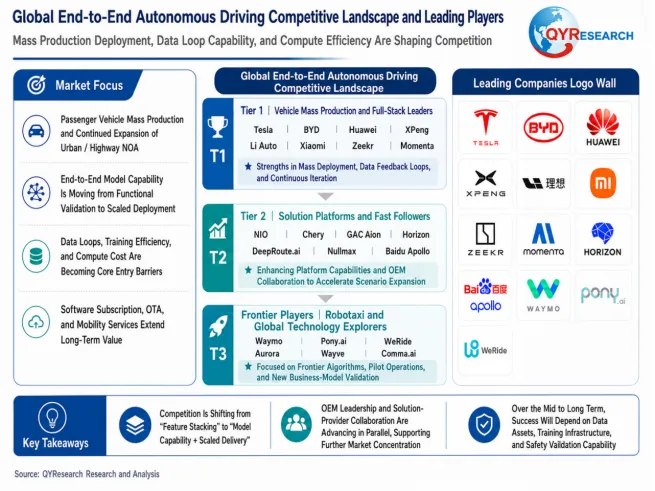
The market remains relatively concentrated in the near term because end-to-end autonomous driving requires large-scale real-world driving data, training compute, production-vehicle integration, OTA capability, and auditable safety validation. First-tier players tend to control fleet data, vehicle access, chip platforms, or high-value operating scenarios. Second-tier companies compete through OEM partnerships, engineering delivery, regional deployment, and specialized scenario coverage. New entrants are looking for breakthroughs in world models, vision-language models, simulation validation, low-cost sensing, and lightweight deployment. Competition is shifting from whether a model can demonstrate capability to whether a system can be mass-produced, validated, audited, upgraded, and monetized sustainably.
Technology Routes, Product Forms, and Application Demand
By product form, the market can be divided into hardware and software & services. Hardware includes onboard compute platforms, sensing suites, domain controllers, central compute platforms, and related integration components. It remains the foundation for volume deployment. Software & services include end-to-end model development, feature licensing, OTA upgrades, data operations, simulation validation, safety toolchains, cloud training, and lifecycle services. QYResearch’s market segmentation shows that hardware still forms the larger revenue base in the early commercialization stage, while software & services are gaining importance as deployments scale and feature upgrades become recurring revenue drivers.
By application, passenger vehicles remain the largest revenue base, driven by highway and city NOA, L2+/L3 feature packages, parking-to-parking automation, and intelligent-EV differentiation. Commercial vehicles are smaller in current revenue scale but have stronger long-term growth logic in logistics, port operations, mining areas, closed campuses, robotaxi fleets, and defined-route autonomous mobility. The commercial segment is particularly attractive where vehicle utilization, labor efficiency, safety monitoring, and cost-per-mile improvements can be quantified.
Regional Structure and Market Opportunities
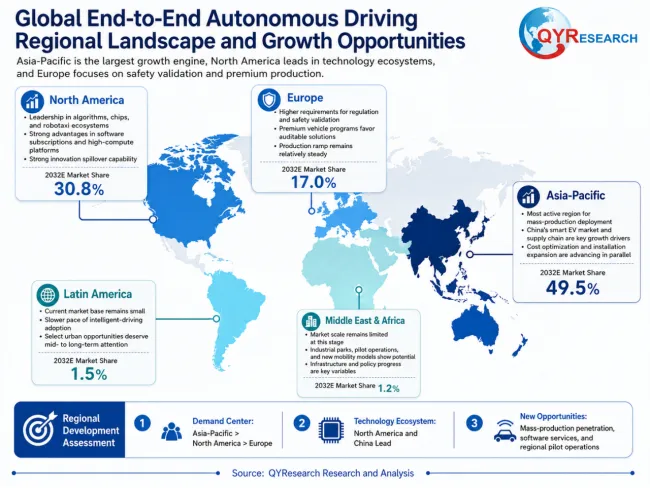
The global market shows clear regional differentiation. Asia-Pacific is the largest demand and growth region, supported by China, Japan, and South Korea’s EV supply chains, intelligent-driving ecosystems, and rapid model-year iteration. China, in particular, benefits from dense OEM competition, fast supplier response, high OTA acceptance, and a large base of intelligent EVs. North America maintains a strong position in AI models, onboard computing platforms, robotaxi operations, software subscriptions, and autonomous-driving infrastructure. Europe places greater emphasis on safety validation, regulatory alignment, liability boundaries, premium-vehicle integration, and auditable system design.
According to QYResearch’s regional market breakdown, Asia-Pacific is expected to remain the largest region over the longer forecast horizon, followed by North America and Europe, while Latin America and the Middle East & Africa remain at a lower base. Future opportunities will concentrate in three areas: rapid mass production and cost reduction in China and the broader Asia-Pacific region; technology spillover from North American AI chips, robotaxi operations, and software ecosystems; and steady growth in Europe around safety compliance, platform deployment, and validation toolchains.
Value Chain Analysis
The upstream segment of the end-to-end autonomous driving value chain includes automotive-grade AI chips, accelerators, cameras, radar, LiDAR, positioning modules, inertial navigation, drive-by-wire braking and steering, automotive operating systems, data collection systems, cloud computing resources, simulation platforms, and data governance tools. The midstream layer consists of OEMs, autonomous-driving algorithm companies, domain-controller suppliers, system integrators, and software-platform providers. Key activities include model training, vehicle-side deployment, scenario-library construction, data-loop management, simulation validation, road testing, safety assessment, and OTA iteration. Downstream applications include passenger-vehicle ADAS, commercial logistics vehicles, robotaxis, autonomous vehicles in ports, mines, industrial parks, intelligent mobility operations, and post-sale software services.
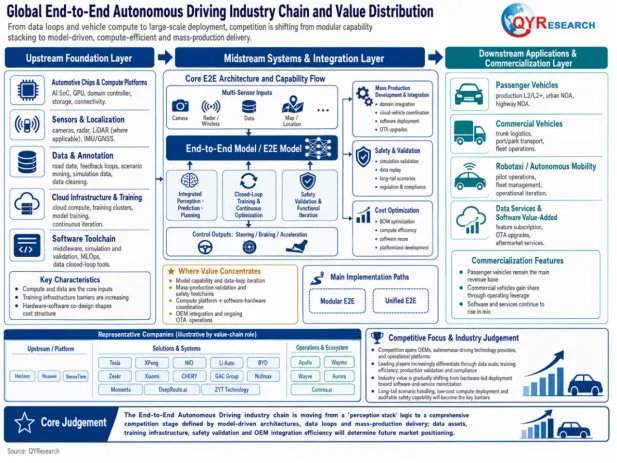
Value concentration is shifting from pure hardware installation toward a compound system of hardware platform + software model + data loop + safety validation. In the short term, onboard compute, sensors, and domain controllers remain the revenue base. In the medium to long term, model licensing, validation toolchains, data operations, OTA feature packages, and lifecycle services are expected to account for a larger share of incremental value. Key barriers include real-world data scale, long-tail scenario coverage, training efficiency, model generalization, automotive-grade safety validation, compute-cost control, and OEM production-integration experience.
Regulation, Barriers, Challenges, and Future Outlook
The development of end-to-end autonomous driving is shaped by road-testing regulation, data compliance, cybersecurity, functional safety, safety of the intended functionality, liability allocation, and market-entry approval. Regulatory timelines differ by region, creating additional cost for cross-market deployment. On the technology side, the industry still faces challenges around explainability, safety auditability, long-tail scenario coverage, consistency between simulation and real-world performance, model degradation monitoring, and fallback strategies. On the production side, chip supply, electrical/electronic architecture, redundancy design, thermal management, power consumption, bill-of-materials control, and aftersales responsibility all require system-level solutions.
Over the next few years, end-to-end autonomous driving is expected to evolve from modular E2E toward more unified E2E architectures, with world models and multimodal interaction becoming increasingly important. In passenger vehicles, competition will focus on city NOA, parking-to-parking driving, L2+/L3 feature packages, and OTA subscriptions. In commercial vehicles, adoption will be driven more directly by measurable operating economics, including higher utilization, lower human intervention, and improved cost per mile. As EV platforms, central compute, AI models, simulation validation, and data-loop systems mature, end-to-end autonomous driving is likely to move from a premium feature on selected models to a core capability in the intelligent EV market.
The report provides a detailed analysis of the market size, growth potential, and key trends for each segment. Through detailed analysis, industry players can identify profit opportunities, develop strategies for specific customer segments, and allocate resources effectively.
The End-to-end Autonomous Driving market is segmented as below:
By Company
Tesla
Nullmax
Momenta
Waymo
Wayve
Aurora
Comma.ai
XPeng Inc.
Huawei
NIO
Li Auto Inc.
BYD
Zeekr (Geely Global)
DeepRoute.ai
ZYT Technology
Horizon
SenseTime
CHERY
Xiaomi
GAC Group
Apollo (Baidu Apollo Go)
WeRide
Segment by Type
Hardware
Software/Services
Segment by Application
Passenger Vehicle
Commercial Vehicles
Each chapter of the report provides detailed information for readers to further understand the End-to-end Autonomous Driving market:
Chapter 1: Introduces the report scope of the End-to-end Autonomous Driving report, global total market size (valve, volume and price). This chapter also provides the market dynamics, latest developments of the market, the driving factors and restrictive factors of the market, the challenges and risks faced by manufacturers in the industry, and the analysis of relevant policies in the industry. (2021-2032)
Chapter 2: Detailed analysis of End-to-end Autonomous Driving manufacturers competitive landscape, price, sales and revenue market share, latest development plan, merger, and acquisition information, etc. (2021-2026)
Chapter 3: Provides the analysis of various End-to-end Autonomous Driving market segments by Type, covering the market size and development potential of each market segment, to help readers find the blue ocean market in different market segments. (2021-2032)
Chapter 4: Provides the analysis of various market segments by Application, covering the market size and development potential of each market segment, to help readers find the blue ocean market in different downstream markets.(2021-2032)
Chapter 5: Sales, revenue of End-to-end Autonomous Driving in regional level. It provides a quantitative analysis of the market size and development potential of each region and introduces the market development, future development prospects, market space, and market size of each country in the world..(2021-2032)
Chapter 6: Sales, revenue of End-to-end Autonomous Driving in country level. It provides sigmate data by Type, and by Application for each country/region.(2021-2032)
Chapter 7: Provides profiles of key players, introducing the basic situation of the main companies in the market in detail, including product sales, revenue, price, gross margin, product introduction, recent development, etc. (2021-2026)
Chapter 8: Analysis of industrial chain, including the upstream and downstream of the industry.
Chapter 9: Conclusion.
Other relevant reports of QYResearch:
Global End-to-end Autonomous Driving Market Research Report 2026
Global End-to-end Autonomous Driving Sales Market Report, Competitive Analysis and Regional Opportunities 2026-2032
Benefits of purchasing QYResearch report:
Competitive Analysis: QYResearch provides in-depth End-to-end Autonomous Driving competitive analysis, including information on key company profiles, new entrants, acquisitions, mergers, large market shear, opportunities, and challenges. These analyses provide clients with a comprehensive understanding of market conditions and competitive dynamics, enabling them to develop effective market strategies and maintain their competitive edge.
Industry Analysis: QYResearch provides End-to-end Autonomous Driving comprehensive industry data and trend analysis, including raw material analysis, market application analysis, product type analysis, market demand analysis, market supply analysis, downstream market analysis, and supply chain analysis.
and trend analysis. These analyses help clients understand the direction of industry development and make informed business decisions.
Market Size: QYResearch provides End-to-end Autonomous Driving market size analysis, including capacity, production, sales, production value, price, cost, and profit analysis. This data helps clients understand market size and development potential, and is an important reference for business development.

Global End-to-end Autonomous Driving Market Research Report 2026

Published Date: 2026-01-05

Pages: 151

Report ld: 5548945
Price:USD 2900.00
(Single User License)
End-to-end Autonomous Driving - Global Market Share and Ranking, Overall Sales and Demand Forecast 2026-2032
Published Date: 2026-01-05
Pages: 142
Report ld: 5548944
Price:USD 3950.00
(Single User License)
Global End-to-end Autonomous Driving Sales Market Report, Competitive Analysis and Regional Opportunities 2026-2032
Published Date: 2026-01-05
Pages: 112
Report ld: 5548912
Price:USD 4250.00
(Single User License)

Global End-to-end Autonomous Driving Market Research Report 2025
Published Date: 2025-12-29
Pages: 188
Report ld: 4744959
Price:USD 2900.00
(Single User License)
End-to-end Autonomous Driving - Global Market Share and Ranking, Overall Sales and Demand Forecast 2025-2031
Published Date: 2025-05-24
Pages: 127
Report ld: 4744958
Price:USD 3950.00
(Single User License)
Global End-to-end Autonomous Driving Sales Market Report, Competitive Analysis and Regional Opportunities 2025-2031
Published Date: 2025-05-24
Pages: 109
Report ld: 4744957
Price:USD 4250.00
(Single User License)


Competition
Key players, new entrants,acquisitions, mergers and expansions,development trends and challenges.

Industry Analysis
Rawmaterial, application, product type, demand,supply,downstream, supply chain etc.

Market Size
Capacity, production, sales, revenue, price, cost etc.

Customized Information
We can offer customized survey and information to meet ourclient's need.
