Low Earth Orbit Communication Satellite Research:expected to reach approximately US$11.529 billion by 2032


QYResearch has recently released the industry report “2026 Global Low Earth Orbit Communication Satellite Industry Research Report,” covering product definition, technology routes, market size, competitive landscape, application scenarios, regional structure, and value-chain evolution of Low Earth Orbit Communication Satellites. This article focuses on demand changes, technology evolution, and supply-chain opportunities in satellite broadband, direct-to-cell connectivity, IoT communications, aviation and maritime connectivity, enterprise private networks, military data transport, and government secure communications.
A Low Earth Orbit Communication Satellite refers to a communication satellite system operating in low Earth orbit and mainly used for broadband internet access, mobile coverage extension, IoT data backhaul, private network communications, and secure data transmission. It typically consists of a satellite bus, communication payload, phased-array antenna, inter-satellite link, onboard processing unit, power and thermal-control systems, propulsion system, attitude and orbit control system, ground gateways, and user terminals. Compared with traditional high-orbit communication satellites, LEO communication satellites provide lower latency, broader coverage, scalable network capacity, higher revisit frequency, and faster deployment through large-scale constellations and multi-beam coverage. They are evolving from a supplementary connectivity tool for remote areas into a key layer of global digital infrastructure, mobile network extension, and secure communications.
The core functions of LEO communication satellites include global or regional broadband connectivity, maritime and aviation mobile communications, direct access for mobile phones and IoT terminals, military low-latency data links, and government emergency communications. As high-throughput payloads, optical inter-satellite links, software-defined payloads, mass satellite manufacturing, and lower-cost launch capabilities continue to mature, the commercial boundaries of LEO communication satellites are expanding and creating a tighter industrial loop across satellite manufacturing, launch services, ground terminals, spectrum resources, network operation, and application services.
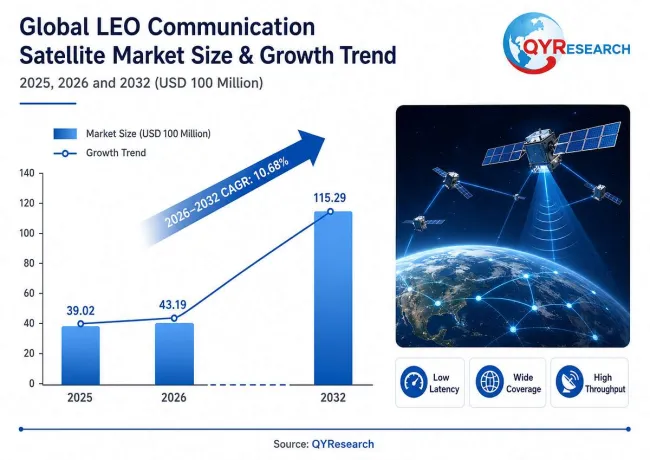
According to QYResearch statistics, the global Low Earth Orbit Communication Satellite market size was approximately US$3.902 billion in 2025 and is expected to reach approximately US$11.529 billion by 2032, with a compound annual growth rate of approximately 10.68% during 2026–2032. The market size mainly covers LEO communication satellite-related markets for broadband internet, direct-to-cell services, IoT communications, military data transport, government secure communications, and regional sovereign communication networks. From the demand side, growth is mainly driven by large-scale commercial broadband constellation deployment, commercialization of direct-to-cell services, rising aviation, maritime and enterprise private network demand, military LEO data network construction, and national satellite internet infrastructure investment. From the supply side, leading players are investing in high-throughput satellite platforms, optical inter-satellite links, phased-array antennas, mass manufacturing, low-cost launches, global service licensing, and ground terminal ecosystems. Overall, the industry is entering a key transition from constellation deployment to scaled operation and secure communications infrastructure, with future growth mainly coming from above-500 kg high-throughput satellites, military LEO network orders, large-scale constellation construction in China and Europe, direct-to-cell services, and 5G/6G non-terrestrial network integration.
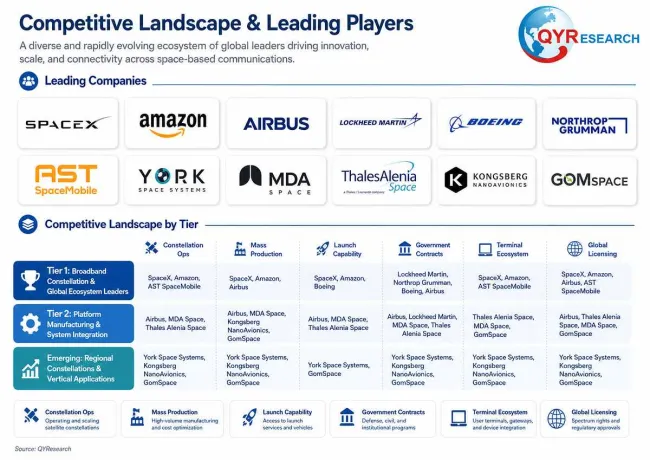
The global LEO communication satellite market remains relatively concentrated, but the competitive structure is moving from the dominance of a single leader toward a multi-layer landscape consisting of commercial broadband constellation operators, national constellation developers, defense prime contractors, satellite platform manufacturers, and regional new entrants. Representative companies include SpaceX, Amazon Leo, Airbus, China Aerospace Science and Technology Corporation, Genesat, Geespace, York Space Systems, Lockheed Martin, AST SpaceMobile, GalaxySpace, Northrop Grumman, Kongsberg NanoAvionics, MDA Space, Thales Alenia Space, Open Cosmos, GomSpace, Boeing, Hongqing Technology, and China Aerospace Science and Industry Corporation. The first tier mainly includes companies with constellation operation, satellite mass production, launch capability, and global service ecosystems. The second tier mainly includes prime contractors and platform manufacturers serving government secure communications, military LEO networks, and regional constellation projects. New entrants and regional manufacturers focus more on small and medium satellite platforms, IoT communications, national constellation programs, and vertical applications. Future competition will no longer be determined only by satellite count, but by launch capability, spectrum and orbital resources, terminal ecosystems, government contracts, global operating licenses, integrated space-ground network capability, and sustained financing capacity.
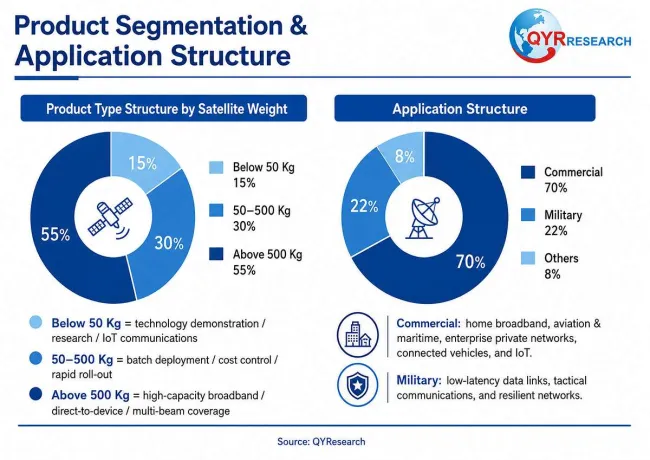
By product type, weight-based segmentation is one of the most stable and commonly used approaches in the LEO communication satellite market, including below 50 kg, 50–500 kg, and above 500 kg. Satellites below 50 kg are typically used for technology demonstration, research, IoT communications, and low-cost supplementary networks; their unit value is relatively low but deployment is flexible. Satellites in the 50–500 kg segment were important in early LEO internet constellations and medium-sized communication platforms, supporting batch deployment, cost control, and rapid constellation build-out. Satellites above 500 kg are becoming the core revenue contributor, mainly serving high-capacity broadband, direct-to-cell connectivity, multi-beam coverage, optical inter-satellite links, and high-power communication platforms. By application, commercial, military, and other uses form the main demand structure. Commercial applications remain the largest segment, driven by home broadband, remote-area access, aviation and maritime connectivity, enterprise private networks, connected vehicles, IoT, and mobile operator coverage extension. Military applications are growing faster, supported by low-latency data links, missile warning, tactical communications, sensor-to-shooter connectivity, and distributed resilient communication networks.
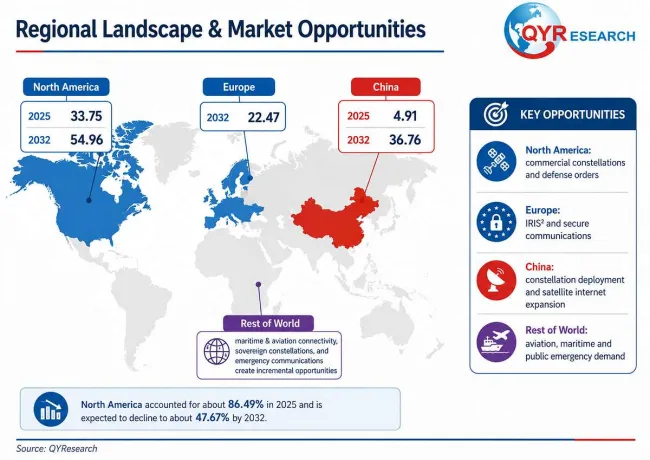
Regionally, North America remains the core market for LEO communication satellites, supported by leading commercial constellations, launch capability, military LEO network orders, terminal ecosystems, and capital markets. According to QYResearch statistics, the North American market size was approximately US$3.375 billion in 2025, representing about 86.49% of the global market; by 2032 it is expected to reach US$5.496 billion, while its share is expected to decline to around 47.67% as China, Europe, and other regions enter large-scale constellation deployment. Europe is expected to be driven by IRIS², secure communications, multi-orbit integration, and regional commercial constellations, reaching approximately US$2.247 billion by 2032. China has entered a rapid growth phase since 2023, with a market size of approximately US$491 million in 2025 and an expected US$3.676 billion by 2032. Its growth mainly comes from projects such as Qianfan, Guowang, Genesat, GalaxySpace, and Geespace, as well as demand from satellite internet, emergency communications, connected vehicles, low-altitude economy, and secure communications. Other Asia-Pacific markets, the Middle East, Australia, and Latin America will generate incremental demand through domestic constellation plans, international constellation service deployment, maritime and aviation connectivity, and government emergency communications.
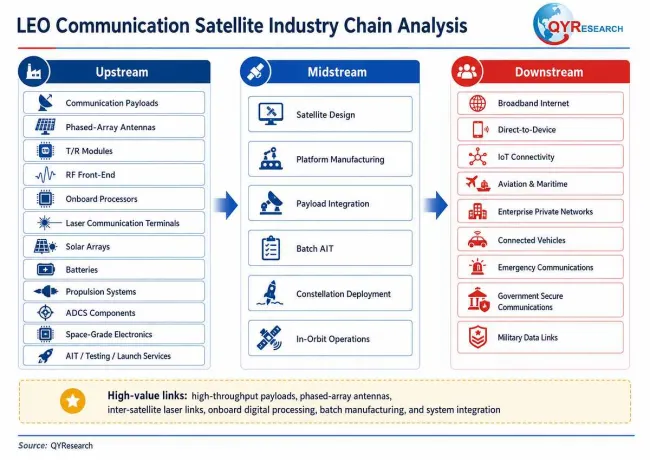
The upstream value chain of LEO communication satellites includes communication payloads, phased-array antennas, T/R modules, RF front-end components, onboard processors, optical communication terminals, solar arrays, batteries, propulsion systems, attitude and orbit control components, star trackers, reaction wheels, thermal-control materials, space-grade electronic components, carbon-fiber composites, and high-reliability connectors. Core equipment and basic capabilities also include AIT assembly and test lines, thermal-vacuum testing, vibration testing, EMC testing, ground telemetry and control, spectrum coordination, and launch services. The midstream includes satellite design, platform manufacturing, payload integration, mass assembly and testing, constellation deployment, and in-orbit operation. Value is concentrated in high-throughput communication payloads, phased-array antennas, optical inter-satellite links, onboard digital processing, mass manufacturing, and system integration. Downstream applications include commercial broadband, mobile operator supplemental coverage, direct-to-cell services, aviation and maritime connectivity, enterprise private networks, connected vehicles, IoT, emergency communications, government secure communications, and military data links. In the future, the supply chain will move toward standardized platforms, mass production, localized sourcing, coordinated satellite-terminal ecosystems, and multi-orbit integration. Companies with core payloads, low-cost launch capability, ground terminal ecosystems, and global operating capability will hold stronger bargaining power across the value chain.
The LEO communication satellite industry benefits from policy support related to satellite internet, space security, emergency communications, digital infrastructure, and defense communications in multiple countries, but it also faces high technical, capital, certification, and operational barriers. Companies must manage spectrum and orbital coordination, cross-border communication licensing, export controls, space debris mitigation, collision avoidance, in-orbit operations, launch windows, terminal cost, cybersecurity, and declining commercial ARPU. For market participants, satellite manufacturing capability alone is no longer sufficient to establish long-term competitiveness. System-level capability built around satellite platforms, communication payloads, launch services, spectrum resources, ground networks, terminal ecosystems, government contracts, and global operating licenses will define future market positions.
In the coming years, the LEO communication satellite industry will continue upgrading toward higher throughput, optical inter-satellite links, software-defined payloads, direct-to-cell services, 5G/6G NTN integration, larger satellite platforms, mass satellite manufacturing, and integrated space-ground networks. Commercial broadband will expand from home and remote-area connectivity to aviation, maritime, connected vehicles, and enterprise private networks. Military and government secure communications will become a more certain growth area. China, Europe, and regional sovereign constellations will push the global market from North America-led growth toward a more multipolar structure. Overall, LEO communication satellites are becoming an important component of global communication infrastructure and secure communication systems, with long-term growth supported by ubiquitous connectivity demand, national strategic investment, terminal ecosystem expansion, and continuous innovation in space network technologies.
The report provides a detailed analysis of the market size, growth potential, and key trends for each segment. Through detailed analysis, industry players can identify profit opportunities, develop strategies for specific customer segments, and allocate resources effectively.
The Low Earth Orbit Communication Satellite market is segmented as below:
By Company
SpaceX
Thales Alenia Space
OneWeb Satellites
Lockheed Martin
Boeing
Planet Labs
Northrop Grumman
ISS-Reshetnev
Kepler Communications
SSL (Space Systems Loral)
Segment by Type
Below 50 Kg
50-500 Kg
Above 500 Kg
Segment by Application
Commercial
Military
Others
Each chapter of the report provides detailed information for readers to further understand the Low Earth Orbit Communication Satellite market:
Chapter 1: Introduces the report scope of the Low Earth Orbit Communication Satellite report, global total market size (valve, volume and price). This chapter also provides the market dynamics, latest developments of the market, the driving factors and restrictive factors of the market, the challenges and risks faced by manufacturers in the industry, and the analysis of relevant policies in the industry. (2021-2032)
Chapter 2: Detailed analysis of Low Earth Orbit Communication Satellite manufacturers competitive landscape, price, sales and revenue market share, latest development plan, merger, and acquisition information, etc. (2021-2026)
Chapter 3: Provides the analysis of various Low Earth Orbit Communication Satellite market segments by Type, covering the market size and development potential of each market segment, to help readers find the blue ocean market in different market segments. (2021-2032)
Chapter 4: Provides the analysis of various market segments by Application, covering the market size and development potential of each market segment, to help readers find the blue ocean market in different downstream markets.(2021-2032)
Chapter 5: Sales, revenue of Low Earth Orbit Communication Satellite in regional level. It provides a quantitative analysis of the market size and development potential of each region and introduces the market development, future development prospects, market space, and market size of each country in the world..(2021-2032)
Chapter 6: Sales, revenue of Low Earth Orbit Communication Satellite in country level. It provides sigmate data by Type, and by Application for each country/region.(2021-2032)
Chapter 7: Provides profiles of key players, introducing the basic situation of the main companies in the market in detail, including product sales, revenue, price, gross margin, product introduction, recent development, etc. (2021-2026)
Chapter 8: Analysis of industrial chain, including the upstream and downstream of the industry.
Chapter 9: Conclusion.
Other relevant reports of QYResearch:
Low Earth Orbit Communication Satellite - Global Market Share and Ranking, Overall Sales and Demand Forecast 2026-2032
Global Low Earth Orbit Communication Satellite Market Outlook, In‑Depth Analysis & Forecast to 2032
Global Low Earth Orbit Communication Satellite Sales Market Report, Competitive Analysis and Regional Opportunities 2026-2032
Global Low Earth Orbit Communication Satellite Market Research Report 2026
Benefits of purchasing QYResearch report:
Competitive Analysis: QYResearch provides in-depth Low Earth Orbit Communication Satellite competitive analysis, including information on key company profiles, new entrants, acquisitions, mergers, large market shear, opportunities, and challenges. These analyses provide clients with a comprehensive understanding of market conditions and competitive dynamics, enabling them to develop effective market strategies and maintain their competitive edge.
Industry Analysis: QYResearch provides Low Earth Orbit Communication Satellite comprehensive industry data and trend analysis, including raw material analysis, market application analysis, product type analysis, market demand analysis, market supply analysis, downstream market analysis, and supply chain analysis.
and trend analysis. These analyses help clients understand the direction of industry development and make informed business decisions.
Market Size: QYResearch provides Low Earth Orbit Communication Satellite market size analysis, including capacity, production, sales, production value, price, cost, and profit analysis. This data helps clients understand market size and development potential, and is an important reference for business development.

Low Earth Orbit Communication Satellite - Global Market Share and Ranking, Overall Sales and Demand Forecast 2026-2032

Published Date: 2026-06-04

Pages: 132

Report ld: 6724177
Price:USD 3950.00
(Single User License)
Global Low Earth Orbit Communication Satellite Market Outlook, In‑Depth Analysis & Forecast to 2032
Published Date: 2026-06-04
Pages: 154
Report ld: 6724176
Price:USD 4900.00
(Single User License)
Global Low Earth Orbit Communication Satellite Sales Market Report, Competitive Analysis and Regional Opportunities 2026-2032
Published Date: 2026-06-04
Pages: 135
Report ld: 6724175
Price:USD 4250.00
(Single User License)
Global Low Earth Orbit Communication Satellite Market Research Report 2026
Published Date: 2026-06-04
Pages: 134
Report ld: 5976240
Price:USD 2900.00
(Single User License)
Low Earth Orbit Communication Satellite- Global Market Share and Ranking, Overall Sales and Demand Forecast 2026-2032
Published Date: 2026-02-11
Pages: 105
Report ld: 5981290
Price:USD 3950.00
(Single User License)
Global Low Earth Orbit Communication Satellite Market Outlook, In‑Depth Analysis & Forecast to 2031
Published Date: 2025-10-03
Pages: 141
Report ld: 5166664
Price:USD 4900.00
(Single User License)


Competition
Key players, new entrants,acquisitions, mergers and expansions,development trends and challenges.

Industry Analysis
Rawmaterial, application, product type, demand,supply,downstream, supply chain etc.

Market Size
Capacity, production, sales, revenue, price, cost etc.

Customized Information
We can offer customized survey and information to meet ourclient's need.
