Smart Micro Modular Data Center Research:compound annual growth rate of approximately 7.12% from 2026 to 2032


2026 Global Smart Micro Modular Data Center Industry Research Report
QYResearch has recently released the industry report “2026 Global Smart Micro Modular Data Center Industry Research Report”, focusing on product definition, technology routes, market size, competitive landscape, application scenarios, regional structure and supply chain evolution of Smart Micro Modular Data Centers. This article highlights demand changes, technology upgrades and supply chain opportunities in edge computing, enterprise server rooms, financial branches, industrial sites, telecom access rooms, healthcare, education and small-to-medium data center scenarios.
A Smart Micro Modular Data Center refers to a prefabricated and integrated data center infrastructure unit designed for rapid deployment, flexible expansion and intelligent operation. It is typically composed of standard racks, enclosed cold or hot aisles, power distribution systems, UPS, precision cooling, fire protection, security, cabling, environmental monitoring and energy management systems. Through modular design, factory pre-integration, fast on-site installation and remote intelligent management, it provides a standardized operating environment for IT equipment. Its core functions include stable power supply, temperature and humidity control, physical security, energy monitoring, fault warning and centralized operation for servers, storage and network equipment. Major applications include enterprise branches, edge computing nodes, industrial internet sites, smart campuses, financial outlets, telecom access rooms, healthcare and education facilities, and small-scale cloud-edge infrastructure.
In terms of product form, Smart Micro Modular Data Centers combine the characteristics of traditional data center infrastructure, modular data centers and edge computing infrastructure. They emphasize compact design, high integration, standardization, intelligence and repeatable deployment. With the growth of AI inference, video analytics, industrial IoT, low-latency services and distributed computing demand, data processing capability is moving from centralized large data centers toward edge nodes closer to users, devices and business sites. Smart Micro Modular Data Centers reduce construction cycles, lower on-site engineering complexity, improve operation visibility and enhance environmental adaptability, becoming an important infrastructure format for enterprise digital transformation, distributed computing deployment and energy-saving upgrades.
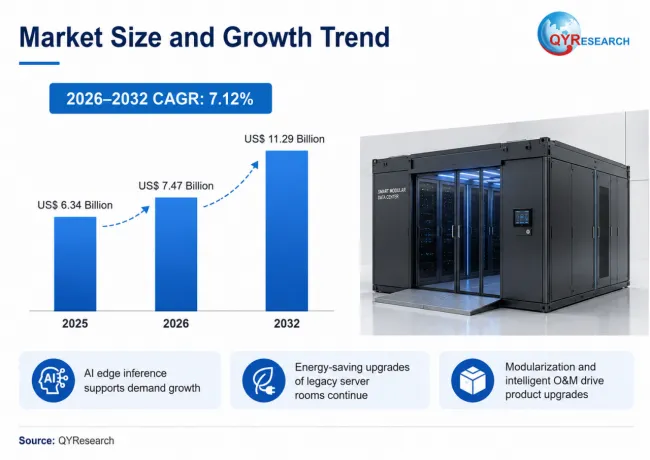
According to QYResearch’s preliminary research, the global Smart Micro Modular Data Center market size was approximately US$6,340.00 million in 2025 and approximately US$7,472.00 million in 2026. It is expected to reach approximately US$11,289.12 million by 2032, with a compound annual growth rate of approximately 7.12% from 2026 to 2032. The above market size mainly covers integrated Smart Micro Modular Data Center solutions based on rack-level, row-level, room-level and small prefabricated modules, including power distribution, cooling, racks, aisle containment, monitoring management and related integration delivery. From the demand side, market growth is mainly driven by AI edge inference, enterprise digital transformation, industrial internet, smart cities, remote branch IT upgrades, local data processing in finance and healthcare, telecom network extension and energy-saving renovation of small server rooms. From the supply side, leading suppliers are investing in high-power-density racks, modular UPS, in-row cooling, liquid-cooling compatibility, intelligent monitoring platforms, prefabricated delivery capabilities, global service networks and regional channel expansion. Overall, the industry is evolving from standard server room replacement to cloud-edge collaborative infrastructure. Future growth will mainly come from edge computing node deployment, renovation of existing small server rooms, distributed AI inference infrastructure, high-reliability industry applications and digital infrastructure build-out in emerging markets. According to public statistics from the International Energy Agency, global data center electricity demand is expected to increase significantly with the growth of AI and digital services, which strengthens the need for energy-efficient, high-density and monitorable modular infrastructure. In China, the National Development and Reform Commission and other authorities have also proposed targets such as lowering the average PUE of data centers to below 1.5 by the end of 2025 and raising overall rack utilization, further encouraging green, modular and intelligent data center infrastructure upgrades.
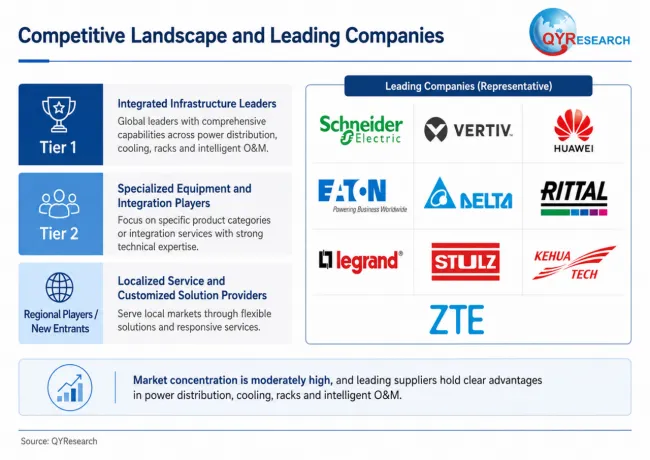
Key global participants in the Smart Micro Modular Data Center market include Schneider Electric, Vertiv, Huawei, Eaton, Delta Electronics, Rittal, Legrand, STULZ, Kehua Tech, Canovate, ZTE and ZTT Group. The first tier is mainly composed of integrated infrastructure suppliers with global capabilities in power distribution, cooling, racks, monitoring software and service networks. Their advantages lie in complete product portfolios, mature engineering experience, strong cross-regional delivery capability and deep cooperation with large enterprises, cloud service providers, telecom operators and critical industry customers. The second tier usually has specialized strengths in UPS, precision cooling, racks, fire protection, cabling or regional engineering integration, and enters the small data center and edge computing markets through modular solution capabilities. Regional suppliers and new entrants often compete through pricing, delivery speed, local services and industry-specific customization. The overall competitive landscape is characterized by global leaders dominating high-end and multinational projects, regional brands serving local industry customers, and system integrators participating deeply in project delivery. Future competition will shift from single hardware configuration to system energy efficiency, rapid deployment, intelligent operation, remote monitoring, lifecycle services, high-power-density adaptation and liquid-cooling compatibility. Companies with standardized product platforms and repeatable project delivery capabilities are expected to scale more effectively.
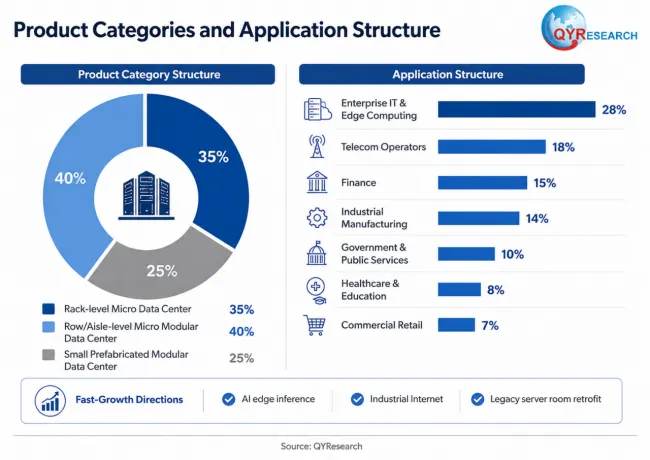
Smart Micro Modular Data Centers can be classified by product form into rack-level micro data centers, row-level or aisle-level micro modular data centers, and small prefabricated modular data centers. Rack-level products usually integrate UPS, PDU, cooling, monitoring, security and fire protection into a single rack or a small number of racks, making them suitable for stores, branches, industrial sites, hospital departments, schools and small offices with limited space. Row-level or aisle-level products are based on multiple racks, enclosed cold or hot aisles, in-row cooling and centralized power distribution, and are suitable for enterprise server rooms, campus edge nodes, financial branches and telecom access rooms. Small prefabricated modular data centers emphasize factory prefabrication, fast on-site assembly and scalable expansion, and are suitable for regional cloud nodes, edge computing stations, disaster recovery centers and rapid construction projects. From the application perspective, stable downstream markets include enterprise IT and edge computing, telecom operators, finance, government and public services, industrial manufacturing, healthcare, education and commercial retail. Faster-growing directions include AI edge inference, industrial internet, video and security analytics, smart campuses, low-latency service nodes and energy-saving renovation of existing server rooms. Highly regulated and high-reliability industries place greater emphasis on redundant architecture, physical security, data localization, remote operation and auditable maintenance.
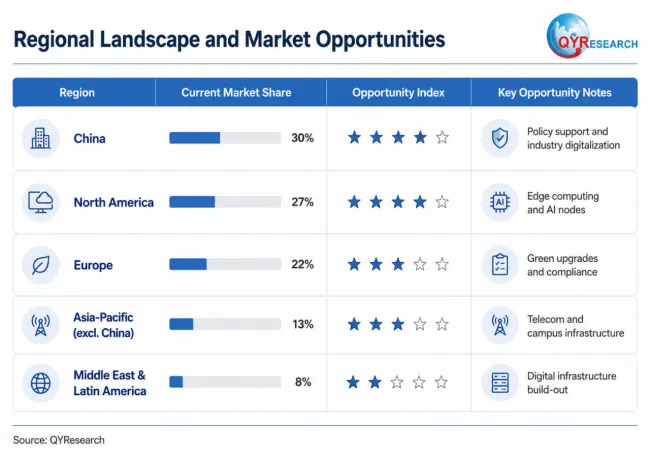
From a regional perspective, North America, Europe and China are major consumption markets for Smart Micro Modular Data Centers, with demand driven by cloud-edge collaboration, enterprise digitalization, AI infrastructure expansion, industrial automation and renovation of legacy server rooms. In North America, demand is active in edge computing, retail outlets, industrial sites, financial services and AI inference nodes, with customers focusing on rapid deployment, reliable power supply, remote operation and integration with existing IT management platforms. In Europe, energy efficiency, sustainability, compliance and data localization are important considerations, pushing modular data centers toward green power, efficient cooling and visible energy monitoring. In China, policies related to computing infrastructure, green data centers and industry digitalization are supporting deployment in government campuses, telecom operators, finance, education, healthcare, manufacturing and transportation. Emerging markets such as Southeast Asia, the Middle East and Latin America are driven by digital economy development, telecom network construction, cloud service penetration and urban infrastructure upgrades, creating rising demand for micro modular solutions that are easy to deploy, simple to operate and adaptable to different environments. On the supply side, European and North American companies have strengths in high-end power distribution, cooling, monitoring software and global project management, while Chinese and Asian suppliers are improving competitiveness in cost control, engineering delivery, system integration and regional services. The future supply chain is expected to combine global platform development with localized delivery.
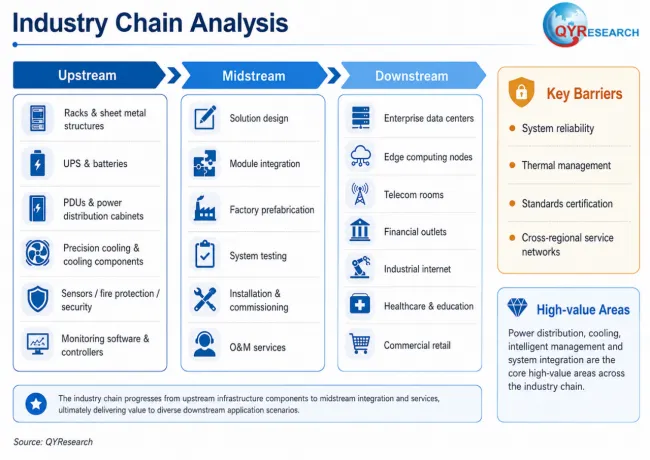
The upstream supply chain of Smart Micro Modular Data Centers mainly includes racks, sheet metal structures, UPS, batteries, PDUs, power distribution cabinets, precision air conditioners, fans, compressors, cooling coils, sensors, fire protection systems, access control and security systems, cabling systems, monitoring software, controllers and energy management modules. Core equipment includes power distribution systems, cooling systems, aisle containment, intelligent monitoring platforms and operation management software. Midstream companies are responsible for solution design, module integration, factory prefabrication, system testing, on-site installation, commissioning and after-sales operation. Value is concentrated in power distribution, cooling, intelligent management, system integration and long-term services. Downstream applications include enterprise data centers, edge computing nodes, telecom access rooms, financial outlets, government campuses, industrial internet sites, healthcare and education facilities, smart transportation and commercial retail. Key barriers include system reliability design, thermal management capability, power redundancy, project experience, standards certification, monitoring software capability, cross-regional service networks and customer trust. Future supply chain evolution will be driven by high-density power and cooling, lower PUE, liquid-cooling compatibility and intelligent management. Modular products will develop toward standardized platforms combined with industry-specific customization, while the boundaries between system integrators and equipment suppliers will continue to blur. Companies with lifecycle service capabilities will gain stronger customer stickiness and a more favorable profit structure.
From a policy perspective, major economies are promoting AI computing power, digital infrastructure, green data centers, energy efficiency, data security and resilient supply chains. As a rapidly deployable and repeatable infrastructure format, Smart Micro Modular Data Centers are expected to benefit from edge computing, energy-saving renovation and industry digitalization. However, the industry still faces several barriers and challenges. First, high-reliability power and cooling systems require long-term engineering validation, while customers have very low tolerance for downtime. Second, finance, healthcare, government and telecom customers have strict requirements for certification, data security, fire protection, energy efficiency and operational compliance. Third, high-power-density AI servers create pressure on cooling, space, noise and energy management. Fourth, project customization remains significant, requiring a balance between scalable manufacturing and customized delivery. Fifth, price competition, raw material fluctuations, delivery cycles and local service capability will continue to affect supplier profitability.
In the coming years, Smart Micro Modular Data Centers will continue to evolve toward higher density, greener operation, stronger intelligence, prefabricated delivery and edge deployment. In terms of technology, in-row cooling, aisle containment, modular UPS, lithium battery energy storage, intelligent environmental monitoring, AI-enabled operation, digital twins, liquid-cooling compatibility and remote operation platforms will become key areas of product iteration. In terms of applications, AI inference, industrial vision, smart cities, vehicle-to-everything infrastructure, local financial transaction nodes, medical imaging processing, education and research computing, and private deployment for small and medium-sized enterprises will generate additional demand. In terms of competition, integrated infrastructure suppliers will continue to strengthen platform products and global delivery, while regional suppliers will enter niche markets through local customer relationships, cost advantages and fast response. The industry will move from hardware assembly competition toward competition in system efficiency, intelligent operation, customer scenario understanding and lifecycle services. As data center architecture evolves from large centralized facilities to a coordinated model of core cloud, regional centers and edge nodes, the market value of Smart Micro Modular Data Centers will become increasingly evident.
The report provides a detailed analysis of the market size, growth potential, and key trends for each segment. Through detailed analysis, industry players can identify profit opportunities, develop strategies for specific customer segments, and allocate resources effectively.
The Smart Micro Modular Data Center market is segmented as below:
By Company
Schneider Electric SE
Huawei Digital Power Technologies Co., Ltd.
Vertiv Holdings Co
Delta Electronics, Inc.
Rittal GmbH & Co. KG
Eaton Corporation plc
STULZ GmbH
Cannon Technologies Ltd
nVent Electric plc
DOBE Computing Co., Ltd.
H3C Technologies Co., Limited
ZTE Corporation
Nanjing Canatal Data-Centre Environmental Tech Co., Ltd.
NTT FACILITIES, INC.
Daiwa House Industry Co., Ltd.
Segment by Type
Built-In UPS
External UPS Connection
Segment by Application
Enterprise Branch Office
Industrial Edge Computing
Financial Branch
Medical Institution
Education and Research
Transportation Site
Government Administration
Each chapter of the report provides detailed information for readers to further understand the Smart Micro Modular Data Center market:
Chapter 1: Introduces the report scope of the Smart Micro Modular Data Center report, global total market size (valve, volume and price). This chapter also provides the market dynamics, latest developments of the market, the driving factors and restrictive factors of the market, the challenges and risks faced by manufacturers in the industry, and the analysis of relevant policies in the industry. (2021-2032)
Chapter 2: Detailed analysis of Smart Micro Modular Data Center manufacturers competitive landscape, price, sales and revenue market share, latest development plan, merger, and acquisition information, etc. (2021-2026)
Chapter 3: Provides the analysis of various Smart Micro Modular Data Center market segments by Type, covering the market size and development potential of each market segment, to help readers find the blue ocean market in different market segments. (2021-2032)
Chapter 4: Provides the analysis of various market segments by Application, covering the market size and development potential of each market segment, to help readers find the blue ocean market in different downstream markets.(2021-2032)
Chapter 5: Sales, revenue of Smart Micro Modular Data Center in regional level. It provides a quantitative analysis of the market size and development potential of each region and introduces the market development, future development prospects, market space, and market size of each country in the world..(2021-2032)
Chapter 6: Sales, revenue of Smart Micro Modular Data Center in country level. It provides sigmate data by Type, and by Application for each country/region.(2021-2032)
Chapter 7: Provides profiles of key players, introducing the basic situation of the main companies in the market in detail, including product sales, revenue, price, gross margin, product introduction, recent development, etc. (2021-2026)
Chapter 8: Analysis of industrial chain, including the upstream and downstream of the industry.
Chapter 9: Conclusion.
Other relevant reports of QYResearch:
Global Smart Micro Modular Data Center Market Outlook, In‑Depth Analysis & Forecast to 2032
Global Smart Micro Modular Data Center Sales Market Report, Competitive Analysis and Regional Opportunities 2026-2032
Global Smart Micro Modular Data Center Market Research Report 2026
Benefits of purchasing QYResearch report:
Competitive Analysis: QYResearch provides in-depth Smart Micro Modular Data Center competitive analysis, including information on key company profiles, new entrants, acquisitions, mergers, large market shear, opportunities, and challenges. These analyses provide clients with a comprehensive understanding of market conditions and competitive dynamics, enabling them to develop effective market strategies and maintain their competitive edge.
Industry Analysis: QYResearch provides Smart Micro Modular Data Center comprehensive industry data and trend analysis, including raw material analysis, market application analysis, product type analysis, market demand analysis, market supply analysis, downstream market analysis, and supply chain analysis.
and trend analysis. These analyses help clients understand the direction of industry development and make informed business decisions.
Market Size: QYResearch provides Smart Micro Modular Data Center market size analysis, including capacity, production, sales, production value, price, cost, and profit analysis. This data helps clients understand market size and development potential, and is an important reference for business development.

Smart Micro Modular Data Center- Global Market Share and Ranking, Overall Sales and Demand Forecast 2026-2032

Published Date: 2026-07-09

Pages: 141

Report ld: 6726675
Price:USD 3950.00
(Single User License)
Global Smart Micro Modular Data Center Market Outlook, In‑Depth Analysis & Forecast to 2032
Published Date: 2026-06-07
Pages: 153
Report ld: 6726674
Price:USD 4900.00
(Single User License)
Global Smart Micro Modular Data Center Sales Market Report, Competitive Analysis and Regional Opportunities 2026-2032
Published Date: 2026-06-07
Pages: 143
Report ld: 6726673
Price:USD 4250.00
(Single User License)
Global Smart Micro Modular Data Center Market Research Report 2026
Published Date: 2026-06-07
Pages: 139
Report ld: 6726672
Price:USD 2900.00
(Single User License)


Competition
Key players, new entrants,acquisitions, mergers and expansions,development trends and challenges.

Industry Analysis
Rawmaterial, application, product type, demand,supply,downstream, supply chain etc.

Market Size
Capacity, production, sales, revenue, price, cost etc.

Customized Information
We can offer customized survey and information to meet ourclient's need.
